From breaking news coverage to the political debates or even entertainment events. Most audiences prefer live captions for comfort. This prevents possible confusion and any accessibility concerns.
Many broadcasters are now shifting towards reliable live captioning services rather than relying solely on basic auto-generated subtitles. The global live captioning service market is currently valued at over USD 910 million and is projected to exceed the USD 2 billion mark by 2035.
The best live captioning service, like MediaServicesIQ by Digital Nirvana, helps broadcasters streamline entire broadcasting workflows through AI-powered captioning, compliance monitoring, metadata generation, and more. Let’s learn more about how live captioning impacts the overall viewer experience and why accuracy and latency matter so much before you go live.
What Are Live Captioning Services?
Live Captioning refers to the conversion of spoken audio into synchronized text in real time throughout a live event or broadcast. These captions are typically visible on the TV screens, OTT platforms, social streams, and live webinars in real time.
Todreal-time captioning services typically support:
- Live television broadcasts
- Sports events
- News coverage
- Government sessions
- Religious broadcasts
- Corporate live streams
- OTT and streaming platforms
- Hybrid virtual events
Many enterprise broadcasters also require integration with monitoring, metadata, and compliance systems to ensure captions remain accurate throughout the entire workflow.
Digital Nirvana’s MediaServicesIQ platform supports these workflows through AI-driven caption generation, transcription, conformance checking, and compliance monitoring capabilities.
Why Caption Accuracy Can Make or Break a Broadcast?
Without accurate captions, viewers may be unable to relate to or understand conversations or announcements, and may even perceive misinformation in sensitive broadcasts. Here are some aspects that are directly impacted by inaccurate live captions.
- Accessibility
Millions of viewers have hearing impairments or noisy viewing environments. They directly rely on live captions for their everyday streaming.
- Viewer Experience
Accurate captions ensure that your audiences always stay engaged throughout the live sports, discussions, and different multilingual events.
- Regulatory Compliance
Many broadcasts have unavoidable captioning standards. This prevents potential compliance issues.
- Brand Reputation
Incorrect captions can quickly turn into major public issues, especially during political broadcasts or emergency coverage.
Latency In Real-Time Captioning
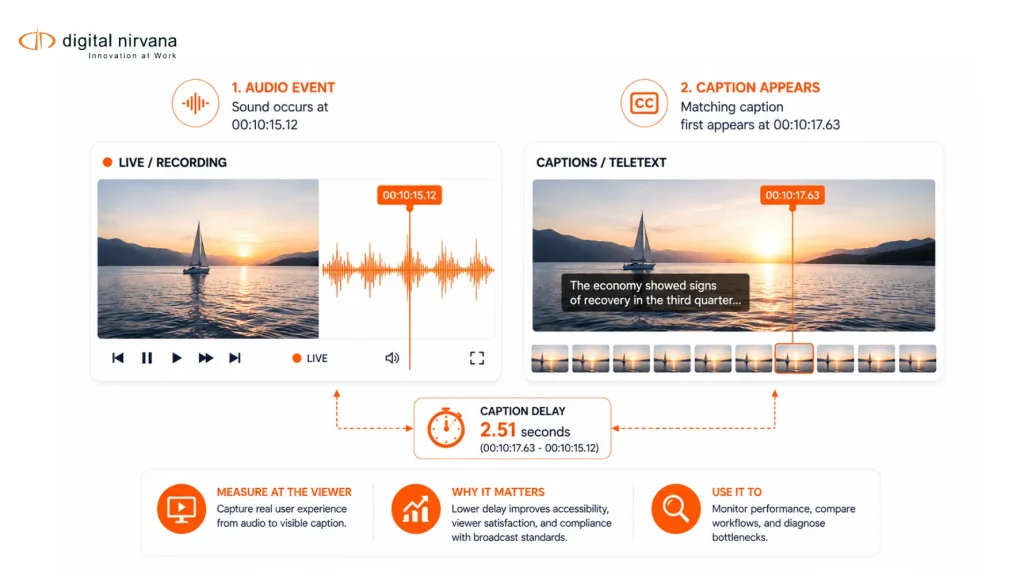
Latency refers to the delay between spoken audio and displayed captions. In live broadcasting, even a few seconds of delay can negatively affect the viewer’s experience.
Suppose you are watching a cricket match and you miss the wicket just because the live captions got delayed by a few seconds. Now, such delays quickly disconnect viewers from the live moment.
What Causes Captioning Delays?
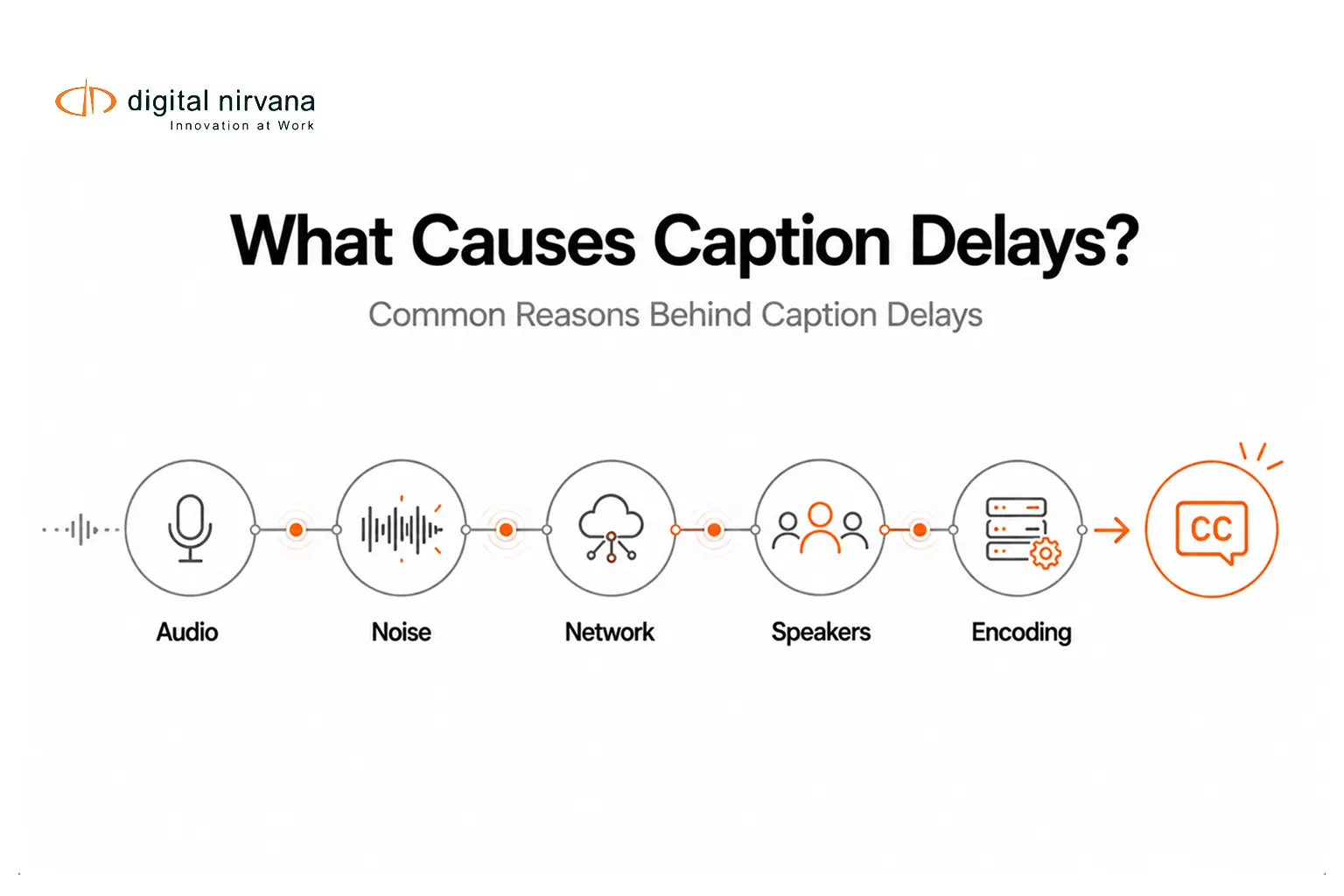
Several factors contribute to latency:
- Poor audio quality
- Network delays
- Background noise
- Multiple speakers talking simultaneously
- Encoding and transmission delays
- Inaccurate speech recognition models
- Manual correction workflows
Modern AI-driven systems are improving latency performance significantly by combining automated speech recognition with adaptive learning and cloud-based processing.
Industry workflows now commonly target caption delays of around 1–3 seconds for live streaming environments.
What are the Challenges Behind Live Broadcast Captioning?
Real-time captioning services face operational challenges during live events.
- Multiple Speakers
Panel discussions, debates, and sports commentary often involve overlapping conversations that are difficult to process accurately.
- Background Noise
Crowd reactions, music, stadium noise, and environmental interference can reduce transcription accuracy.
- Fast-Paced Speech
News anchors, commentators, and presenters often speak rapidly, making synchronization more difficult.
- Technical Failures
Internet interruptions, encoder failures, or workflow disruptions can impact live caption delivery.
- Regional Accents And Multilingual Speech
Speech recognition engines must handle different dialects, accents, and languages consistently.
- Compliance Pressure
Broadcasters must maintain caption quality standards throughout long-duration live events without interruptions.
This is why enterprise-grade captioning platforms increasingly combine AI automation with monitoring and quality assurance workflows.
Digital Nirvana’s MediaServicesIQ ecosystem supports caption quality conformance, compliance monitoring, metadata creation, and automated transcription workflows within broadcast environments.
Compliance Requirements Broadcasters Must Follow
One of the most important aspects you can never ignore in broadcasting is compliance. Different regions have different kinds of accessibility and broadcast regulations, such as
- Accuracy: Captions should correctly represent spoken dialogue and important sounds.
- Synchronization: Captions must align closely with the overall timing of the speech.
- Completeness: Important spoken information should not be omitted.
- Placement and Readability: Captions should never block the view of the main content on the screen.
You must also maintain proper logging, monitoring, and archival workflows to ensure compliance when required. AI-powered compliance monitoring systems automate the entire quality-tracking and reporting processes across all your broadcast operations.
What Makes Live Captions Compliant?
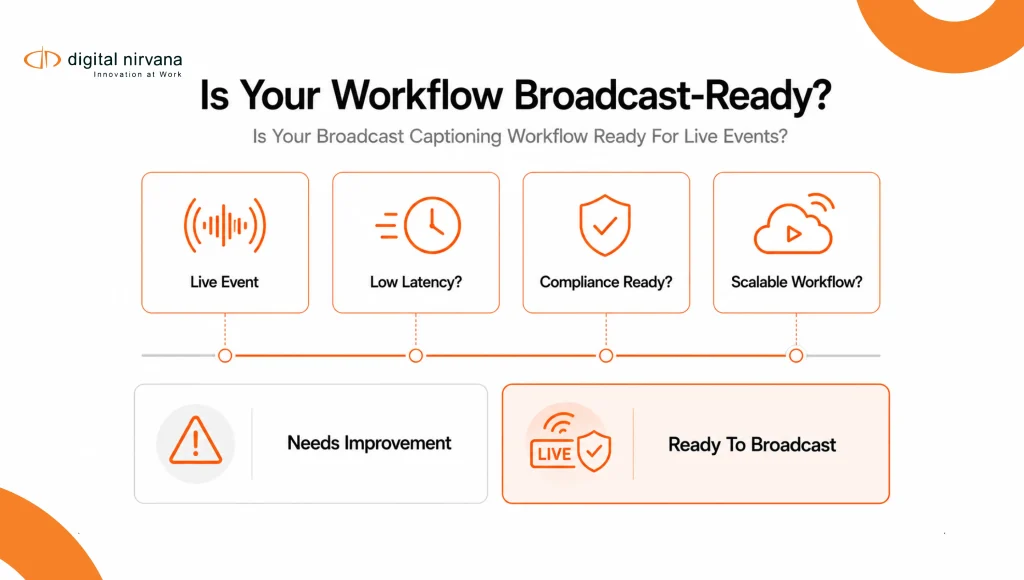
Before launching any live broadcast, broadcasters should verify the following:
- Audio Quality Validation
Clear audio input dramatically improves caption accuracy.
- Low-Latency Infrastructure
Ensure caption workflows are optimized for real-time processing and synchronized delivery.
- Caption Quality Monitoring
Use automated monitoring systems to detect caption gaps, synchronization failures, or formatting issues.
- Redundancy Planning
Always maintain backup captioning workflows for uninterrupted broadcasts.
- Multilingual Support
For international broadcasts, confirm language coverage and translation capabilities beforehand.
- Metadata Integration
Integrated metadata improves content indexing, archive retrieval, and workflow automation.
- Compliance Logging
Maintain records of caption quality, transmission logs, and monitoring reports.
- Human Review Workflows
Hybrid workflows combining AI and human oversight often improve overall caption reliability for high-profile events.
- Platform Compatibility
Verify caption compatibility across television, OTT platforms, mobile apps, and social streaming channels.
- Accessibility Testing
Test captions from the viewer’s perspective before going live.
How AI is Improving Real-Time Captioning Services?
Modern platforms no longer treat captioning as a standalone process. Instead, caption generation is becoming part of a larger intelligent media workflow.
AI-powered systems can now support:
- Automated speech recognition
- Speaker detection
- Metadata extraction
- Caption conformance checks
- Ad detection
- Content classification
- Face and logo recognition
- Multilingual translation
Digital Nirvana’s MediaServicesIQ platform integrates several of these capabilities into a centralized workflow environment designed for broadcasters, newsrooms, and live media operators.
This integrated approach reduces operational complexity while improving scalability and compliance management.
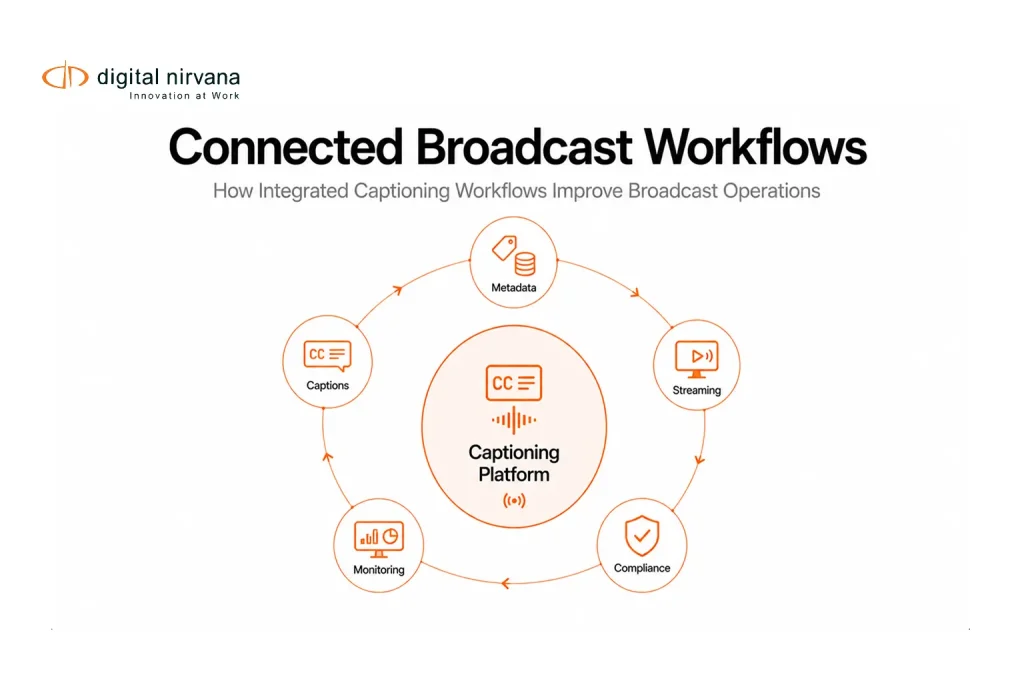
Why Broadcasters Need Digital Nirvana’s Integrated Captioning Workflows?
Many broadcasters still use disconnected tools for captioning, monitoring, metadata management, and compliance tracking. That creates workflow inefficiencies. Platforms like Digital Nirvana combine captioning, metadata intelligence, and compliance workflows into a unified media operations ecosystem.
- Integrated workflows automate the entire captioning and monitoring tasks in the most strategic manner. This helps your production teams focus more on broadcast quality instead of worrying about these aspects.
- It simplifies and speeds up the entire metadata captioning process. This improves overall turnaround time for different live streams and multi-platform distribution.
- A unified workflow with centralized monitoring helps track captions, compliance alerts, stream quality, metadata generation, and more from one place, making workflows simpler and more optimized.
- Integrated systems ensure that your captions are logged into quality iReports, transmission records, and other compliance data throughout the broadcast for further analysis.
- Captioning improves how your content is indexed, searched, and archived across various media platforms.
- It helps cover multiple live events simultaneously without hindering the captioning workflow and overcomplicating it. It can manage high-volume broadcasts consistently across regions and platforms.
This becomes especially important for 24/7 broadcasters, OTT providers, sports networks, and multilingual media companies managing large volumes of live content.
FAQs
They can convert spoken audio into real-time on-screen text, improving accessibility and convenience for viewers.
Accuracy primarily depends on audio quality, speaker clarity, and background noise. AI and quality monitoring prevent any accuracy mishaps in live captioning.
Caption delays of 1 to 3 seconds are still acceptable, provided the overall synchronization and readability are maintained.
Compliance is important for meeting accessibility regulations and avoiding potential legal or reputational risks.
AI majorly improves overall speed and scalability. But many broadcasters still use human captioners alongside AI captions for some critical live events.
Yes. Many modern platforms support multilingual captioning and real-time translation workflows.
They bring AI-powered transcription, caption generation, conformance checking, compliance monitoring, and other aspects that make all your live media operations seamless.
Conclusion
Captioning errors are not acceptable in live broadcasting. Even the smallest captioning errors can give rise to major accessibility issues or compliance violations. This slows down your operational scalability and seamless workflow integration.
Platforms like MediaServicesIQ by Digital Nirvana truly help broadcasters improve live captions by AI-driven automation, compliance intelligence, real-time monitoring, and effective metadata management. This brings better-positioned, compliant, and more audience-friendly live experiences across every platform.
Key Takeaways
- Live captioning is no longer just an accessibility feature for broadcasters. It directly affects the viewer experience, audience retention, and the professional delivery of a live event across television and streaming platforms.
- Accuracy matters the most during live broadcasts because even small captioning mistakes can confuse viewers or misrepresent important information. Sports commentary, breaking news, and public events especially require captions that are clear, readable, and properly synchronized.
- Low latency plays a huge role in keeping audiences engaged during real-time events. When captions appear too late, viewers feel disconnected from the live experience and may lose trust in the broadcast quality.
- Broadcast compliance is becoming stricter as accessibility expectations worldwide continue to grow. Reliable live captioning services help broadcasters maintain proper standards while reducing the risk of complaints, penalties, or reputation damage.
- Integrated captioning workflows save broadcasters time by combining transcription, monitoring, metadata, and compliance processes into a single system. This creates smoother operations for teams handling large volumes of live content every day.