A media ops director sits through four vendor demos in a single week. Every tool tags the same polished sample reel with near-perfect accuracy. Faces get identified, logos get flagged, scenes get described cleanly. Three months after signing with the vendor that looked best on paper, the same tool is missing half the on-screen text in low-light footage and mislabeling recurring segments that any human logger would catch immediately. The demo wasn’t wrong. It just wasn’t testing on the content that actually matters.
This is the single most common mistake media organizations make when evaluating metadata tagging tools. They compare marketing claims and curated demos instead of running an actual accuracy bake off on their own footage. A proper bake off takes more time upfront, but it’s the difference between a tool that works in a sales deck and one that works on a Tuesday afternoon during breaking news.
Why Vendor Demos Don’t Predict Real-World Accuracy
Every metadata tagging vendor demos on content chosen to make their AI look strong. Clean audio, good lighting, standard camera angles, familiar faces. That’s not dishonest, it’s just not representative of what most archives actually contain. Real footage includes overlapping speakers, poor lighting, regional accents, on-screen graphics that shift mid-shot, and years of archival material shot on older equipment with different compression artifacts.
Accuracy numbers quoted in vendor marketing are almost always benchmarked against curated datasets, not against the specific content types a given newsroom, sports network, or archive actually processes. A tool that scores 95 percent on a vendor’s benchmark can perform very differently once it hits your live feed or your decade-old archive.
The Market Pressure Behind This Decision
Archive and production teams are under real pressure to automate tagging as content volume grows faster than manual logging capacity ever could. That urgency sometimes pushes teams to commit to a tool based on a strong demo rather than a validated test, especially when a compliance deadline or an archive monetization initiative is driving the timeline.
At the same time, the cost of getting this wrong isn’t small. A tool with poor accuracy on your actual content creates more manual cleanup work than manual tagging would have in the first place, and it erodes trust in automated metadata across the whole organization, which makes future automation efforts harder to sell internally.
Where Informal Evaluations Fall Short
Most organizations do some form of evaluation before buying, but it usually isn’t rigorous enough to catch real problems. Common gaps include:
- Testing only on vendor-provided sample content instead of the organization’s own footage
- Evaluating a single content type when the archive actually spans news, sports, and archival formats with very different characteristics
- No agreed accuracy threshold before testing starts, so results get judged subjectively after the fact
- Comparing tools on different footage sets, making the results impossible to compare fairly
- Skipping edge cases entirely (low light, overlapping speech, older archival formats) because they’re less convenient to test
None of these gaps are intentional shortcuts. They happen because a proper bake off takes coordination across archive, engineering, and vendor teams, and that coordination is easy to skip under deadline pressure.
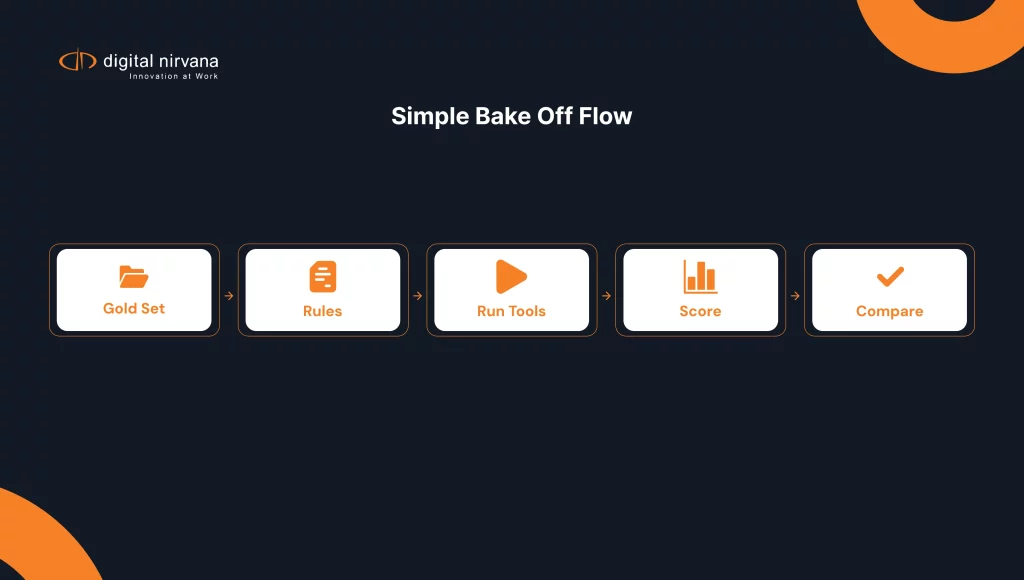
How to Run an Actual Metadata Tagging Bake Off
A useful bake off follows a structured process rather than an open-ended trial period.
Build a representative test set. Pull footage from your actual archive across the content types and conditions the tool will need to handle: live broadcast, archival material, different lighting and audio conditions, and any edge cases that have historically caused problems.
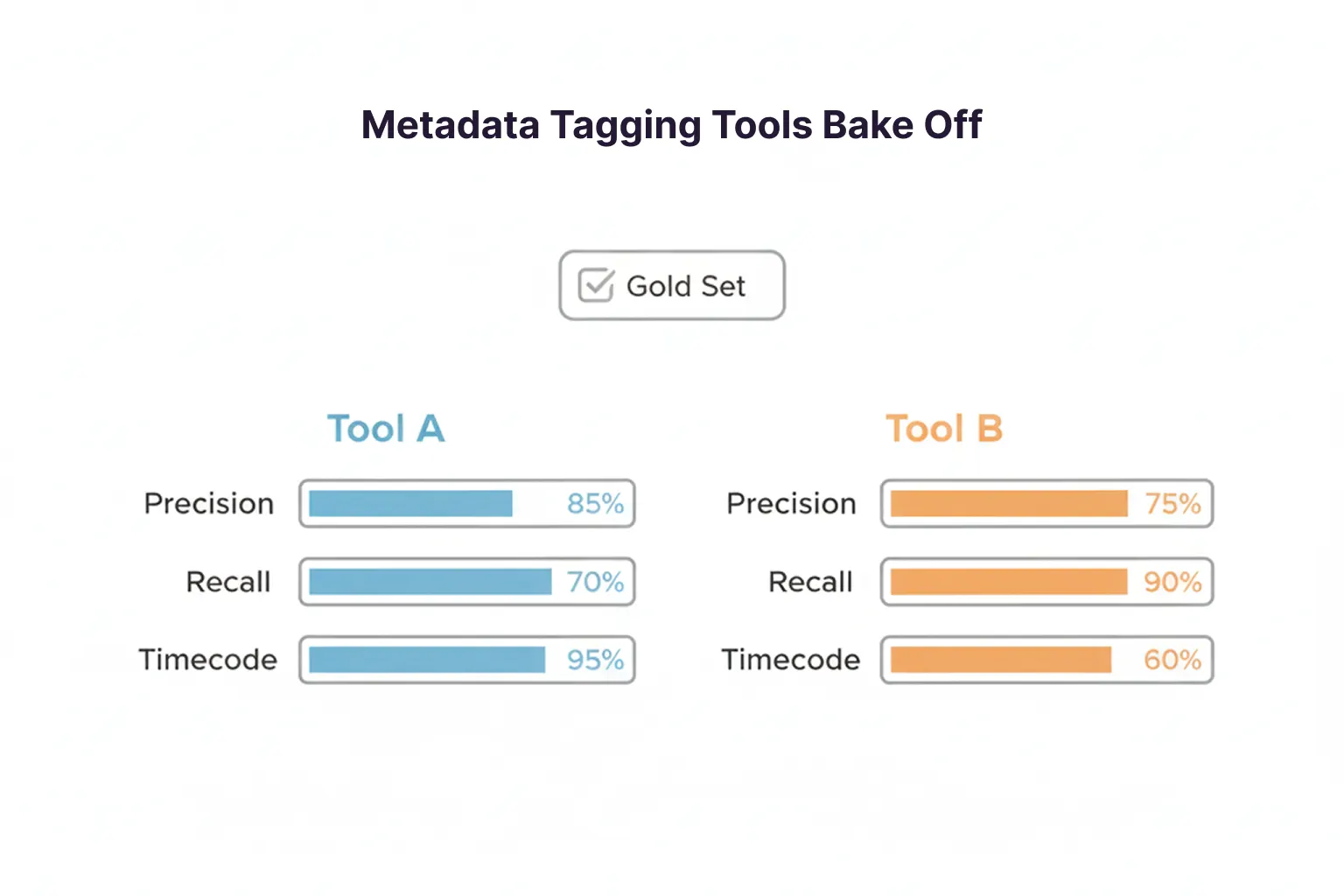
Set accuracy thresholds before testing, not after. Decide what “good enough” means for each tag category (entity recognition, scene description, OCR, logo detection) before you see any results, so the evaluation stays objective.
Test every vendor on the exact same footage. This sounds obvious, but it’s the step most commonly skipped. Comparing tool A on one clip set and tool B on another makes the results meaningless.
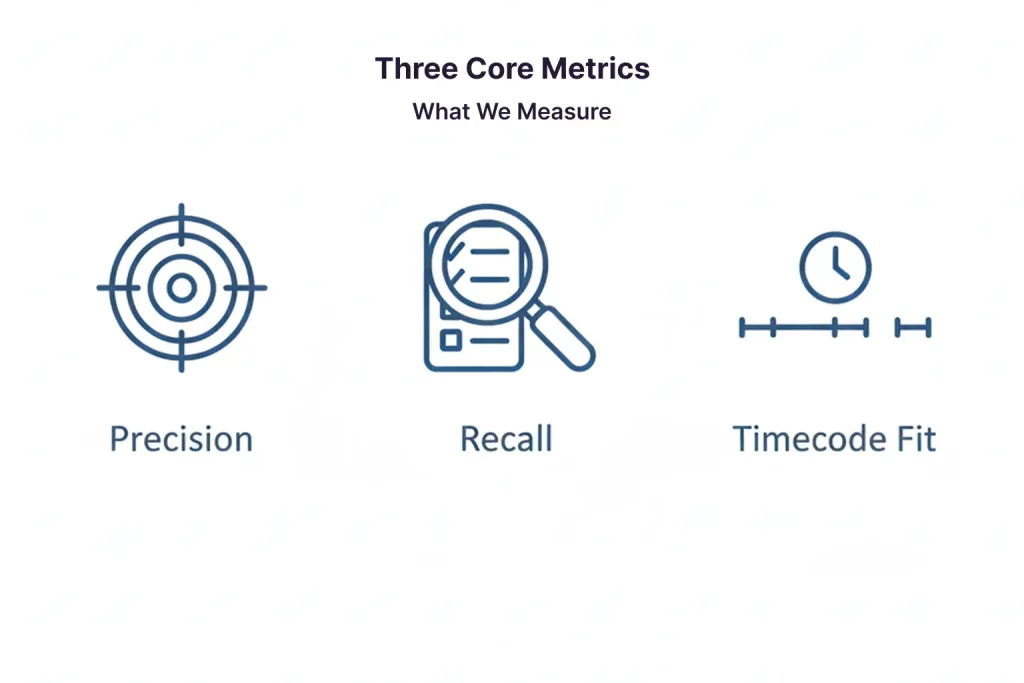
Score both false positives and false negatives. A tool that tags aggressively but incorrectly can create as much cleanup work as one that misses tags entirely. Both failure modes matter.
Include a human review pass. Have someone familiar with the content manually verify a sample of the automated tags, rather than trusting the vendor’s own accuracy report.
A Real-World Bake Off Workflow
Consider a sports network evaluating tagging tools for player, logo, and scene metadata across live and archival footage. A proper bake off looks like this:
- Pull a test set spanning three seasons: recent HD broadcasts, mid-quality archival footage, and one low-light night game
- Define accuracy thresholds separately for player identification, sponsor logo detection, and scene description
- Run each candidate tool against the identical test set
- Score results against a human-reviewed baseline, tracking both missed tags and incorrect tags
- Weight results toward the content types that make up the majority of the archive, not just the cleanest footage
This kind of structured comparison is exactly how teams evaluating MetadataIQ for media indexing and search typically validate performance before rolling a tool out across their full archive, since the platform is designed to handle live and archival processing across varied broadcast conditions rather than curated sample content.
Measurable Impact of Getting This Right
Organizations that run a proper bake off before committing to a tagging tool typically avoid the hidden cost of post-deployment cleanup, since accuracy gaps get caught before the tool is processing live production volume. Teams also gain a clearer picture of where human review is genuinely still needed, which helps set realistic expectations for editorial and archive staff rather than assuming full automation from day one.
The organizations that skip this step tend to discover accuracy gaps only after the tool is already embedded in a production workflow, which is a far more expensive time to find out a tool underperforms on their specific content.
Implementation Considerations
A few practical points make a bake off actually useful:
- Involve the people who will use the tags daily (archive staff, loggers, editors) in scoring accuracy, not just engineering
- Test integration with existing MAM/DAM systems and NLE tools, since accuracy on paper doesn’t matter if the tags don’t flow into the actual production workflow
- Budget enough time for a real bake off, typically several weeks rather than a single demo session
- Decide upfront how AI-generated tags and human review will work together long term, not just during the evaluation
Key Capabilities to Prioritize
| Capability | Why It Matters | Common Gap |
|---|---|---|
| Testing on your own content | Vendor demos don’t reflect your archive’s real conditions | Relying on curated sample reels |
| Consistent test set across vendors | Makes accuracy comparisons meaningful | Different footage used per vendor |
| False positive and false negative scoring | Both error types create cleanup work | Measuring only overall “accuracy” as one number |
| Coverage of edge cases | Real archives include imperfect footage | Testing only clean, well-lit content |
| Human-reviewed baseline | Vendor-reported accuracy can be optimistic | Trusting vendor benchmarks without verification |
Common Objections, Answered
“We don’t have time to run a full bake off.” A structured test takes longer than a demo, but far less time than cleaning up mistagged metadata after a tool is already in production.
“The vendor’s accuracy numbers are already published.” Published benchmarks reflect the vendor’s test data, not your archive’s actual footage conditions, which is exactly why an internal test matters.
“AI accuracy will only improve over time, so early gaps don’t matter.” Improvement happens, but a tool that struggles significantly on your content today will still create real cleanup burden while you wait for that improvement.
Success Metrics to Track
During and after a bake off, track tag accuracy by content type (not just an overall average), the ratio of false positives to false negatives, time spent on manual correction post-deployment, and how accuracy holds up on the toughest edge cases in your test set rather than only the average case. These numbers give a far more honest picture than a single accuracy percentage.
Where This Fits Into a Broader Metadata Strategy
An accuracy bake off isn’t just a procurement step, it’s the foundation for trusting automated metadata across an entire archive. Tools evaluated properly against real content integrate more smoothly into the AI/ML layer that generates scene descriptions, OCR, and object recognition through MediaServicesIQ, and they feed cleaner metadata into the broader indexing and governance structure that MetadataIQ is built to manage. For organizations pairing automated tagging with managed human review to close accuracy gaps on legacy or difficult archival content, Media Enrichment services provide that layer without requiring a full internal build-out.
Why This Matters for Digital Nirvana Customers Specifically
Accuracy claims only matter when they hold up against a customer’s actual content, not a curated demo reel. Digital Nirvana’s approach pairs AI-driven tagging with human-in-the-loop review specifically so accuracy gaps get caught and corrected rather than silently accumulating across a growing archive. This matters most for organizations with large archives spanning multiple decades of footage quality, and for live production teams who need tagging accuracy to hold up under real broadcast conditions rather than lab conditions. Detailed examples of how this plays out across broadcast, sports, and archive customers are available in Digital Nirvana’s success stories.
Conclusion
A metadata tagging tool is only as good as its accuracy on the content you actually have, not the content a vendor chose to demo. Running a structured, apples-to-apples bake off before committing takes more effort upfront, but it’s far cheaper than discovering accuracy gaps after a tool is already processing your live production volume. The organizations that get this right treat evaluation as seriously as they treat the buying decision itself.
Key Takeaways
- Vendor demos are built to look strong and rarely reflect how a tool performs on your actual archive
- Test every candidate tool on the identical footage set, including edge cases like low light and archival material
- Score both false positives and false negatives, not just a single overall accuracy number
- Involve the staff who will actually use the tags in scoring accuracy, not engineering alone
- Track accuracy by content type after deployment, not just during the initial bake off
FAQ
What is a metadata tagging bake off? It’s a structured, side-by-side evaluation of multiple tagging tools against the same footage set, used to measure real-world accuracy before committing to a vendor.
Why don’t vendor-published accuracy numbers predict real performance? Published benchmarks are based on the vendor’s own test data, which is typically cleaner and more curated than an organization’s actual archive, especially archival or low-quality footage.
How long should an accuracy bake off take? Most thorough evaluations take several weeks, enough time to test across content types, edge cases, and a human-reviewed baseline rather than a single demo session.
Should teams measure false positives as well as false negatives? Yes. A tool that over-tags incorrectly can create as much manual cleanup work as one that misses tags entirely, so both error types need to be scored separately.