A breaking news producer has four minutes before air. Somewhere in six hours of raw feed sits the one clip that proves the story: a specific quote, a specific face, a specific moment. A junior researcher scrubs the timeline by hand while the clock keeps moving. This scene repeats itself daily across newsrooms, sports control rooms, and post-production suites. It is not a staffing problem. It is a metadata problem.
Broadcast teams generate more video than any human team can manually log, tag, or catalog. Without a structured way to capture what is actually inside that footage, even the richest archive becomes a black box. Metadata management solves that, and it has quietly become one of the most important operational investments a media organization can make.

Why Metadata Management Has Become Non-Negotiable
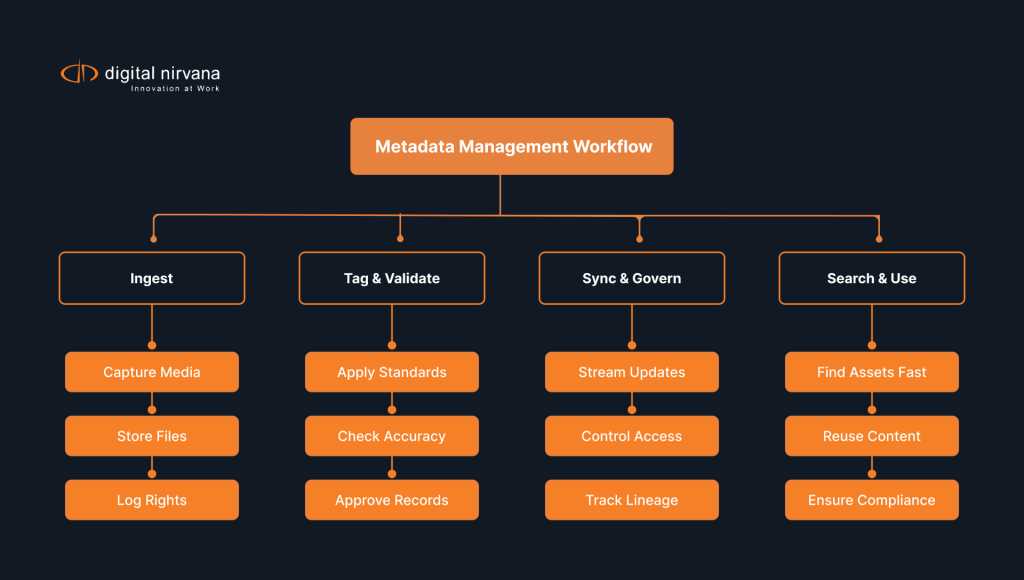
Metadata is the descriptive layer that makes video searchable: who appears on screen, what was said, where and when it was recorded, what scenes, logos, or objects show up, and how the asset connects to other content in the library. Without it, footage is just a file with a timestamp.
The volume problem is real. A single 24-hour news channel can produce hundreds of hours of footage a week across live feeds, B-roll, and archive material. Sports leagues generate multiple camera angles per game. OTT platforms ingest new catalog titles constantly. Manually reviewing and tagging all of it is not scalable, and teams that try end up with inconsistent, incomplete, or outdated metadata that nobody trusts.
The cost shows up in predictable ways: hours lost hunting for a clip that should take seconds to find, missed licensing revenue because archive footage is technically unsearchable, and compliance exposure when a team cannot prove what aired and when. These are the exact pain points that push broadcast engineering leads, media operations managers, and archive directors toward purpose-built metadata tools like MetadataIQ.
The Regulatory and Competitive Pressure Behind the Shift
Broadcast compliance obligations, closed captioning rules from the FCC, and accessibility standards from bodies like Ofcom all depend on accurate, time-coded records of what was broadcast. When metadata is incomplete, proving compliance during an audit becomes a scramble instead of a quick export.
At the same time, competitive pressure is rising from every direction. Streaming platforms compete on catalog discoverability. Sports rights holders compete on how fast they can turn a big play into a shareable clip. News organizations compete on speed to publish. In every one of these races, the team with faster, more reliable metadata wins the moment.
Where Traditional Metadata Approaches Fall Short
Most legacy workflows rely on one of three approaches, and each has a ceiling.
Manual logging works at small scale but collapses under live news, sports, or high-volume archive ingestion. It is slow, inconsistent between loggers, and nearly impossible to standardize across a large team.
Basic MAM/DAM tagging without AI assistance usually captures only surface-level fields: title, date, and a handful of manually entered keywords. It does nothing for searching inside the content itself, such as finding a specific quote or a specific person’s appearance.
Spreadsheet or database workarounds built by internal teams tend to break down as libraries grow. They rarely integrate cleanly with editing systems like Avid or Grass Valley, which means editors and producers end up working around the tool instead of with it.
None of these approaches scale to the volume, speed, and compliance demands of modern broadcast and streaming operations.
How AI-Powered Metadata Management Actually Works
Modern metadata management platforms use AI to automatically generate rich, searchable metadata as content is ingested, whether live or archival. That typically includes automatic speech recognition for transcripts, facial and logo recognition, scene detection, object identification, and quality scoring, all indexed and searchable within seconds of ingestion.
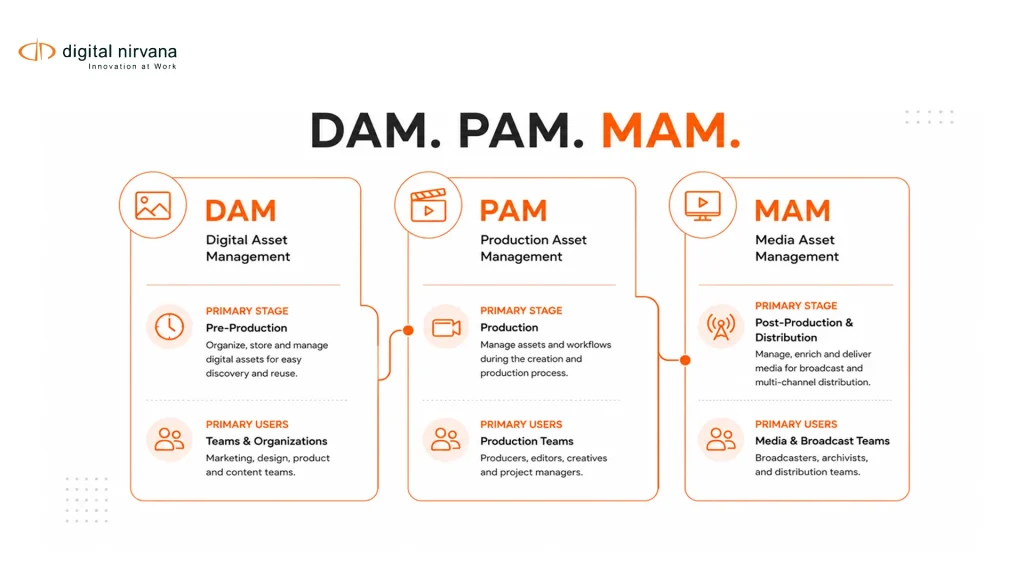
Instead of a researcher scrubbing a timeline, a team can search by spoken keyword, face, location, or scene type and get a time-coded result instantly. Platforms like MetadataIQ are built specifically to plug into existing MAM, DAM, and PAM systems, so teams are not ripping out their editorial workflow to get there. The underlying AI/ML detection capabilities, including OCR, object recognition, and scene explanation, are also available as standalone microservices through platforms like MediaServicesIQ for teams that want to build metadata intelligence into their own systems via API.
A Real-World Workflow: From Raw Feed to Findable Clip
Picture a sports desk covering a live tournament. As each camera feed comes in, AI-powered metadata tagging runs in the background, identifying players, logos, key plays, and even crowd reaction moments, all time-stamped automatically. When the highlights producer needs a specific player’s game-winning shot for a sponsor package, they search by player name and play type instead of scrubbing four hours of footage.
The same logic applies in a newsroom. A breaking story references a public statement made two years earlier. Instead of asking the archive team to manually pull tape, the assignment editor searches the transcript index directly and finds the exact quote with the surrounding context, ready to clip and air within minutes.
This is the practical difference between an archive that is stored and an archive that is actually monetizable and usable.
Measurable Impact of Metadata Automation
| Workflow Area | Manual Approach | AI-Powered Metadata Management |
| Clip search time | Hours per request | Seconds to minutes |
| Metadata consistency | Varies by logger | Standardized across all content |
| Archive discoverability | Low, keyword-only if tagged at all | High, searchable by speech, face, scene, object |
| Compliance readiness | Manual reporting, audit stress | Time-coded records ready for export |
| Licensing potential | Limited by search friction | Higher, since footage is easier to find and clear |
These gains compound over time. A better-tagged archive today makes every future search, every licensing inquiry, and every compliance audit faster.
Implementation Considerations for Broadcast Teams
Before rolling out a metadata management platform, most teams need to think through a few operational questions. Does the tool integrate with your existing editorial systems, such as Avid or Grass Valley, without disrupting current workflows? Can it handle both live ingestion and batch processing of legacy archive material? Does it support the specific detection types your content actually needs, such as sports logo recognition or multilingual transcript search?
Team readiness matters too. Media operations staff will need a short onboarding period to shift from manual tagging habits to trusting AI-generated metadata, and quality scoring dashboards help build that trust quickly by flagging low-confidence tags for human review.
Key Capabilities to Prioritize
- Live and archive processing so the tool works for both breaking news and legacy libraries
- Deep integration with MAM/DAM/PAM systems rather than a standalone silo
- Multi-modal detection, including speech-to-text, facial recognition, logo detection, OCR, and scene description
- Quality scoring and dashboards to monitor metadata accuracy over time
- API access for teams that want to embed metadata intelligence into custom tools
- Scalable ingestion that keeps pace with live, high-volume feeds without lag
Addressing the Common Objections
“We already have a MAM system.” Most MAM systems store content well but were never built to generate deep, searchable metadata on their own. AI-powered metadata tools are designed to plug into that existing system, not replace it.
“Manual tagging works fine for us.” It often does, until volume grows, a compliance audit hits, or a licensing opportunity requires proof of what is actually in the footage. The hidden cost of manual tagging is the opportunity it quietly closes off.
“AI accuracy is a risk.” The strongest implementations pair automated tagging with human review workflows and confidence scoring, so teams get speed without giving up oversight. This is the same human-in-the-loop principle behind Managed AI operations more broadly.
Success Metrics Worth Tracking
Teams evaluating a metadata management rollout should track search time per clip request, percentage of archive content with complete metadata, compliance audit preparation time, and licensing or repurposing revenue tied to previously hard-to-find archive footage. These are concrete, measurable indicators that the investment is paying off, not just anecdotal convenience.
How Digital Nirvana Supports Broadcast Metadata Operations
Digital Nirvana built MetadataIQ specifically for the volume and speed demands of broadcast, sports, news, and archive operations. It automates metadata tagging across live and archival content, integrates with existing MAM/DAM/PAM systems, and gives media operations teams quality dashboards to keep confidence high as automation scales.
For teams that also need compliance logging and proof-of-performance alongside metadata, MonitorIQ covers broadcast monitoring, QoE, and ad verification in the same ecosystem. Organizations with large legacy archives that need transcription and captioning layered on top of metadata often pair this with TranceIQ or the managed, human-assisted workflows available through Media Enrichment. Read more about how these workflows have played out for real customers on the success stories page.
Why This Matters Beyond a Single Workflow
Metadata management is not a niche technical upgrade. It touches nearly every operational goal a broadcast or media organization has: faster production under deadline pressure, defensible compliance records, a monetizable archive instead of a dormant one, and a foundation that supports everything from AI-assisted editing to future licensing deals. Organizations that treat metadata as a strategic asset rather than a back-office chore consistently move faster than competitors still relying on manual logs and tribal knowledge. Digital Nirvana’s approach, combining AI automation with human oversight across products like MetadataIQ and services like Media Enrichment, reflects exactly that philosophy: speed and searchability without sacrificing accuracy or accountability.
Conclusion
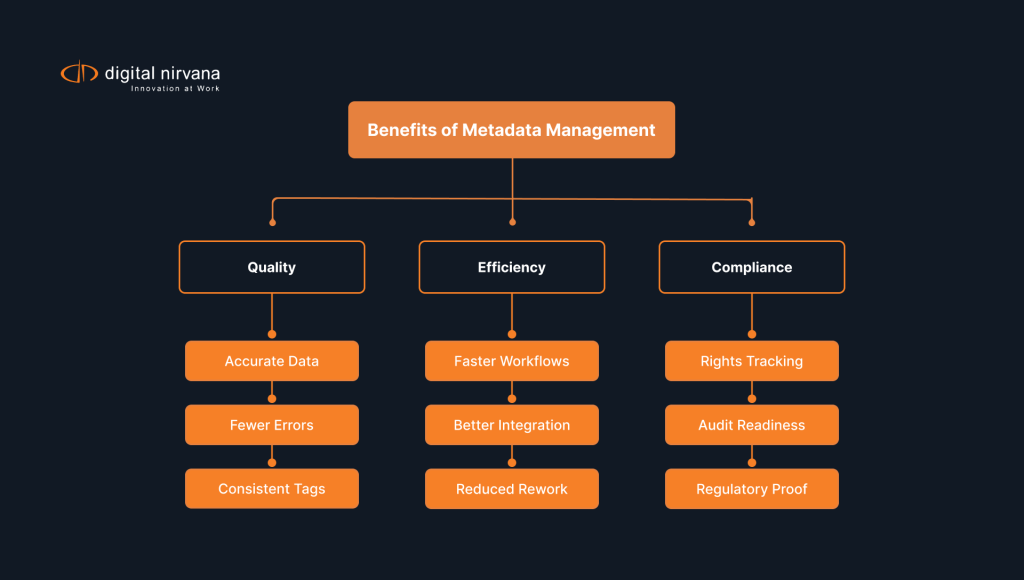
Metadata is the difference between an archive that sits idle and one that actively works for a broadcast organization every day, powering faster production, cleaner compliance, and new revenue from content that already exists. Manual tagging cannot keep pace with today’s content volume, and generic MAM storage alone does not solve the search problem. AI-powered metadata management closes that gap, turning raw footage into a searchable, governable, monetizable asset.
Key Takeaways
- Manual video logging cannot scale with modern broadcast, sports, and streaming content volume
- AI-powered metadata management enables searchable, time-coded indexing across live and archival footage
- Deep MAM/DAM/PAM integration matters more than a standalone metadata tool
- Quality scoring and human review keep AI-generated metadata trustworthy
- Well-tagged archives unlock compliance readiness and new licensing revenue
- Track search time, metadata completeness, and audit prep time to measure ROI
Frequently Asked Questions
What is metadata management in broadcasting? It is the process of capturing, tagging, and organizing descriptive information about video and audio content, such as speech, faces, scenes, and objects, so it can be searched, governed, and reused efficiently.
How is AI-powered metadata different from manual tagging? AI-powered metadata is generated automatically at ingestion using speech recognition, facial and logo detection, and scene analysis, delivering consistent, searchable results in seconds instead of hours of manual review.
Does metadata management replace our existing MAM system? No. Tools like MetadataIQ are designed to integrate with existing MAM, DAM, and PAM systems, adding a deep search and tagging layer rather than replacing the storage system already in place.