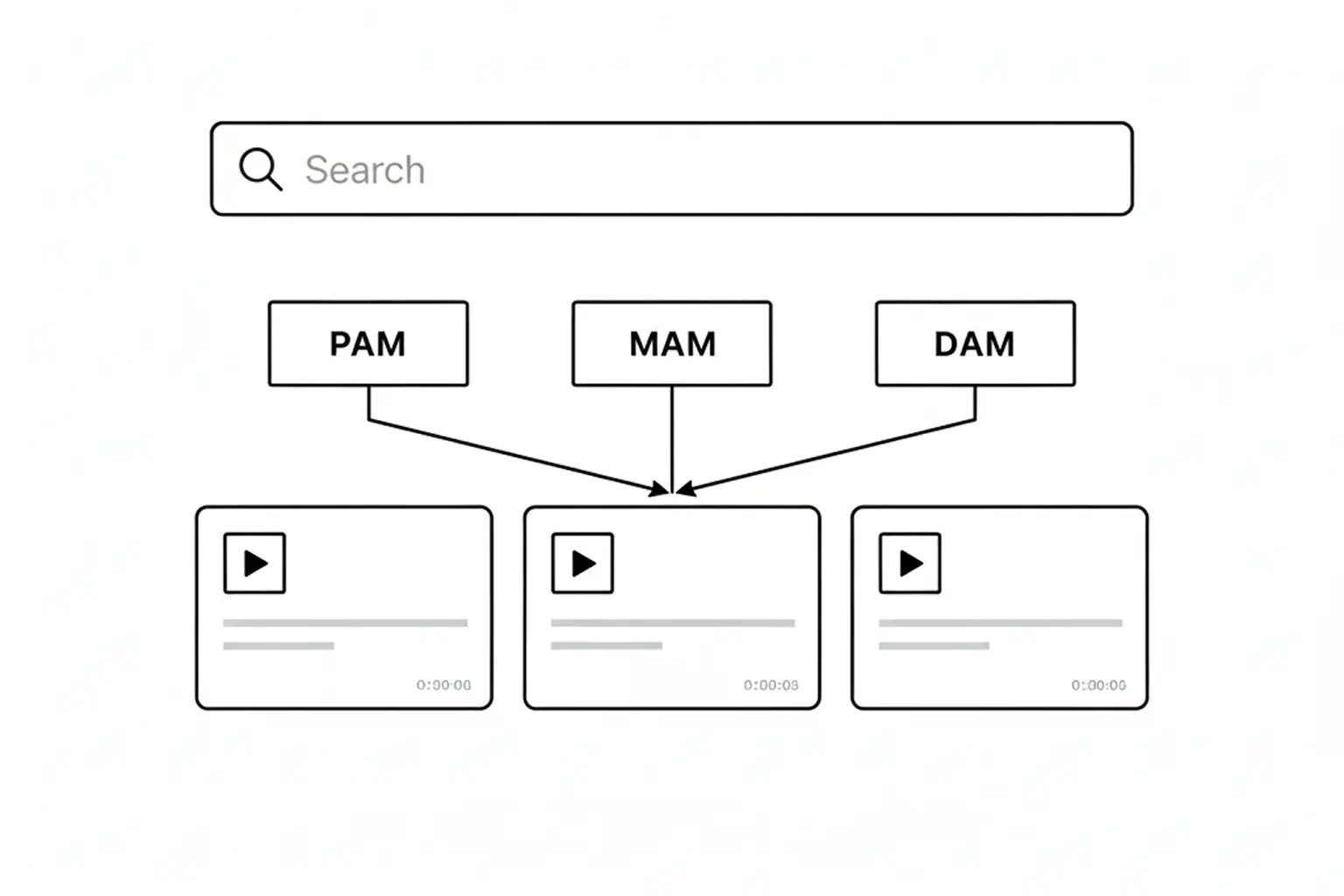
Your team needs one clip. Search should take seconds. Instead, you get multiple versions with slightly different titles, missing previews, and conflicting dates. Someone downloads three files, opens two broken proxies, then messages a coworker, “Which one is the real one?”
That daily friction is not just annoying. It is operational drag that compounds. The root cause is usually the same: DAM, MAM, and PAM are connected, but not truly synchronized.
In this article, Search Drift refers to the slow, compounding gap between what people expect search to return and what your systems actually return, as metadata and asset references diverge across DAM, MAM, and PAM over time.
Why DAM, MAM, And PAM Sync Breaks In Broadcast Environments
Broadcast stacks grow under real pressure: breaking news, sports deadlines, promo demands, archive requests, compliance, and digital distribution. Over time, teams add tools that solve local problems. The unintended result is a multi-system environment where the same content is represented in multiple places, each with its own identifiers and metadata habits.
Here are the most common reasons sync breaks.
Multiple Systems Create Multiple Sources Of Truth
A MAM is typically designed for media-heavy workflows and deeper production integrations, while DAM is broader, serving cross-team distribution and reuse.
A PAM is often closer to active production and creative collaboration. In many shops, it becomes the place where work starts and evolves before it is finalized.
When each system can edit titles, descriptions, rights, or identifiers, drift is guaranteed unless you define ownership rules.
The Same Asset Gets Multiple IDs
Broadcasters often have multiple representations of the same content:
- A work-in-progress sequence inside PAM
- A packaged program segment inside MAM
- A distribution-ready derivative inside DAM
If these objects lack a canonical identifier and a clear parent-child relationship model, each system effectively creates its own reality.
Proxy Lifecycles Are Not Governed Like Master Assets
Proxy workflows are essential for speed, but proxies often get treated like temporary byproducts. MAM-oriented environments often rely on proxies to improve review and editing efficiency.
When proxies are regenerated, moved, renamed, or expired without updating every dependent reference, the preview breaks and trust collapses.
DAM Vs MAM Vs PAM, In One Minute
A simple way to align stakeholders is to define what each system is for, in broadcaster terms.
- DAM manages digital assets across teams and departments, typically optimized for sharing, reuse, governance, and distribution.
- MAM is purpose-built for rich media workflows, especially video, and often includes deeper integrations and media-specific capabilities.
- PAM supports collaboration during the production stage, when assets and versions evolve quickly before finalization.
If you want a second viewpoint on DAM vs MAM positioning, Hyland also summarizes the difference as DAM being broader and MAM being deeper for video-heavy industries like broadcasting.
Quick Comparison Table
| System | Primary Focus | What It Commonly Owns | Typical Risk If Not Governed |
| PAM | In progress production | WIP versions, project context, editor notes | Duplicate versions, unclear publish state |
| MAM | Media workflow lifecycle | house IDs, editorial metadata, orchestration | Diverging metadata, broken proxy references |
| DAM | Library and distribution | taxonomy, reuse metadata, downstream packaging | Inconsistent titles, tags, and rights info |
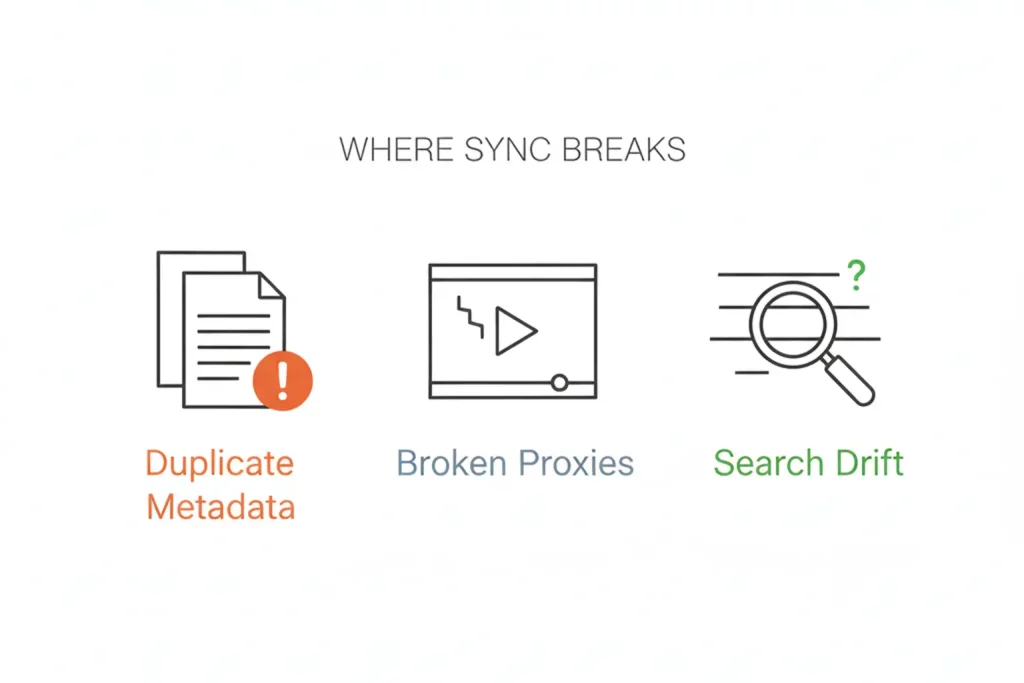
The Three Failure Modes: Duplicate Metadata, Broken Proxies, Search Drift
Duplicate Metadata
Duplicate metadata is not just repeated fields. It is repeated meaning.
Common examples:
- The same segment appears under slightly different titles across systems
- The same person or show exists in multiple spellings or formats
- Rights and usage windows differ between DAM and MAM
- Episode numbers, air dates, and season labels disagree across tools
Typical root causes:
- No canonical ID shared across DAM, MAM, and PAM
- Two-way sync without field-level ownership rules
- Uncontrolled vocabularies and taxonomy drift
- Manual edits that override automated mappings
Broken Proxies
A broken proxy happens when a system expects a playable preview or edit proxy, but the reference no longer resolves.
Typical causes:
- A proxy is regenerated, but one system still points to the old rendition
- Storage paths change, buckets change, or permissions change
- Naming conventions differ between tools or vendors
- Lifecycle policies purge proxies while metadata still advertises availability
- Timecode alignment changes, and the proxy no longer matches editorial markers
Broken proxies are not just a UX issue. They interrupt review, slow production, and force teams to work around the system.
Search Drift
Search Drift is the long-term symptom. It looks like:
- Search results that look close but are not reliable
- Editors are spending time validating which result is correct
- Producers recreating work because the retrieval is untrusted
- Compliance teams are struggling to prove usage history due to inconsistent references
Search Drift spreads quietly because people adapt to it. They ask coworkers instead of searching. They keep private folders. They relabel files locally. Every workaround makes the ecosystem less searchable and less governable.
The Sync Blueprint: Canonical IDs, Ownership, And Mapping
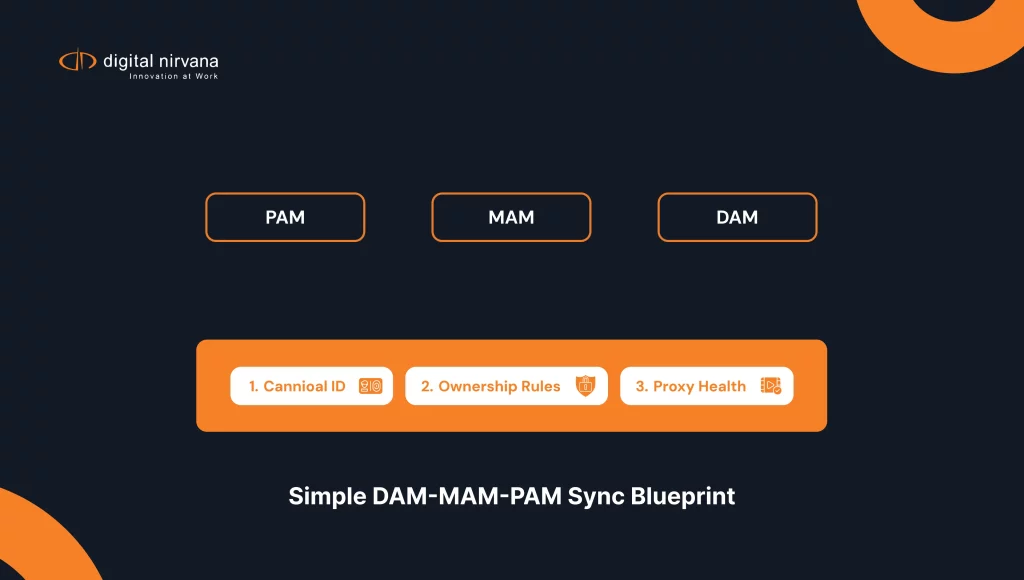
You do not fix DAM MAM sync problems by adding another connector. You fix them by defining rules that every connector must obey.
Step 1: Establish One Canonical Identifier
Pick one durable ID that follows the content through its lifecycle, even as files are transcoded, repackaged, or derived.
Practical rules:
- The canonical ID is not a filename
- Every derivative, proxy, and distribution package references the canonical ID
- Every system stores the canonical ID in a consistent field
- Relationships are explicit, such as parent, child, version of, derived from
When you do this well, duplicates become measurable and fixable instead of mysterious.
Step 2: Define Metadata Ownership By Domain
Not every field should be editable everywhere. Decide which system is the system of record for each domain.
A common broadcaster-friendly ownership map looks like this:
- PAM owns: project context, WIP status, editor notes, internal collaboration fields
- MAM owns: house IDs, segment boundaries, air dates, usage history, production lifecycle states
- DAM owns: brand taxonomy, marketing-friendly titles, distribution packaging metadata, downstream reuse labels
Then define field-level rules:
- One way push for authoritative fields
- Two-way sync only where conflicts are resolvable
- Clear precedence rules when collisions occur
Step 3: Standardize Meaning With A Shared Schema Contract
You do not need identical schemas across all tools. You do need a shared semantic contract so that “title,” “episode,” “rights,” and “version” mean the same thing across system boundaries.
Broadcasters often use frameworks such as EBUCore to describe audiovisual resources in a standardized way.
Even if you do not fully implement a standard, aligning your core fields to recognized semantics reduces ambiguity and mapping errors.
Step 4: Lock Controlled Vocabularies
If one system allows free text and shows names, and another uses a dropdown, drift is inevitable.
Minimum vocabulary to control:
- Show and series names
- People and roles
- Sports teams and leagues
- Locations
- Rights categories
- Compliance labels and content warnings
This one step alone dramatically reduces duplicate search results.
Proxy Integrity: How To Prevent Broken Proxies At Scale
Treat proxies as first-class assets, not disposable byproducts.
Define Proxy Generation Rules
Document the standards teams can rely on:
- When proxies are created, such as ingest, publish, archive, and restore
- Which renditions are mandatory for which departments
- What quality standards apply, such as codec, resolution, and audio channels
- Whether proxies must preserve timecode alignment and marker compatibility
Store Proxy Lineage And Validation Data
At minimum, store:
- Canonical asset ID
- Proxy ID and rendition type
- Creation timestamp
- Storage location and permission model
- Validation signal, such as checksum, duration match, or playable status
Monitor Proxy Health Continuously
Track operational signals that reveal issues before users complain:
- Proxy availability rate by collection
- Broken reference count per week
- Median proxy load time
- Proxy regeneration failure rate
- Proxy to master mismatch incidents
If you can measure it, you can govern it.
How To Enable Round-Trip Metadata Enrichment Without Replacing Your Stack
Most broadcasters do not want another repository. They want better metadata inside the tools they already use.
That is where round-trip enrichment matters.
A healthy enrichment loop looks like this:
- Extract media from PAM or MAM, or from managed storage
- Generate time aligned insights, such as speech to text, on screen text, and other indexing signals
- Normalize tags, apply governance rules, and map to your schema contract
- Write enriched metadata back into PAM and MAM, and optionally into DAM for downstream reuse
This is also where commercial value appears, because better enrichment improves search, speeds clip turnaround, and reduces rework.
For teams aligning DAM MAM workflows with production reality, Digital Nirvana positions MetadataIQ as a media indexing and PAM MAM integration capability designed to plug into existing workflows.
If you want a focused view of their approach to metadata strategy inside production workflows, their Production Workflow Metadata article is also relevant.
Where PAM MAM Integration Becomes A Practical Advantage
PAM MAM integration is not just about moving data. It is about reducing the number of places a person has to decide, “What is correct?”
A governed integration should ensure:
- Editors log once, in the most natural place
- House IDs and publish states stay consistent
- Enrichment attaches to the canonical ID and becomes searchable everywhere
- DAM inherits approved descriptive metadata for distribution and reuse
If you are actively planning integration work, these two internal reads help frame security and workflow alignment:
- Secure MAM integration for broadcast operations.
- PAM integration concepts for broadcast workflows.
Implementation Checklist And KPIs
Architecture Patterns That Work In Real Broadcast Environments
- Hub And Spoke
One metadata broker or integration layer pushes approved fields to DAM, MAM, and PAM. - System Of Record With Event Sync
Each domain has a system of record, and other systems subscribe to events and updates. - Enrichment Loop
Enrichment is generated externally, then written back into the operational systems under governance rules.
The right pattern depends on how many write points you currently have, and which system your teams treat as primary.
Governance Checklist
- Canonical ID is defined and stored consistently in all systems
- Ownership map documented and approved
- Field-level write permissions implemented
- Controlled vocabularies enforced
- Conflict resolution rules defined
- Audit trail and versioning enabled
- Proxy lineage stored and validated
- Scheduled reconciliation jobs run for duplicates, missing proxies, and schema violations
KPIs That Reveal If You Are Winning
- Duplicate asset rate in search results
- Metadata completeness score for required fields
- Percentage of assets with validated proxies
- Median time to find for common tasks, such as locating a highlight, a package, or a promo shot
- Reuse rate, meaning reused assets vs recreated assets
- Support tickets related to missing previews or broken playback
FAQs
Dam mam usually refers to how a DAM and a MAM split responsibilities. DAM tends to support broader library and distribution needs, while MAM is deeper for video-heavy workflow and production integrations.
Because the same real-world content is represented as different objects with different IDs and partially different metadata. Without a canonical ID and ownership rules, systems drift, and duplicates multiply.
Proxy regeneration without synchronized reference updates, storage path or permission changes, inconsistent rendition naming, and lifecycle rules that remove proxies while systems still point to them.
Start with canonical IDs, ownership mapping, controlled vocabularies, and proxy health monitoring. Then add governance-enriched metadata that writes back to your operational tools, so improvements show up where teams actually search and work.
No. It is equally a governance project. Engineering builds the pipes, but operations defines truth ownership, vocabulary control, and what happens when conflicts occur.
Conclusion
DAM, MAM, and PAM can absolutely work together, but only if they are synchronized with intention. Once you establish one canonical identifier, define ownership of metadata domains, and treat proxies as first-class assets, duplicates shrink, previews stay reliable, and search becomes trustworthy again.
Key Takeaways:
- Use one canonical ID across DAM, MAM, and PAM, and enforce it everywhere.
- Define metadata ownership by domain, so only one system is authoritative per field set.
- Treat proxies as first-class assets with lineage, validation, and monitoring.
- Standardize meaning with a shared schema contract, then map and validate consistently.
- Use governed round-trip enrichment so metadata improvements land back inside PAM and MAM, where teams actually work.