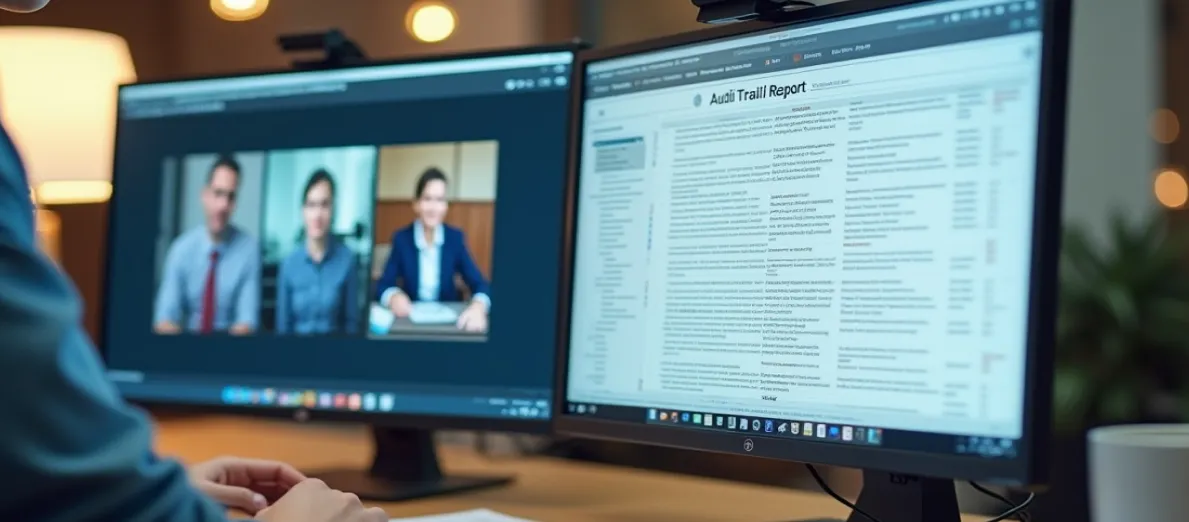
A research analyst is combing through a 45-minute earnings call recording, scrubbing back and forth trying to find one specific line about guidance. A newsroom producer is doing the same thing with a press conference, hunting for a quote that has to make the 6 p.m. broadcast. A post-production editor is doing it again with a raw interview file, looking for the one soundbite that will anchor the whole piece.
None of these people are transcribing for the sake of transcribing. They’re all trying to solve the same problem: audio and video are hard to search, hard to skim, and hard to reuse until someone turns them into text.
That’s why transcription matters, not as a nice-to-have production step, but as the foundation that makes everything else (search, compliance, accessibility, repurposing) actually possible.
What Transcription Actually Does
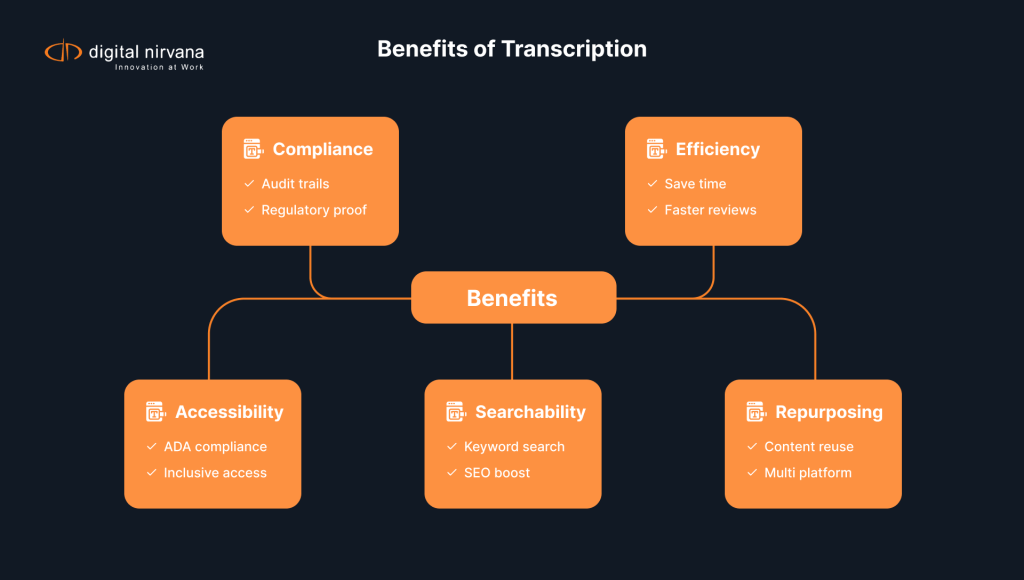
Transcription converts spoken audio into written text. That sounds simple, but the value isn’t the text itself. It’s what the text unlocks: searchability, indexing, translation, captioning, analysis, and reuse. A transcript is the raw material that every downstream workflow, from closed captioning to metadata tagging to content repurposing, depends on.
Without a transcript, a video is a black box. You can watch it start to finish, or you can guess where the part you need is and scrub around hoping to find it. With a transcript, that same video becomes searchable, skimmable, and quotable in seconds.
The Real Cost of Skipping Transcription
Teams that treat transcription as optional usually don’t notice the cost until it compounds. Here’s where it shows up:
Wasted production hours. Manually scrubbing through raw footage to find a quote, a clip, or a moment can eat up hours per asset. Multiply that across a newsroom’s daily output or a post-production house’s weekly deliverables, and it becomes a real line item, not a minor inconvenience.
Missed compliance obligations. Broadcasters and public-facing organizations are often required to retain accurate records of what was said on air or in public meetings. Without transcripts, proving what was actually said becomes a manual, error-prone exercise.
Lost searchability. Video and audio content that isn’t transcribed is effectively invisible to search, both internal archive search and external search engines. That’s lost discoverability and lost SEO value sitting in a media library nobody can find.
Slower turnaround under deadline pressure. In live news, sports, and breaking events, the team that gets a searchable transcript first gets the clip, the quote, and the story out first.
Where Transcription Delivers the Most Value
Newsrooms and Breaking News
When a press conference or live event happens, producers need to find quotes fast, not after a full manual review. A real-time or near-real-time transcript lets teams search dialogue as it’s spoken, pull the exact soundbite they need, and get it to air or publish without losing the news cycle. This is one of the clearest cases where speed and accuracy directly affect whether a story makes deadline.
Financial and Investment Research
Earnings calls are dense, time-sensitive, and full of language that carries real financial weight. Research teams need accurate, fast transcripts to extract guidance language, analyst questions, and management commentary without waiting hours for a manual turnaround. During earnings season, transcript speed becomes a genuine competitive factor for research operations racing to publish analysis before competitors.
Post-Production and Archive Search
Editors reviewing hours of raw interview footage rely on transcripts to find usable soundbites without scrubbing through every minute of source material. For archives and media libraries, transcripts double as the foundation for metadata tagging, letting teams search across years of footage by spoken keyword instead of relying on whatever sparse tags were logged at ingest.
Accessibility and Captioning
Every closed caption file starts with a transcript. Before dialogue can be timed, formatted, and displayed on screen, it has to exist as text first. Accurate transcription is the prerequisite step that determines how accurate the resulting captions will be, which is why caption quality problems can almost always be traced back to a transcription issue upstream.
Education and Lecture Capture
Universities and e-learning providers rely on transcripts for lecture accessibility, multilingual translation, and searchable course archives. A transcript turns a one-hour lecture recording into something students can search, skim, and study from directly, not just replay from start to finish.
Manual Transcription vs AI Transcription vs Hybrid Workflows
| Approach | Speed | Accuracy | Best For |
|---|---|---|---|
| Fully manual | Slow | High, but inconsistent under time pressure | Low-volume, highly sensitive content |
| Fully automated (ASR) | Very fast | Drops with accents, jargon, overlapping speech | High-volume, low-stakes drafts |
| Hybrid (AI + human review) | Fast | Consistently high | Most production environments |
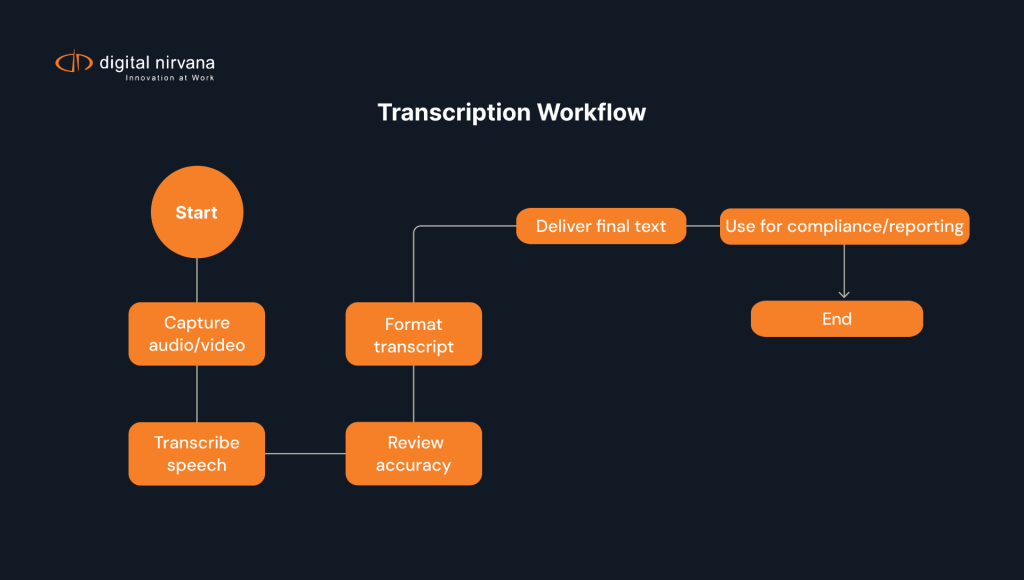
Pure ASR is fast but stumbles on industry terminology, proper nouns, and accents, exactly the details that matter most in financial transcripts, technical broadcasts, and legal or compliance-sensitive content. Fully manual transcription is accurate but doesn’t scale to the volume most media and research operations handle today. The workflow that actually holds up under real deadlines combines automated speech recognition with human review, catching what the machine gets wrong without sacrificing the speed AI provides.
Transcription Accuracy: What Actually Affects It
A few factors consistently determine whether a transcript is usable as-is or needs heavy correction:
- Audio quality – Background noise, overlapping speakers, and poor microphone placement degrade accuracy fast.
- Domain-specific language – Financial terminology, medical language, and industry jargon trip up generic ASR models.
- Number of speakers – Multi-speaker panels and interviews are harder to transcribe accurately than single-speaker content.
- Accents and dialects – ASR accuracy still varies significantly across accents, which is why human review remains essential for diverse speaker pools.
- Turnaround pressure – Rushed manual transcription without a QA pass tends to introduce more errors than a properly reviewed hybrid workflow.
A Quick Checklist Before You Trust a Transcript
- Names, titles, and technical terms have been checked against a reference list
- Speaker labels are consistent throughout
- Numbers, dates, and figures have been double-checked (critical for financial transcripts)
- A human reviewer has passed over any AI-generated draft
- The transcript has been time-stamped if it will feed into captioning or metadata tagging
- The file format matches what downstream tools (captioning, search, archive systems) require
How Digital Nirvana Approaches Transcription
Transcription only delivers value when it’s fast, accurate, and built to feed directly into whatever comes next, captions, searchable metadata, or structured research output. That’s the problem TranceIQ is built to solve, pairing cloud-based transcription with human review workflows so teams get speed without sacrificing the accuracy that compliance-sensitive and deadline-driven content demands.
For organizations that need transcription at higher volume or with specialized domain expertise, Media Enrichment extends that capability with managed, human-assisted transcription, captioning, and translation support. Financial research teams working against earnings-season deadlines can lean on the Investment Research solution built specifically around fast, accurate transcript turnaround for earnings calls and market-moving events.
Once a transcript exists, its value multiplies. MetadataIQ turns transcript text into searchable metadata across an entire archive, while MediaServicesIQ layers in additional AI-driven intelligence like scene descriptions and speaker recognition on top of the base transcript. For teams handling public meeting recordings, lecture capture, or compliance-sensitive audio, that same transcript becomes the backbone for accessibility and retrieval, a use case reflected across the Learning Management solution.
Transcription as the Foundation of Modern Media Operations
Every workflow discussed here, captioning, archive search, compliance logging, research analysis, points back to the same starting material: an accurate transcript. Teams that treat transcription as a strategic input rather than an afterthought consistently move faster, search more effectively, and reduce the manual labor buried in their production pipelines. Real-world examples of this in practice, across broadcast, financial research, and education, are documented on the Digital Nirvana success stories page.
Frequently Asked Questions
How accurate is AI transcription today? Modern ASR performs well on clear, single-speaker audio, but accuracy drops with background noise, overlapping speech, and specialized terminology. Most production environments still pair AI transcription with human review for content where accuracy matters.
How long does transcription typically take? Turnaround depends on volume, audio quality, and method. AI-assisted transcription with human review can turn around same-day for most content, while high-volume or highly technical material may take longer to ensure accuracy.
Is transcription the same as captioning? No. Transcription produces the raw text of spoken audio. Captioning takes that text and times, formats, and displays it synchronized with video, following specific readability and accessibility standards.
Why does transcription matter for SEO? Search engines can’t watch video, but they can crawl transcript text. Publishing transcripts alongside video content gives search engines and AI search tools something to index, improving discoverability.
Key Takeaways
- Transcription converts audio into searchable, reusable text, and it’s the foundation every downstream workflow (captioning, metadata, research analysis) depends on.
- Skipping transcription costs teams in wasted production hours, missed compliance obligations, and lost searchability.
- Hybrid workflows combining AI speed with human review consistently outperform either fully automated or fully manual transcription on accuracy and turnaround.
- Transcription accuracy depends heavily on audio quality, domain-specific language, speaker count, and accents, factors worth accounting for before trusting a transcript as final.
- Treat transcription as a strategic input to your broader content and research operations, not a one-off production task.