If you work with video or audio at scale, you already know this pain. You have a transcript, you know the quote exists, yet you still end up scrubbing through a two-hour recording to find the exact moment.
The issue is not that you lack transcripts. It is that you lack timestamped transcripts.
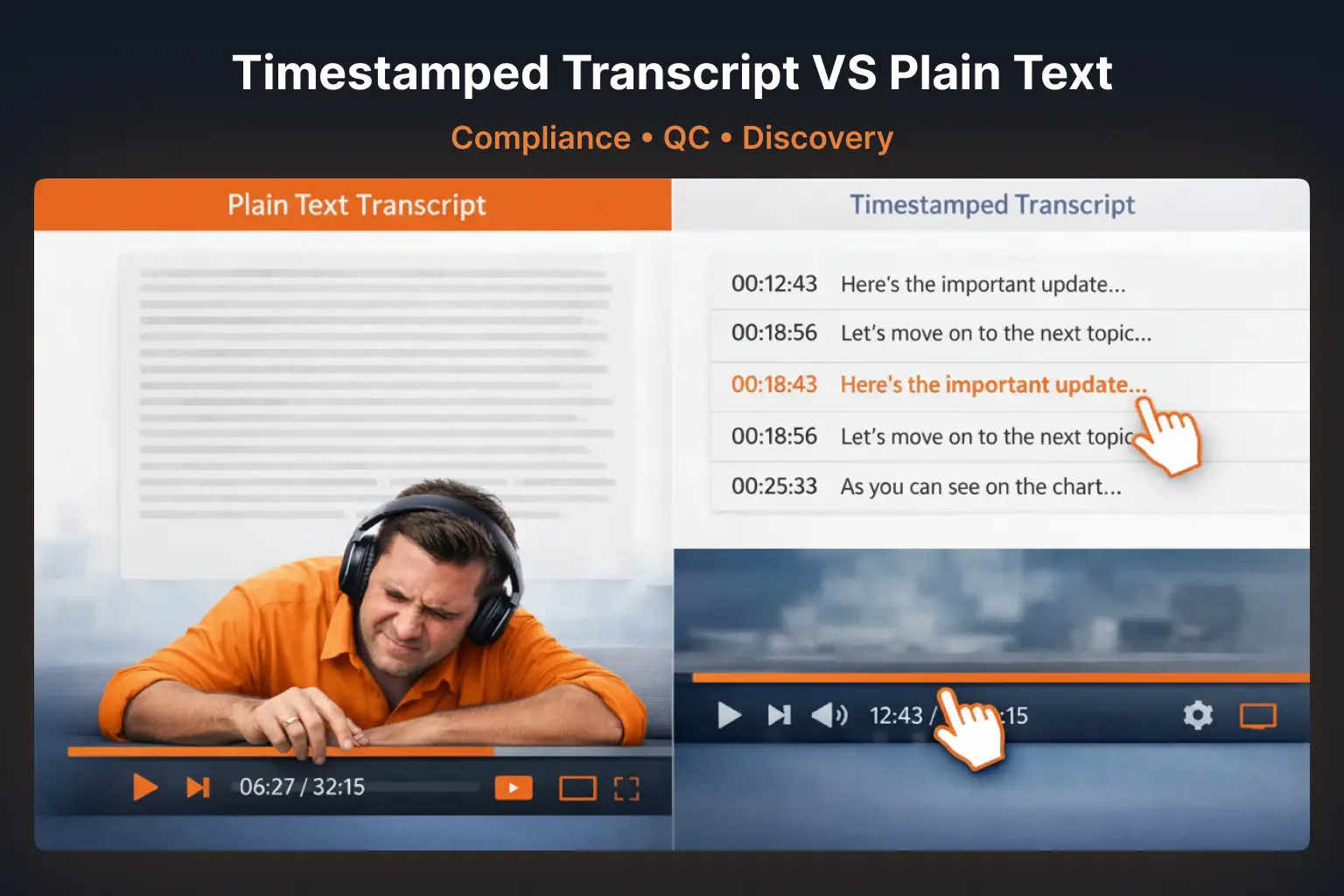
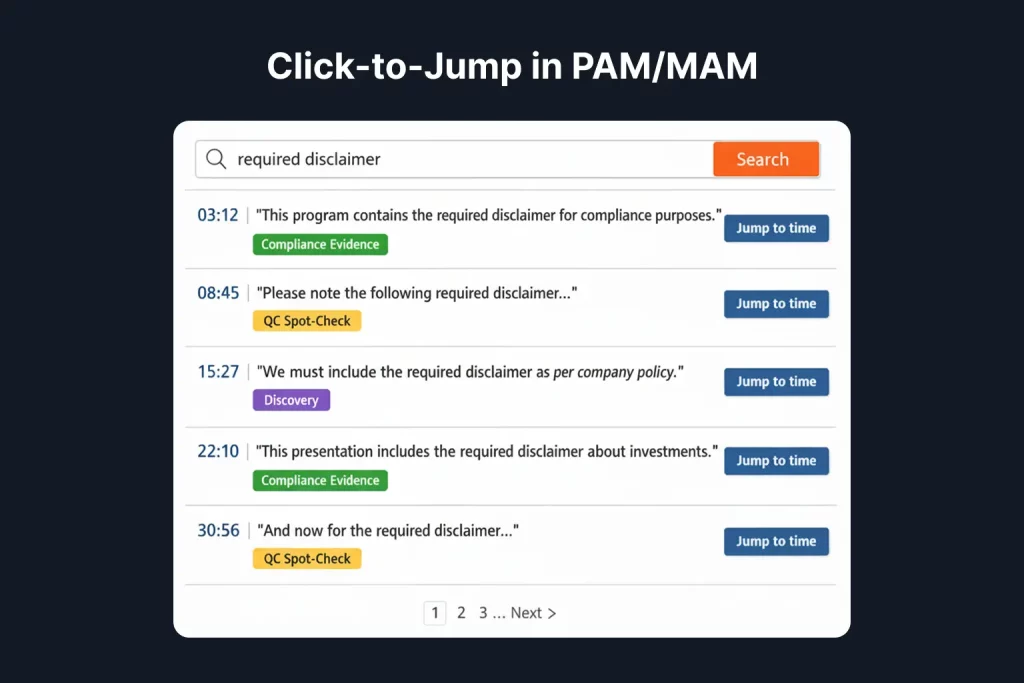
Timestamped or time-coded transcripts turn plain text into a navigation and audit layer for your media. Every word is linked back to the exact moment in the file. That single difference changes how your teams handle compliance checks, quality control, and discovery across your entire library. Modern platforms demonstrate that time-linked transcripts enable users to click a line of text and jump directly to that point in the recording, saving review time and improving search accuracy.
In this article, we unpack why timestamped transcripts beat plain text for compliance, QC, and discovery, and how Digital Nirvana’s MetadataIQ helps media organizations put time-coded transcripts at the heart of their workflows.
Plain Text Vs Timestamped Transcripts
Plain text and timestamped transcripts both convert speech to text, but they do very different jobs in a broadcast or media environment.
A plain text transcript:
- Contains the spoken content in a linear form
- May include speaker labels
- Has no direct link back to the media timeline
A timestamped or time-coded transcript:
- Links each line or segment of text to a precise timecode in the audio or video
- Often uses SMPTE or similar formats that match your production tools
- Allows users to click text and jump to that exact point in the file
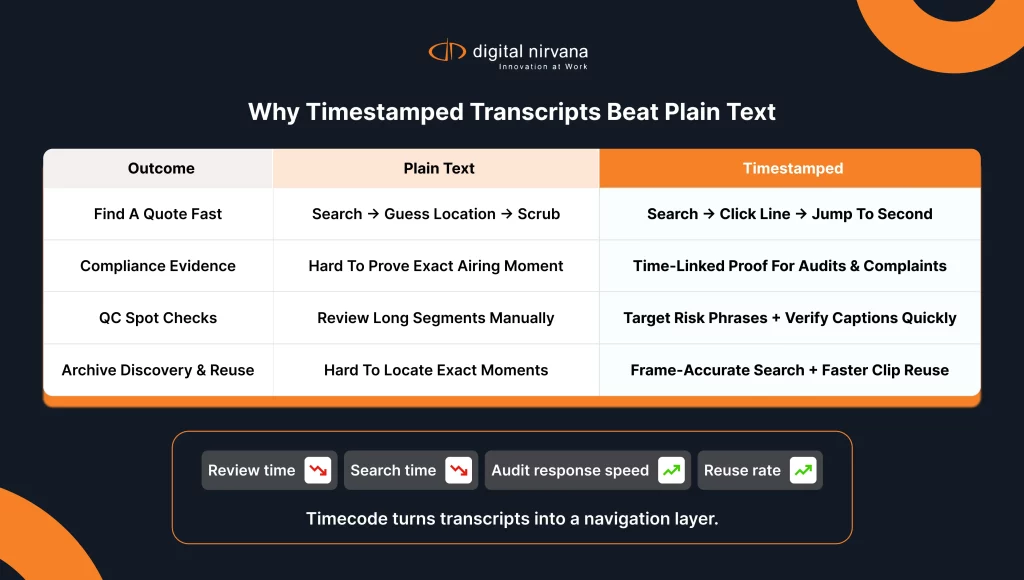
In short, a plain text transcript tells you what was said. A timestamped transcript tells you what was said and exactly where it lives. That “where” is what compliance, QC, and discovery teams care about most.
Why Timestamped Transcripts Win For Compliance
Compliance teams live in a world of proof. They need to show what went to air, when it aired, and whether it met internal and regulatory standards. Broadcast compliance platforms are built to record and log every second, then surface issues and evidence quickly.
Timestamped transcripts make it easier to produce that evidence.
1. Stronger Audit Trails
With time-coded transcripts, you can search for a phrase, disclaimer, or brand reference and immediately jump to the corresponding frame in the recording. This is critical when:
- Responding to regulator inquiries
- Handling complaints about specific wording
- Proving that required disclaimers or captions were present at a given time
Legal and investigative fields have already shown how timestamped transcripts help reconstruct timelines and verify exactly what was said at which minute in a recording.
2. Faster Response To Compliance Incidents
Compliance teams often work under time pressure. Without timestamps, they must:
- Search the transcript for the term
- Guess where in the audio or video the quote appears
- Manually scrub and cross-check
With timestamped transcripts, the workflow is different:
- Search the transcript
- Click the line of concern
- Land exactly on the relevant section of the media
This saves time and reduces the risk of missing context that might sit a few seconds before or after the quote.
3. Better Alignment With Monitoring Tools
Solutions such as Digital Nirvana’s MonitorIQ handle compliance logging, monitoring, and proof of performance. When you align MonitorIQ style monitoring with timestamped transcripts generated by MetadataIQ, every alert or ad verification event can be backed by:
- Exact recording segments
- The corresponding time-coded transcript excerpt
- Supporting metadata such as channel, region, and program
That combination makes it easier to close the loop between what was scheduled, what aired, and what was actually said.
How Timecoded Transcripts Improve QC And Review
Quality control is often treated as a technical function, focused on file integrity, loudness, and delivery specs. Yet content quality, consistency, and adherence to internal guidelines are equally important.
Timestamped transcripts give QC teams a precise textual view into content.
1. Targeted Spot Checks
Instead of watching full programs, QC operators can:
- Filter for risky terms or topics
- Jump directly to those points in the file
- Confirm tone, context, and required edits
Transcription quality resources show that adding timestamps to transcripts is a standard part of QA, because it allows reviewers to check structure, labels, and timing much more efficiently.
2. Verifying Caption And Subtitle Alignment
When transcripts are time-coded, they also act as a reference for captions and subtitles. If a section of captions is missing or out of sync, QC teams can:
- Compare caption files to the time-coded transcript
- Identify misaligned segments
- Correct the issue without watching the entire program again
This is particularly important for meeting caption regulations, such as CC608 or CC708, that MonitorIQ helps broadcasters track.
3. Supporting Content Versioning And Edits
For versioning and re-edits, time-coded transcripts provide a map of where sensitive language, outdated references, or region-specific segments appear. Instead of relying on memory or previous edit notes, editors have a searchable, time-linked reference to guide their changes.
Timestamped Transcripts As A Discovery Engine
Discovery is where timestamped transcripts deliver some of their most visible benefits.
1. Frame Accurate Internal Search
Searchable transcripts that link text to timecodes let users move from query to a specific segment in one click. Studies on video transcript tools show that this kind of “click to jump” workflow significantly reduces the time spent reviewing long recordings.
Inside a PAM or MAM environment, this means:
- Producers search for a quote, name, or topic
- The system returns transcript hits
- Each hit opens at exactly the right moment in the player
MetadataIQ is designed specifically for this pattern, sending transcripts to Avid as time-indexed markers that editors and producers can search for within MediaCentral and Interplay.
2. Better Cross Library Discovery
Time-coded transcripts support discovery across your entire archive. You can ask richer questions, for example:
- “Show me every instance where this brand was mentioned during prime time in the last quarter.”
- “Find all segments where a spokesperson discussed this specific policy.”
Because every line is associated with time, you can pull back not only the quote, but also the preceding and following context, which is often where the storytelling value sits.
3. External Search And Key Moments
Time-linked transcripts also fuel external discovery. When transcripts include timestamps, search engines and platforms can create “key moments” or “jump to time” links in search results, taking viewers directly to the part of the video that answers their query.
For OTT and digital publishers, this improves user satisfaction and supports SEO for video content.
Inside A Timecoded Transcript Workflow
To understand why timestamped transcripts are so powerful, it helps to see how they flow through a modern media workflow.
1. Capture
Audio or video is ingested from live feeds, studio recordings, or file-based sources into your edit or MAM environment.
2. Automatic Transcription With Timestamps
Using an automatic transcription engine, every spoken word is converted to text and time-aligned. Many AI transcription tools now output segment or word-level timing by default.
3. Enrichment And Quality Checks
Transcripts may be enriched with:
- Speaker labels
- Language detection
- Basic QC checks, such as incomplete segments or confidence scores
4. Indexing Back Into Media Systems
The time-coded transcript is then indexed back into your PAM, MAM, newsroom, or compliance system, often as markers or sidecar metadata. This is how MetadataIQ works with Avid: it sends speech-to-text and video intelligence metadata directly into MediaCentral and Interplay, so editors can search without leaving their tools.
5. Use Across Teams
- Compliance teams use the transcript for audits and investigations
- QC teams use it for spot checks and caption verification
- Producers and editors use it for discovery and fast edits
- Archive teams use it for long-term search and reuse
Plain-text transcripts rarely reach all these teams in a usable form. Time-coded transcripts, integrated with core systems, do.
How MetadataIQ Delivers Timestamped Transcripts At Scale
MetadataIQ is Digital Nirvana’s metadata automation platform for media, built to generate transcripts and rich metadata and then index them into Avid and other ecosystems.
For timestamped and time-coded transcripts, MetadataIQ:
1. Generates Time-Indexed Speech To Text
MetadataIQ automatically produces speech-to-text transcripts for file-based assets and can stream transcripts from growing or live assets in real time. Each line is aligned to media time, which means the output can be:
- Brought into Avid as markers
- Used directly by local language teams
- Passed downstream as caption-ready text
2. Combines Transcripts With Video Intelligence
Beyond speech, MetadataIQ also supports:
- Face recognition
- Logo and object detection
- OCR for on-screen text
Combined, this creates layered metadata in which spoken words, visuals, and graphics share the same timecode spine.
3. Integrates With MonitorIQ And Other Tools
In a typical deployment:
- MonitorIQ records and monitors channels for compliance and QoE
- MetadataIQ generates time-coded transcripts and metadata for the same content
- Together, they provide both the evidence and the analysis layer required for modern compliance and content monitoring
4. Scales Across Channels And Languages
MetadataIQ is built as a secure, scalable SaaS or on-premises deployment, with multilingual capabilities. That means timestamped transcripts can be generated consistently across channels, regions, and languages, rather than handled ad hoc by different teams.
Implementation Blueprint: Moving From Plain Text To Timecoded
If your current workflows still rely primarily on plain-text transcripts, a phased approach can help you transition without disruption.
1. Map Priority Use Cases
Identify where timestamped transcripts will make the biggest difference, for example:
- Regulatory response and audit support
- Ad verification and proof of performance
- Fast turnaround editing for news or sports
2. Decide On Timestamp Granularity
Different use cases need different levels of detail, for example:
- Every sentence or phrase for general review
- Every speaker’s turn for the contact center and call review
- Word or sub-second level for precise editing and key moment creation
3. Integrate MetadataIQ With Your PAM And MAM
Configure MetadataIQ to:
- Accept media from your ingest or storage
- Generate timestamped transcripts and metadata
- Push results back into Avid, MAM, or compliance tools as markers or sidecar files
4. Update Compliance And QC Playbooks
Ensure teams know how to:
- Search within timecoded transcripts
- Use timestamps to jump directly to media inside their tools
- Log outcomes and export evidence packages for auditors or internal reviews
5. Iterate And Expand
Collect feedback from early users, refine timestamp formats, and extend coverage across:
- Additional channels or regions
- More content types, such as podcasts and digital-only video
- Multilingual content that feeds global operations
Measuring Success: KPIs To Track
To show the value of moving from plain text to timestamped transcripts, track both workflow and business metrics.
Consider measuring:
- Time taken to locate and verify a specific on-air statement before and after timestamped transcripts
- Number of compliance or legal inquiries answered within internal targets
- Average QC review time per hour of content
- Search time for editors and producers working on promos or recuts
- Volume of archive content reused in new productions or digital formats
Research on metadata and transcription quality shows that richer, well-structured transcripts are directly linked to faster review, improved search, and better reuse. Timecoded transcripts are a practical way to achieve that in day-to-day media workflows.
FAQs
The terms are often used interchangeably. Timestamped transcripts usually refer to text with visible time markers at intervals, while timecoded transcripts emphasise precise alignment with media timecode formats used in professional tools. In practice, both connect text to specific moments in a recording.
Not necessarily. Platforms like MetadataIQ are designed to plug into existing PAM and MAM systems, such as Avid MediaCentral and Interplay, by delivering transcripts as markers or sidecar files instead of replacing your core tools.
No. While the benefits are clear for long programs, timecoded transcripts also help with shorter clips, promos, and digital content by making it easier to track specific phrases, claims, and brand mentions, which is important for compliance and sponsorship.
Because each segment of text is tied to an exact time, legal and compliance teams can reconstruct events, verify exact language used on air, and provide precise evidence in response to regulatory or legal questions. This approach is widely used in legal and investigative transcription contexts.
Yes. When video transcripts include timestamps, platforms and search engines can surface key moments and jump links that take viewers directly to the relevant parts of the content, improving engagement and discoverability.
Conclusion
Plain-text transcripts are better than no transcripts at all, but they were never designed for the demands of modern media operations. Compliance teams need defensible evidence, QC needs targeted visibility into content quality, and editors need fast discovery across huge libraries.
Timestamped transcripts meet those needs by turning text into a structured navigation and audit layer, anchored to your media timelines. They enable moving from a phrase on a page to the exact second of content in a single click, which is the foundation of efficient compliance, QC, and discovery.
Solutions such as MetadataIQ were created for this reality. By generating timecoded transcripts and rich metadata and pushing them back into Avid and other PAM and MAM ecosystems, Digital Nirvana helps broadcasters and content owners replace manual search and patchwork processes with an integrated, time-aware workflow.
If your teams are still relying on plain text transcripts and manual scrubbing when issues arise, there is a clear next step. Put timestamped transcripts at the heart of your compliance, QC, and discovery processes and measure how much time, cost, and stress you remove from the system.
Key Takeaways:
- Timestamped or timecoded transcripts connect every line of text to an exact moment in audio or video, which plain text cannot do.
- Compliance teams use time-coded transcripts to respond more quickly to regulators, complaints, and legal requests with precise, defensible evidence.
- QC and review teams use timestamped transcripts to target problem areas, verify captions, and support consistent content standards.
- Time-linked transcripts turn your archive into a discovery engine, enabling frame-accurate search and richer reuse of existing content.
- MetadataIQ makes timestamped transcripts practical at scale by integrating automatic, time-indexed transcription into existing Avid and media workflows.