A content team wants to launch three new language markets this quarter. Subtitles are easy enough to scale. Dubbing is where the plan stalls, because the two options on the table both look expensive in different ways.
Full manual dubbing means studios, voice actors, and a production timeline measured in months, not days. Fully automated AI dubbing is faster and cheaper, but it often sounds exactly like what it is: synthetic, flat, and missing the emotional beats that make a scene land. Neither option fits a release calendar that needs to move quickly across multiple markets at once.
Hybrid AI dubbing exists specifically to close that gap, and it’s becoming the default approach for teams that need real scale without sacrificing the parts of dubbing that actually require a human ear.
What Hybrid AI Dubbing Actually Means
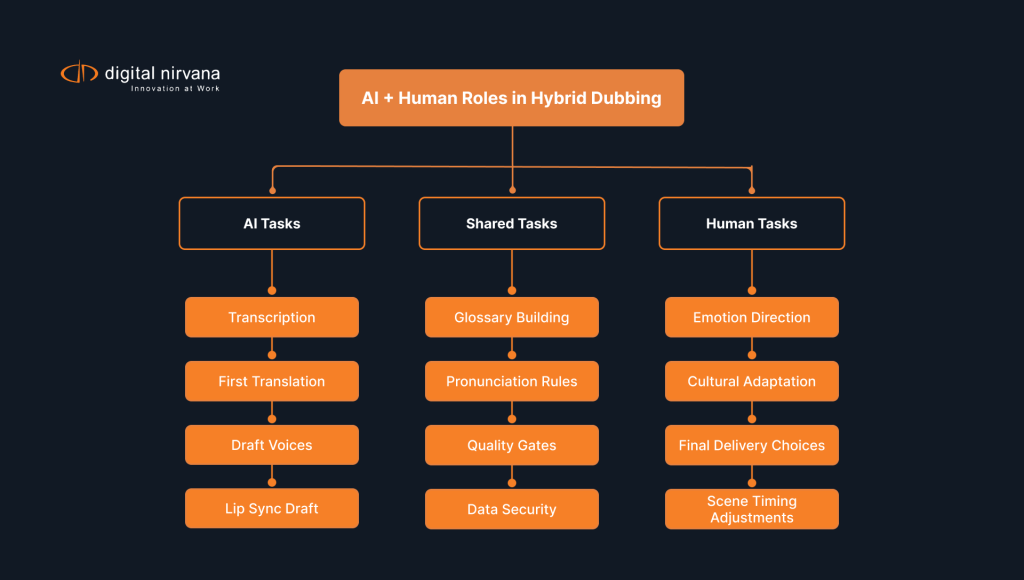
Hybrid dubbing isn’t a compromise between AI and human work. It’s a deliberate division of labor, where each side does what it’s actually good at.
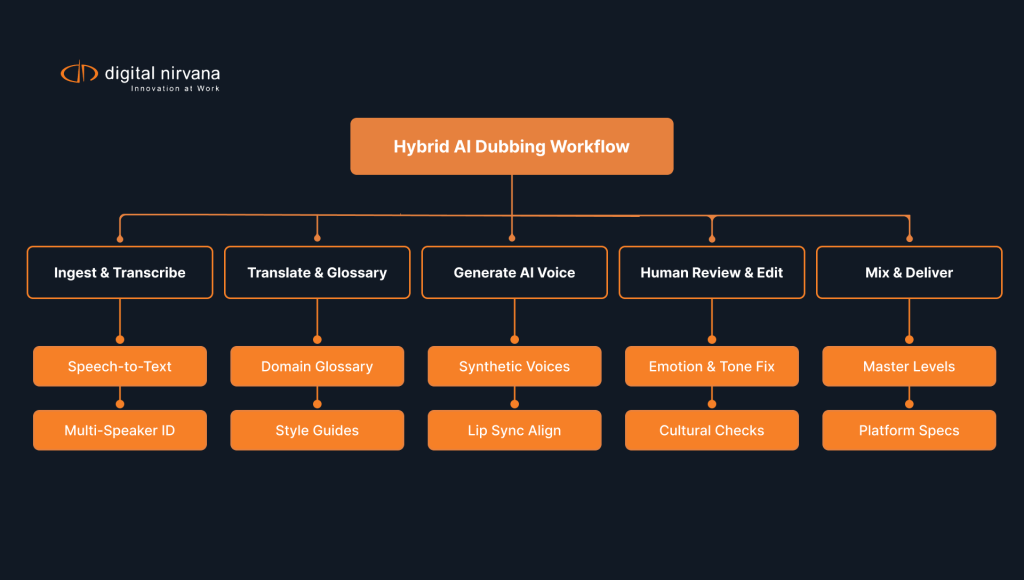
AI handles the parts that are mechanical and repetitive: transcription, first-pass translation, timing alignment, and draft voice synthesis. These are tasks where speed and consistency matter more than creative judgment, and AI does them faster than any manual process ever could.
Human linguists, directors, and audio engineers then step in for the parts that require judgment: refining tone and intent, catching cultural nuance, adjusting emphasis on key lines, and fine-tuning lip-sync and audio mix. This is where the emotional truth of a scene either survives translation or doesn’t.
Why Pure Automation Falls Short for Dubbing Specifically
Dubbing is a harder problem than subtitling, and it’s worth being clear about why. A subtitle just needs to convey meaning within a character limit. A dubbed voice track needs to convey meaning, match timing, sound natural, and carry the right emotional register, all at once.
Fully automated dubbing tends to struggle with the same handful of issues repeatedly. Sarcasm, idioms, and humor often translate literally instead of contextually, which changes the joke or removes it entirely. Tight automated timing can crush natural breathing patterns and rhythm, making dialogue feel rushed or mechanical. Voice models can flatten prosody in fast, emotional scenes, losing the intensity a human actor would naturally deliver. And regional slang, especially across dialects of the same language, can drift from the original intent without a native speaker reviewing it.
None of this means AI dubbing is unreliable. It means fully unsupervised AI dubbing is risky for anything where brand reputation or viewer trust is on the line.
Where Human Review Actually Earns Its Cost
It’s worth being specific about what human reviewers catch that automation typically misses, because this is where the real value of a hybrid model shows up.
Misread proper nouns are a common failure point, especially in sports, politics, or unfamiliar names, where a machine has no way to know the correct pronunciation without guidance. Cultural fit matters just as much: a joke, idiom, or reference that works in one market can fall flat or even cause offense in another, and only a human reviewer with local context catches that before release. Emphasis and emotional intent are just as easy to lose, since a line delivered flatly by a voice model can completely change how a scene is perceived, even when every word is technically correct.
How a Hybrid Dubbing Workflow Actually Runs
Transcription and first-pass translation. AI generates an accurate source transcript, then produces an initial translation into the target language, giving the team a working draft in a fraction of the time manual translation would take.
Timing and draft voice synthesis. The AI-generated script gets aligned to the original timing, and a draft voice track is synthesized, often using voice cloning or AI-generated speech that approximates the target tone.
Human linguistic and directorial review. Linguists and directors review the draft for meaning, tone, and cultural accuracy, adjusting key lines, correcting idioms, and flagging anything that needs a fresh take rather than a tweak.
Audio engineering and final mix. Engineers handle lip-sync alignment, loudness, and mix quality, making sure the final track matches the technical and sonic standard of the original production.
This isn’t a linear handoff where AI finishes and humans start from scratch. It’s a layered process where AI removes the repetitive groundwork so human specialists can focus their time on the handful of moments in any piece of content that actually determine whether the dub feels natural or not.
The Cost and Speed Case for Hybrid Dubbing
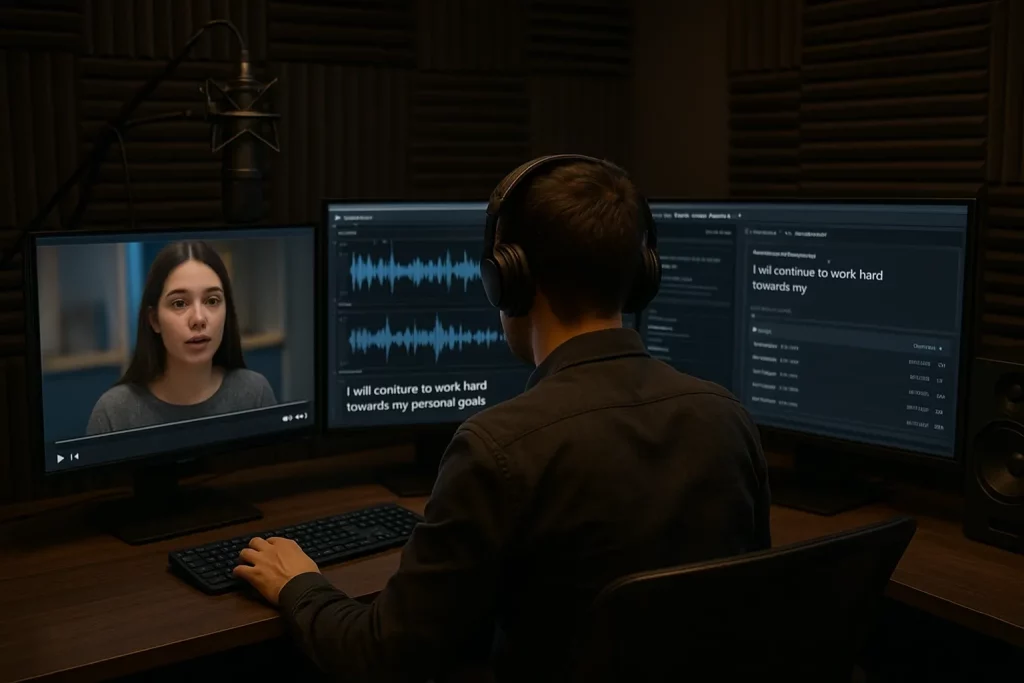
The practical appeal of hybrid dubbing comes down to two numbers that matter to any localization budget: turnaround time and cost per minute.
Hybrid AI dubbing workflows can produce localized audio significantly faster than fully manual studio pipelines, since AI removes the slowest steps (translation drafting, timing alignment, initial voice generation) from the critical path. On cost, teams typically see substantial savings compared to traditional dubbing, since fewer studio hours and less manual translation work are needed per minute of finished content.
That combination is what makes hybrid dubbing viable for content types that traditional dubbing economics never made sense for: catalog back-titles, mid-tier content, and markets that wouldn’t have justified a full studio dub before.
A Practical Framework for Deciding Where to Invest in Dubbing
Not every piece of content needs the same level of dubbing investment, and hybrid workflows make it possible to tier that decision instead of treating it as all-or-nothing.
| Content Type | Recommended Approach |
| Flagship IP, top markets | Higher human review ratio, director-level involvement on key scenes |
| Kids and family content | Heavy human review, since tone and clarity matter disproportionately |
| Mid-catalog, secondary markets | Standard hybrid workflow, moderate review depth |
| Long-tail archive content | Lighter-touch review, prioritizing speed and cost efficiency |
| News and unscripted content | Fast turnaround with targeted review on names and sensitive terms |
This kind of tiering lets a localization budget go further, putting human attention where it has the most impact on viewer perception rather than spreading it evenly across everything.
Measurable Impact of Moving to a Hybrid Model
Teams that shift from fully manual dubbing to a hybrid AI plus human-in-the-loop model typically see change in a few consistent places.
Turnaround time for localized audio drops significantly, since AI-generated drafts remove the slowest manual steps from the pipeline. Cost per minute of dubbed content falls as well, often substantially, which makes it viable to localize content that wouldn’t have cleared the budget bar under traditional dubbing economics. And because human review is still built into the process, quality stays close to fully manual output for the moments that matter most, rather than sacrificing viewer trust for speed.
Key Capabilities Worth Prioritizing in a Dubbing Partner
- AI-powered transcription, translation, and voice synthesis as the drafting layer
- Human linguists and directors reviewing tone, intent, and cultural fit before final delivery
- Voice cloning or AI-generated speech options that support consistent character voices across episodes
- Audio engineering for lip-sync, loudness, and mix quality matched to broadcast standards
- Flexible review depth by content tier, rather than one fixed process for everything
- Integration with existing captioning, subtitling, and transcription workflows
Addressing the Common Objections
“AI dubbing still sounds robotic to us.” Fully automated dubbing often does. Hybrid dubbing specifically exists to fix that gap, using AI for speed and human review for the emotional and cultural nuance automation still misses.
“Human review defeats the purpose of using AI at all.” It doesn’t, because the AI layer removes the slowest and most repetitive parts of the process. Human reviewers aren’t doing the work from scratch, they’re refining a draft that would otherwise have taken far longer to produce manually.
“This still sounds expensive for our full catalog.” It doesn’t have to apply uniformly. A tiered approach, heavier review for flagship content and lighter review for long-tail archive material, lets teams control cost while still getting the quality benefit where it matters most.
How Digital Nirvana Approaches Hybrid Dubbing
Digital Nirvana’s TranceIQ provides the transcription and translation foundation that hybrid dubbing workflows depend on, generating accurate, timecode-indexed source material that speeds up every downstream localization step.
For teams managing dubbing alongside subtitling and captioning as part of a single localization strategy, Media Enrichment provides the managed, human-reviewed layer that keeps quality consistent across high content volume. Broadcasters and OTT platforms coordinating this work with metadata and archive management often connect localization output to MetadataIQ, keeping dubbed and subtitled versions searchable alongside the original content.
Why This Matters for Global Content Strategy Right Now
Content release calendars are compressing, and audiences increasingly expect localized audio, not just subtitles, even for mid-tier and catalog content that would never have justified a full studio dub a few years ago. Hybrid AI dubbing is what makes that expectation financially realistic at scale.
Teams building broader multilingual distribution strategies often layer this alongside MediaServicesIQ for content detection and metadata support across languages, and Digital Nirvana’s success stories show how broadcasters and OTT platforms have used hybrid dubbing to expand into new markets without the traditional studio-scale budget.
Frequently Asked Questions
Is hybrid AI dubbing suitable for broadcast-grade content, or just digital platforms? Yes, when the workflow includes proper human review gates for language, timing, audio, and compliance. Hybrid dubbing is increasingly used across broadcast, OTT, and digital platforms alike.
How much of the dubbing process is actually done by AI versus humans? It varies by content tier. AI typically handles transcription, first-pass translation, timing, and draft voice generation, while humans refine tone, catch cultural nuance, and finalize audio quality.
Can hybrid dubbing maintain consistent character voices across an entire series? Yes. Voice cloning and AI-generated speech, combined with human review for consistency, can maintain the same character voice across episodes and even across seasons.
Conclusion
Localization no longer has to mean choosing between a dub that sounds robotic and a dub that takes months to produce. Hybrid AI dubbing gives teams a realistic middle path: AI handles the speed and scale, humans protect the parts of a performance that actually connect with an audience. For content teams racing to expand into new markets without blowing up the budget, that combination isn’t a compromise. It’s the practical way global localization actually gets done in 2025.
Key Takeaways
- Hybrid AI dubbing divides labor deliberately: AI handles transcription, translation, and timing, humans handle tone, culture, and emotional accuracy
- Fully automated dubbing consistently struggles with idioms, humor, emphasis, and regional slang
- Human review is where misread proper nouns and cultural missteps actually get caught before release
- Tiered review depth by content type lets teams control cost without sacrificing quality on flagship content
- Hybrid workflows meaningfully cut both turnaround time and cost per minute compared to fully manual dubbing
- Voice cloning combined with human oversight supports consistent character voices across an entire series