A project wraps in the edit suite with rich, detailed metadata attached: speaker names, scene descriptions, timeline markers, story context, all of it built up carefully during production. Six months later, someone searches the archive for that same content and finds almost none of it. The metadata that existed during editing simply didn’t survive the move into long-term storage.
This is one of the most common, and most quietly costly, failures in media operations. It’s not that metadata was never created. It’s that it got lost, stripped, or never carried forward at the exact moment content moved from active production into the archive. Understanding why that handoff breaks, and how to actually fix it, matters more than most metadata strategies acknowledge.
Two Systems, One Piece of Content, Two Different Jobs
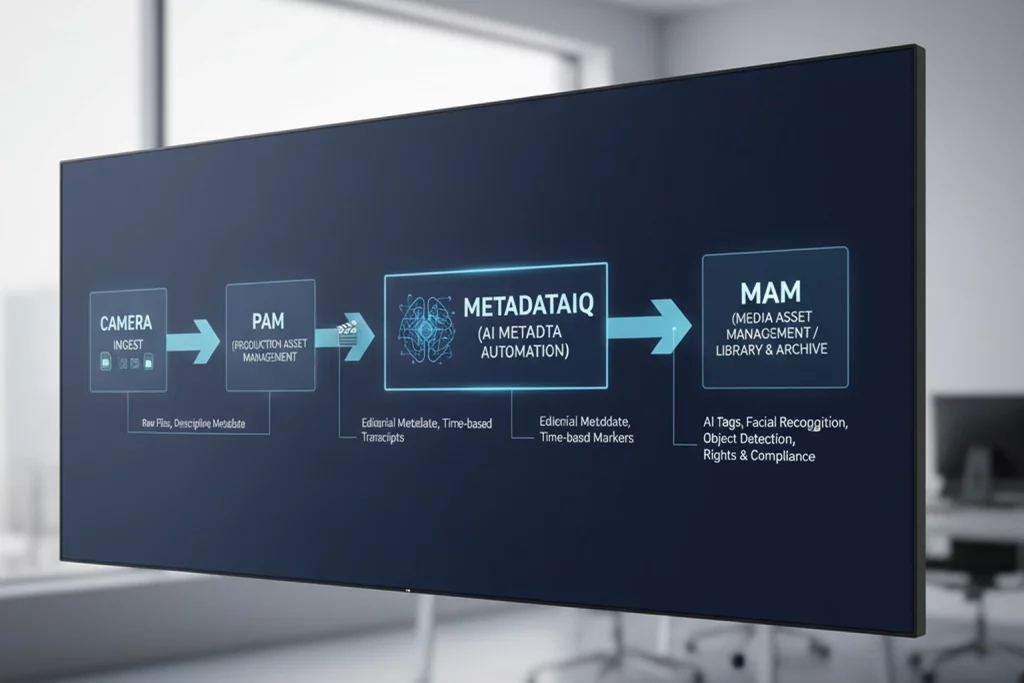
Production Asset Management (PAM) and Media Asset Management (MAM) exist because content has fundamentally different needs during production versus after it’s finished.
PAM handles the active, in-progress phase: dailies, rough cuts, works-in-progress, project timelines. It’s built for speed, flexibility, and the messy, iterative reality of a project still being shaped. MAM handles the finished side: final masters, delivered versions, localization assets, and the long-term archive a content library actually lives in once a project wraps.
Both systems are usually genuinely good at their specific job. The problem isn’t either system individually. It’s the seam between them, the point where a project moves from PAM to MAM, since that handoff is exactly where metadata most commonly gets dropped.
Why Metadata Dies at the Handoff
A few structural reasons explain why this gap keeps happening across so many media organizations, even ones with strong tools on both sides.
Different metadata schemas. PAM systems and MAM systems often use different field structures, naming conventions, and taxonomies. Without an explicit mapping between the two, metadata created in one system doesn’t automatically translate cleanly into the other.
Manual export steps that skip fields. When a project moves from PAM to MAM, the export or delivery process often carries forward the media file itself but not every metadata field attached to it, particularly time-based markers, editorial notes, and anything created informally during the edit rather than in a structured field.
Different priorities at different phases. During production, metadata often gets created for immediate, in-the-moment needs, finding a specific shot, tracking a version, coordinating with a team. Nobody’s necessarily thinking about how that same metadata needs to serve archive search two years later, so it doesn’t get structured with that future use case in mind.
No single owner across the full lifecycle. Production teams own the PAM side. Archive or library teams own the MAM side. Without someone accountable for metadata integrity across the entire handoff, gaps between the two systems become nobody’s specific problem to fix.
What Gets Lost, Specifically
Understanding what actually disappears at this handoff helps clarify why it matters so much for downstream search and reuse.
| Metadata Type | What It Captures | Why It’s Vulnerable at Handoff |
| Timeline markers and comments | Notes tied to specific timecodes during editing | Often exist only inside the NLE project file, not exported |
| Editorial context | Why a shot was chosen, story significance | Rarely captured in structured fields at all |
| Time-based entities | Quotes, reactions, key moments mapped to timecode | Easy to lose if export doesn’t preserve time-coded markers |
| Version and iteration history | Which cut, which approval stage | Often tracked informally, not carried into final archive record |
| Rights and usage notes added mid-production | Territory, usage window, clearance status | Frequently exists in email or a separate document, not the asset record |
The common thread: the richest, most useful metadata is often created informally during active production, exactly the metadata least likely to survive an automated or manual handoff into long-term archive.
Why This Matters More Than It Might Seem
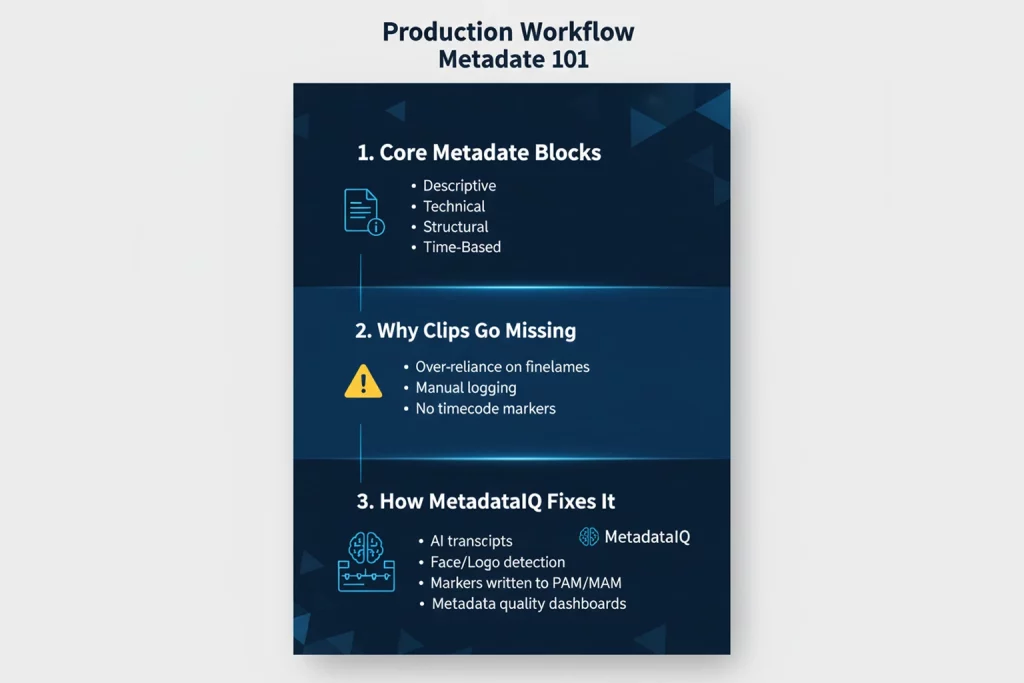
A gap in production workflow metadata doesn’t just mean an archive search returns fewer results. It means the specific, high-value context that made a piece of content genuinely useful, who’s speaking, why a moment matters, what quote is buried where, disappears at exactly the point where it would be most valuable for future reuse, licensing, or compliance review.
This compounds over time. Every project that moves through the same broken handoff adds another layer to an archive that looks complete on the surface but is actually thin on the metadata that makes content truly discoverable and reusable.
How Modern Workflows Actually Close This Gap
The fix isn’t choosing a better PAM or a better MAM individually. It’s building metadata generation and preservation into the workflow that spans both, rather than treating metadata as something each system handles independently.
AI-driven metadata generation applied at ingest and throughout production, transcription, speaker identification, scene tagging, creates structured metadata from the start, rather than depending on manual notes that may or may not survive an export. That same metadata, generated once and structured consistently, can then flow through to the MAM automatically, rather than requiring a separate manual re-tagging effort once a project reaches long-term storage.
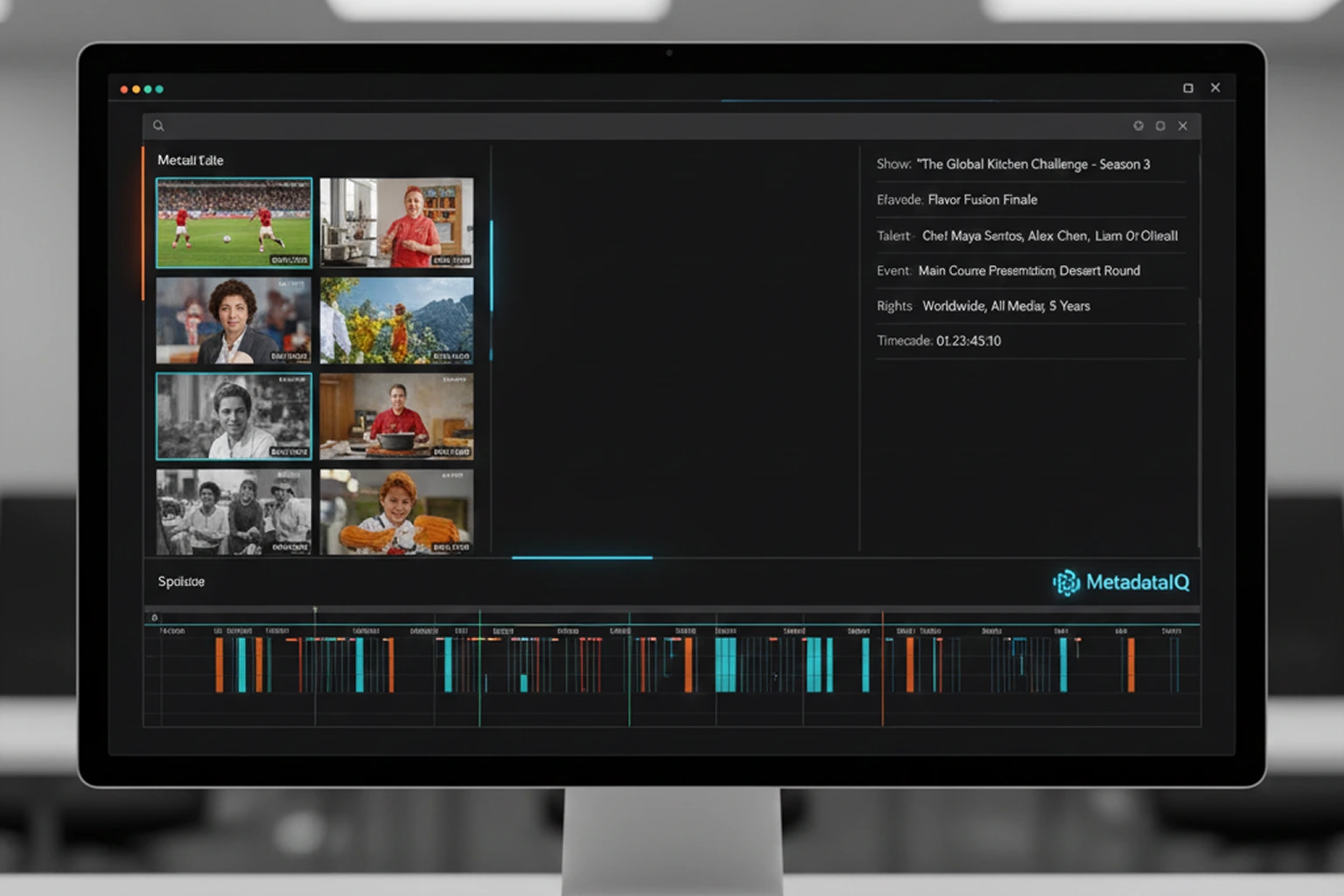
Time-based metadata deserves particular attention here. In production workflows, static metadata gets you to the correct file. Time-based metadata gets you to the right moment inside that file. Timeline markers, segments, and comments mapped to timecode are what let an editor jump straight to a specific quote or reaction shot instead of scrubbing an entire timeline, and that same time-based structure is exactly what needs to survive the move into MAM if archive search is going to be genuinely useful later, not just file-level, but moment-level.
A Practical Workflow: What Should Actually Carry Forward
At ingest, automated transcription and metadata generation begin immediately, creating structured, time-coded data rather than waiting for someone to manually log content later.
During production, timeline markers, comments, and editorial notes get captured in structured fields tied to timecode, not just informal notes inside an NLE project that won’t export cleanly.
At the PAM-to-MAM handoff, metadata mapping between the two systems’ schemas happens automatically, based on a defined field mapping, rather than a manual export process that quietly drops whatever doesn’t fit a predefined template.
In the archive, the same time-based, descriptive, and technical metadata that made content findable during editing remains attached and searchable, so a search two years later returns the same rich context that existed the day the project wrapped.
Measurable Impact of Closing the PAM-to-MAM Gap
Organizations that fix this handoff typically see change in a few consistent places. Archive search quality improves meaningfully, since content arriving in the MAM carries the same rich, time-coded metadata it had during active production, rather than a stripped-down version. Reuse and repurposing accelerate, since editors and producers can find not just the right file but the right moment inside it, months or years after the original project wrapped. And metadata rework drops significantly, since teams stop re-tagging content that technically already had the metadata it needed, just not in a form that survived the handoff.
What to Evaluate Before Assuming Your PAM-to-MAM Handoff Is Solid
A few honest questions tend to reveal whether this gap exists in a given organization’s workflow, even when both systems individually seem to be working fine.
Does metadata created during production, particularly time-coded markers and editorial notes, actually appear in the MAM after a project is archived, or does search only return file-level results? Is there an explicit, maintained mapping between PAM and MAM metadata schemas, or does the export process depend on informal conventions? And is there a single team or role accountable for metadata integrity across the full production-to-archive lifecycle, or does responsibility quietly drop between departments at the handoff point?
Key Capabilities Worth Prioritizing
- AI-driven metadata generation applied at ingest and throughout active production, not just at archive
- Explicit, maintained schema mapping between PAM and MAM metadata fields
- Preservation of time-coded markers and editorial context through the archive handoff, not just file-level metadata
- Clear ownership of metadata integrity across the full production-to-archive lifecycle
- Integration that writes metadata into both PAM and MAM environments from a single generation pass, rather than duplicating effort
Addressing the Common Objections
“Our PAM and MAM are both solid systems, so this shouldn’t be a problem for us.” Individually strong systems are exactly where this gap hides most easily, since the failure isn’t in either system, it’s in the handoff between them, which often gets far less attention than either system on its own.
“We already export metadata when a project moves to archive.” The question worth asking is what specifically survives that export. Time-coded markers and informal editorial notes are the most common casualties, even when basic technical and descriptive metadata does carry forward.
“Fixing this sounds like it requires replacing one of our systems.” It usually doesn’t. The fix is typically a metadata layer that generates structured data consistently and maps it across both systems, working alongside existing PAM and MAM infrastructure rather than replacing either one.
How Digital Nirvana Approaches This Handoff
MetadataIQ is built specifically to generate consistent, time-coded metadata that carries through the full production lifecycle, from ingest through PAM and into MAM, rather than requiring separate tagging efforts at each stage.
For teams whose metadata gap centers specifically on transcription and speech data getting lost between production and archive, TranceIQ provides the transcription foundation that stays attached to content throughout that lifecycle. Organizations extending metadata into visual detection, faces, logos, on-screen text, that also needs to survive the handoff often layer in MediaServicesIQ, while broadcasters managing compliance metadata across the same lifecycle connect this to MonitorIQ.
Why This Matters for Long-Term Archive Value
An archive is only as valuable as the metadata attached to it, and if the richest metadata consistently gets stripped at the exact moment content moves from active production into long-term storage, an organization is quietly building an archive that looks complete but searches poorly, year after year, project after project.
Fixing the PAM-to-MAM handoff isn’t a one-time cleanup project. It’s a structural fix to how metadata flows through the entire content lifecycle, and it’s what separates archives that stay genuinely useful over time from archives that technically hold everything but can only be searched by file name. Digital Nirvana’s success stories show how media organizations have closed exactly this gap without disrupting the production tools their teams already rely on.
Frequently Asked Questions
What’s the actual difference between PAM and MAM? PAM handles active, in-progress production content like dailies and works-in-progress. MAM handles finished, long-term archive content like final masters and delivered versions. Many organizations run both, connected through a handoff at project completion.
Why does metadata get lost specifically at the PAM-to-MAM transition, if both systems handle metadata individually? The two systems often use different metadata schemas and naming conventions, and manual or automated export processes frequently don’t preserve every field, particularly time-coded markers and informal editorial notes created during production.
Does fixing this gap require replacing our existing PAM or MAM system? Usually not. The fix typically involves a metadata generation and mapping layer that works alongside existing PAM and MAM infrastructure, rather than requiring either system to be replaced.
Conclusion
The most expensive metadata gap in many media operations isn’t a lack of tagging. It’s the metadata that existed during production and simply didn’t survive the move into long-term archive. Fixing the PAM-to-MAM handoff, through consistent generation, explicit schema mapping, and clear ownership across the full lifecycle, is what turns an archive that technically stores everything into one that actually stays searchable, useful, and valuable years after a project wraps.
Key Takeaways
- PAM and MAM serve different phases of the content lifecycle, and the handoff between them is where metadata most commonly gets lost
- Time-coded markers and informal editorial notes created during production are the most vulnerable metadata to disappear at handoff
- Different metadata schemas between PAM and MAM require explicit mapping, not an assumed automatic translation
- AI-driven metadata generated consistently from ingest through archive avoids depending on a fragile manual export step
- Clear ownership across the full production-to-archive lifecycle prevents the handoff from becoming nobody’s responsibility
- Fixing this gap is typically a metadata layer added alongside existing systems, not a full platform replacement