You can have perfect playlists, clean traffic logs, and carefully negotiated ad contracts, yet still get the email no broadcaster wants to see.
“Did our spot actually air?”
“Why is there dead air in this break?”
“Can you show us what ran at 8:03 p.m. last Thursday?”
Without robust content monitoring and broadcast compliance logging, answering those questions turns into a forensic exercise. With the right stack, it becomes a simple search and a two-minute screen recording.
Modern content monitoring gives you a single source of truth for what actually left your facility (and OTT stack), across every channel, with timecoded proof you can hand to regulators, advertisers, and executives. Platforms like Digital Nirvana’s MonitorIQ broadcast signal monitoring solution bring AI, cloud, and intuitive clip tools together so engineering, legal, and ad sales all see the same evidence instead of chasing separate systems.
This article breaks down what content monitoring means in 2026, how broadcast compliance logging underpins proof of performance, and how to design workflows that catch issues in real time rather than in the regulator’s inbox.
Content Monitoring And Broadcast Compliance Logging, Defined
Content monitoring and broadcast compliance logging work together, but they are not identical.
- Content monitoring
Continuous recording, analysis, and oversight of your output, across linear, cable, OTT, and STB returns, to ensure quality, compliance, and correct playout. Vendors and regulators increasingly describe this as real-time content monitoring across all channels, with dashboards and alerts for exceptions. - Broadcast compliance logging
The long-term recording and archiving of your channels for legal, regulatory, and contractual proof. Requirements typically include multi-month retention, timecoded records, and exportable evidence for audits or disputes.
In a modern setup, content monitoring systems are both:
- Watch live feeds for issues, and
- Log everything with timecoded recordings, captions, and loudness data for later proof.
Older “logger only” boxes captured the signal and stopped there. Newer AI-ready platforms go further, turning that archive into a searchable, clip-ready library that multiple teams can share.
Why Content Monitoring Matters Now
Several trends have pushed content monitoring from an “engineering nice-to-have” to a “business-critical” priority.
- More outputs, more risk
You might be simulcasting the same show across OTA, cable, satellite, and multiple OTT variants. Compliance monitoring now has to cover IP streams and FAST channels as much as RF. - Stricter regulatory expectations
Regulators expect broadcasters to retain complete recordings, caption data, and political / children’s advertising records, often for months, and to produce proof quickly when requested. - Advertisers are demanding real proof
Ad verification standards from bodies like the IAB emphasise real technical evidence (recordings, logs) to prove campaigns ran as intended, not just affidavits. - Viewers with instant feedback channels
A captioning error, a profanity slip, or a black screen will be posted on social media within minutes. If you cannot see what they saw and remediate fast, you lose trust.
In short, you need to know what happened, when it happened, and have the video to back it up.
From Legal Checkbox To Live Operational Nerve Center
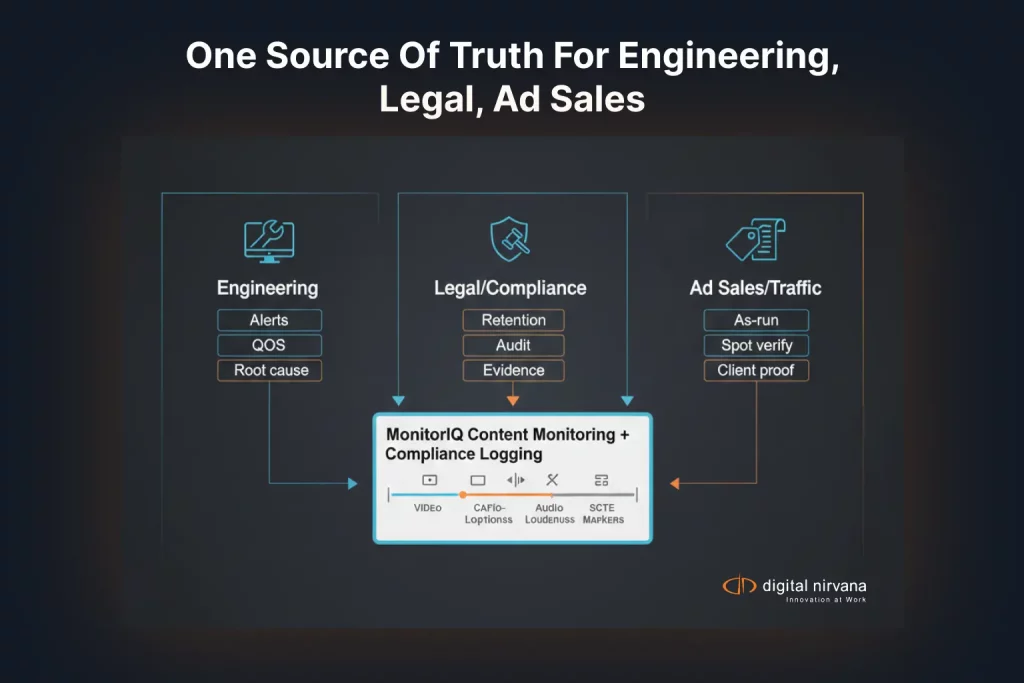
For a long time, compliance logging was bought for legal reasons and lived in a back room. Today, the same systems are expected to support:
- Engineering and playout QA
- Legal and standards teams
- Ad sales and traffic
- Marketing, news, and digital teams
Leading compliance platforms now promote themselves as unified monitoring and analysis layers for broadcast operations, not just recorders.
Digital Nirvana’s own content monitoring blogs clearly describe the shift: a single digital broadcast monitoring system used to track signal integrity, verify ads, catch caption issues, and enable content repurposing, all from one tool.
When you design content monitoring with this broader lens, you stop buying a “compliance box” and start building an operational hub.
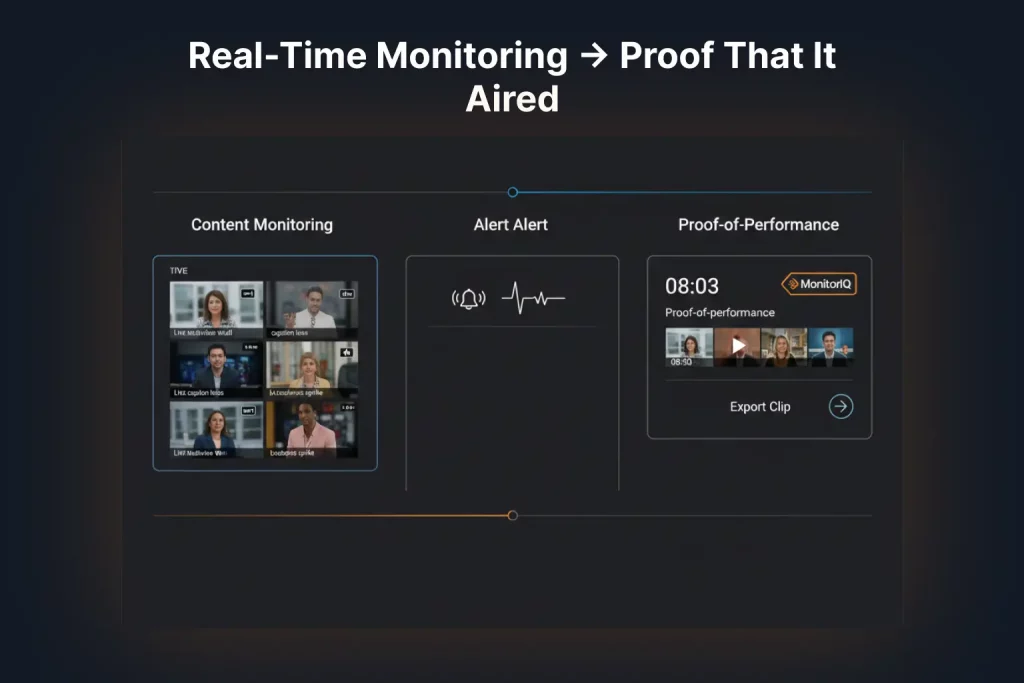
Proving Ads Aired, With Proof-Of-Performance Clips
One of the most visible outcomes of good content monitoring is how easy it becomes to prove ads actually aired.
A strong content monitoring setup should let you:
- Search across logged channels by date, time, and channel
- Use as-run logs or traffic data to jump to the exact break
- Visually confirm the ad in context
- Export a short clip as proof-of-performance for agencies and brands
Ad verification and proof-of-play best practices call for “real technical data capture” and timecoded evidence for campaign compliance, not just verbal assurances.
MonitorIQ, for example, records from any point in the delivery chain, then lets users browse via a thumbnail storyboard, mark in and out points, and export frame-accurate clips in just a few clicks. That is ideal for both ad verification and resolving “did my spot run” disputes quickly.
When ad sales can self-serve those clips, they spend less time arguing about invoices and more time renewing campaigns.
Catching Compliance Issues Before They Become Cases
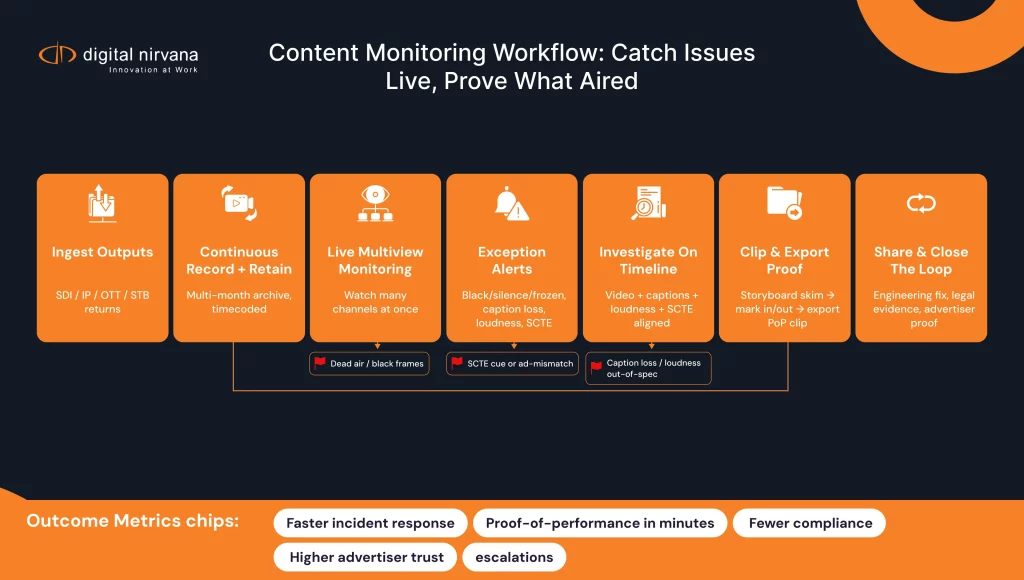
Content monitoring is not only about looking back. It is also about seeing problems as they happen.
Modern compliance monitoring services routinely include:
- Real-time alarms for loss of signal, black screen, or frozen frame
- Caption loss or out-of-spec loudness alerts
- DPI and SCTE cue monitoring for ad insertion problems
- Logging of EAS events and other mandated signals
MonitorIQ’s feature set reflects this evolution, with support for loudness logging, closed captions, SCTE messages, and other metadata, all time-aligned with video on a single page.
The benefit is simple. When there is:
- A missing legal disclaimer,
- A caption outage, or
- A loudness violation,
Engineering sees it on the monitoring UI and can act before the regulator or advertiser does.
Spotting On-Air Errors In Real Time
Beyond regulatory issues, content monitoring serves as an early warning system for the everyday mistakes that erode viewer trust.
Typical on-air errors you want to surface fast include:
- Wrong regional feed or language variant
- Out-of-date promo or pricing information
- Incorrect lower-third or supers in news
- Black, slate, or looping frames in the middle of a break
- OTT variant out of sync with linear
Vendors that focus on QA in compliance monitoring emphasise how accurate logging, live multiview, and exception alerts are the foundation of error-free operations.
With MonitorIQ, multichannel live views and remote access let operations and programming teams scan many channels at once, drill into anomalies, and pull clips for root-cause analysis without tying up edit rooms.
What To Look For In A Content Monitoring Platform
If you are comparing content monitoring and broadcast compliance logging solutions, there are some recurring capabilities that distinguish a “logger” from an “operations platform”.
Look for:
- Multi-source, multi-format ingest
Support for SDI, transport streams, ATSC/DVB, OTT ABR outputs, and set-top box or IP returns, so you see what viewers see, not just what left master control. - Long-term, efficient storage
Flexible retention policies, proxy and high-res storage options, and cloud or hybrid deployment that scales with your channel count. - Integrated metadata and AI
Timecoded captions, loudness, SCTE, and ratings data on a single timeline, plus optional AI for speech-to-text, logo, and ad detection to make logs searchable by keyword or brand. - Clip and share tools for non-engineers
Browser-based clipping, storyboards, and export presets for legal, news, and ad sales teams, without requiring NLE skills. - Role-based access and auditability
Fine-grained permissions so different departments can use the same platform safely, with usage logs for internal governance. - Vendor roadmap and integration strategy
Alignment with your move to IP and cloud, and clear integration options with traffic, playout, captioning, and MAM systems.
This is where tools like MonitorIQ position themselves as “content monitoring, compliance logging, and verification solutions, not just recorders.
How MonitorIQ Elevates Content Monitoring For Broadcasters
Digital Nirvana’s MonitorIQ is built specifically as an ML-powered broadcast content monitoring and compliance logging platform.
Key strengths for solution-aware buyers:
- End-to-end recording
MonitorIQ records from any point in the video delivery chain, from SDI to OTT and STB, so you can compare origination, distribution, and viewer-side outputs in one system. - Single-page, timecoded metadata view
Video, captions, loudness, SCTE, rating data, and watermarks are all timestamped and aligned to the same timeline, making it easier to investigate issues and document compliance. - AI-driven content intelligence
Built-in AI capabilities support ad and logo detection, speech-to-text transcription, and other video intelligence, turning raw recordings into searchable, actionable content. - Rapid clip and share
Storyboard thumbnails let users quickly skim content, set marks, and export frame-accurate clips for legal reviews, advertiser proof-of-performance, or social and promo teams. - Hybrid cloud architecture
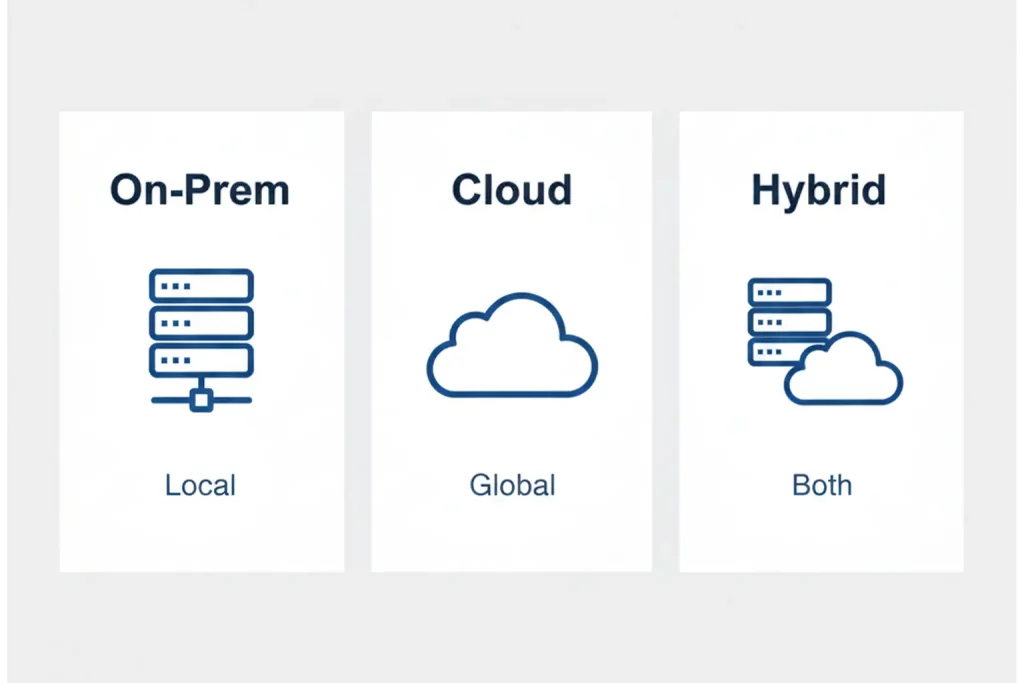
Support for on-prem, cloud, and hybrid deployments, with flexible archiving and storage expansion as channel counts and retention requirements grow.
Combined, this makes MonitorIQ an attractive “Volicon replacement” and forward-looking platform for broadcasters that want both compliance certainty and operational agility.
Example Workflows: Engineering, Legal, And Ad Sales
To see content monitoring in practice, it helps to look at how different teams can use the same system.
Engineering And Operations
- Watch a live multiview of key channels with loudness and caption overlays
- Receive alerts for silence, black frame, missing captions, or SCTE cue failures
- Drill into events with frame-accurate playback and timecoded metadata
- Export clips and logs for root cause analysis and preventive maintenance
Legal, Standards, And Compliance
- Search recorded content by date/time, channel, program, or keyword (using transcripts and captions)
- Export clips and caption transcripts for regulator responses and internal investigations
- Validate political advertising, sponsorship disclosures, and content classification decisions with visual evidence
Ad Sales And Traffic
- Use as-run logs plus MonitorIQ playback to verify that spots aired in the correct breaks
- Export proof-of-performance clips for agencies and advertisers, attached directly to invoices or campaign reports
- Investigate complaints or queries in minutes rather than days
When you put all three workflows on the same platform, “what aired” stops being a source of friction and becomes a shared reference point for the whole business.
Implementation Blueprint For Modern Content Monitoring
If you are moving from legacy compliance loggers to a consolidated content-monitoring approach, a simple blueprint can help keep things on track.
- Clarify requirements across teams
Capture needs from engineering (QoS/QoE), legal (regulatory proof), and commercial (ad verification, sponsorship proof). Use frameworks like IAB ad verification guidelines as an external reference. - Map all relevant outputs
List linear, regional, OTT, and FAST channels that need monitoring. Include return feeds where contractual proof is needed (for example, platforms that re-encode your channels). - Consolidate onto a unified platform
Deploy a solution such as MonitorIQ that can ingest all those feeds, apply consistent logging policies, and provide multi-user access via the browser. - Turn on AI and metadata enrichment where useful
Start with captions and loudness, then add speech-to-text, logo detection, or ad recognition as your teams are ready to use them in workflows. - Standardise proof-of-performance processes
Document how ad sales and traffic will request and produce clips, how long proofs must be retained, and how these are shared with clients. - Build audit playbooks
Create simple guides for regulators, internal auditors, and legal on how they will be supported with evidence from the content monitoring system. Include response time targets and responsibilities. - Measure, improve, expand
Track time to resolve incidents, time to produce proofs, and the number of compliance issues caught pre-air. Expand channel coverage and retention once the value is clear internally.
FAQs
Content monitoring focuses on live oversight and alerting across your channels, helping you catch issues as they happen. Broadcast compliance logging focuses on long-term recording and archiving, so you can prove what aired and when. In practice, modern platforms combine both, recording continuously and providing live monitoring, analysis, and alerting on top.
By recording your output with timecoded audio, video, and metadata, content monitoring systems make it easy to locate a specific break and export a clip that shows the ad in context. This supports proof-of-play and proof-of-performance requirements from advertisers and agencies, and reduces disputes over whether spots ran correctly.
Logs tell you what should have aired. Regulators and advertisers increasingly expect evidence of what aired. Technical ad verification guidelines state that real, technical data capture, not conjecture, is required for campaign compliance. That is why recordings and clips are now standard in audits and reconciliations.
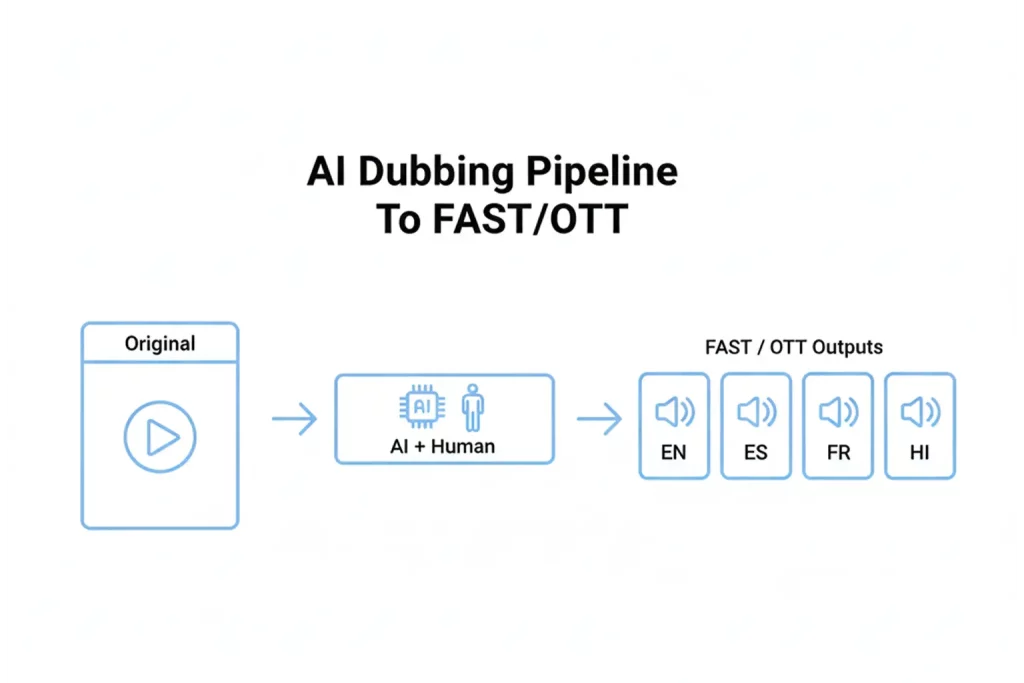
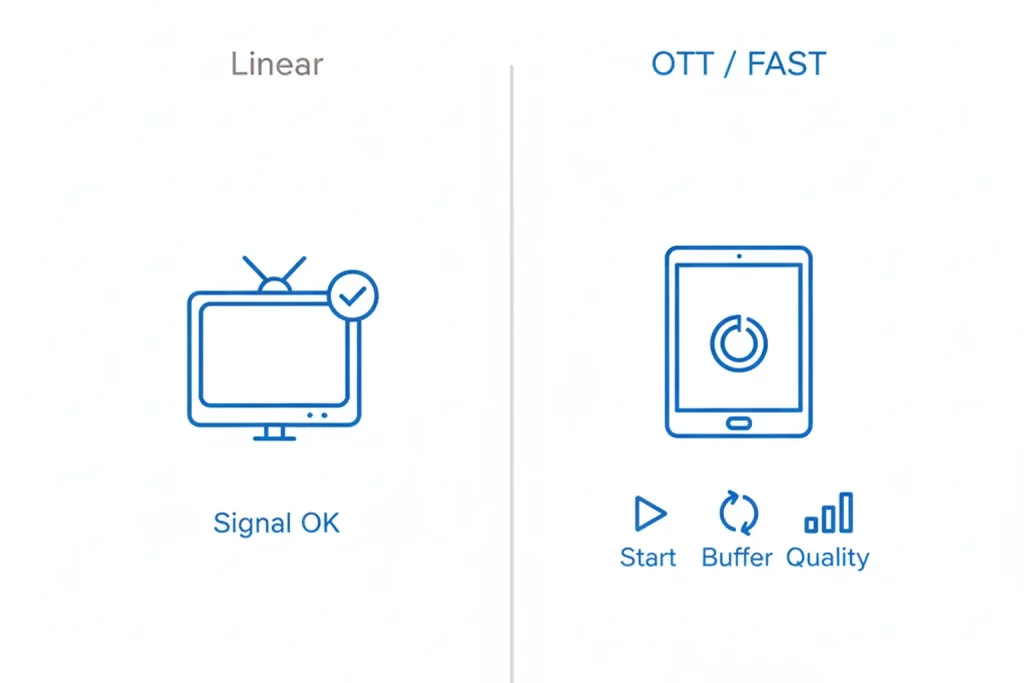
Yes. Modern content monitoring platforms ingest IP streams in HLS, DASH, and other OTT formats, alongside traditional SDI and RF feeds. This lets broadcasters and streamers monitor both linear and OTT QoS/QoE and meet similar compliance expectations across all outputs.
MonitorIQ is positioned as an AI-powered broadcast compliance logging and content monitoring platform that records from any point in the delivery chain and integrates video, captions, loudness, and metadata on a single page. It stands out with its storyboard-based clipping, AI video intelligence, and hybrid cloud architecture, designed as a next-generation replacement for legacy loggers like Volicon.
Conclusion
Content monitoring and broadcast compliance logging used to be about keeping regulators satisfied and archives complete. In 2026, they are about keeping your entire operation honest, agile, and aligned.
When you have a unified view of your output, with timecoded recordings, captions, loudness data, and AI metadata all in one place, three things become easier:
- You can prove ads aired exactly as contracted, which protects revenue and strengthens advertiser trust.
- You can catch compliance issues and quality problems early, which reduces regulatory risk and complaints.
- You can spot and fix on-air errors in real time, which preserves viewer experience across linear and OTT.
Tools like Digital Nirvana’s MonitorIQ show how far the category has come, from simple tape-replacement logging to ML-driven content monitoring that engineering, legal, sales, and marketing can all use.
If you are still relying on fragmented loggers, manual exports, and screenshots when issues arise, now is the right time to rethink content monitoring as a shared, strategic layer that supports compliance, proof of performance, and operational excellence in one move.