An agency emails on a Tuesday. Their client’s 30-second spot was scheduled for the 8pm break on Thursday. The client says they never saw it. Your traffic log says it ran. Your as-run log says it ran.
Now prove it.
If the answer involves someone scrubbing through four hours of recorded output while the agency waits, you do not have ad verification. You have a search party. And the makegood you eventually concede costs more than the spot did.
This is the gap audio and video fingerprinting closes.
Why your as-run log is not proof
Three records describe the same ad break, and teams treat them as interchangeable. They are not.
The traffic log records what was sold and scheduled. The as-run log records what the playout system believes it played. The aired signal is what actually left the facility and reached a viewer.
Most disputes live in the gap between the second and the third. A playout server can report a successful play while the encoder dropped frames, the wrong version rolled, the audio muted, or a regional feed overrode the national break. The as-run log is a statement of intent from the machine that was supposed to do the job. Asking it to certify its own work is not verification.
Fingerprinting supplies the missing record: independent evidence taken from the signal itself. Our guide to broadcast proof of play for ad verification walks through how these logs reconcile in practice.
What audio and video fingerprinting actually is
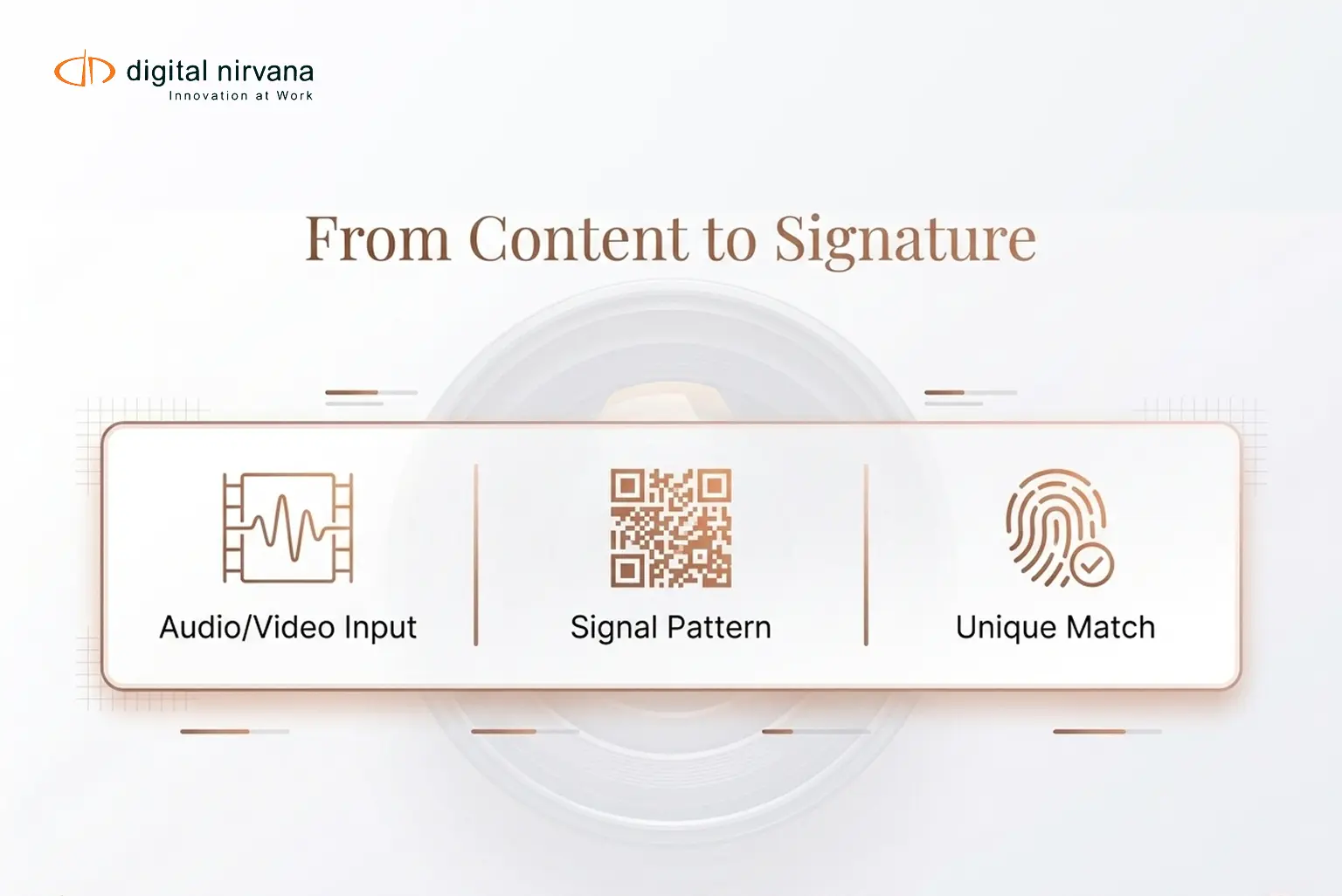
A fingerprint is a compact mathematical signature derived from the content itself. Not metadata attached to it. Not a code hidden inside it. A description of what the media is.
Audio fingerprinting analyses the spectral characteristics of a waveform, typically the pattern of energy peaks across frequency and time, and reduces them to a hash sequence. Video fingerprinting does the equivalent with visual data, generating perceptual hashes from frames and keyframes that describe structure, motion and layout.
Both are built to survive the journey. A spot that has been transcoded, compressed, loudness-normalised, resized, letterboxed or overlaid with a channel bug should still match its reference, because the signature describes perceptual characteristics rather than exact bits.
This is the family of techniques known as automatic content recognition, or ACR. Fingerprinting dominates it for one practical reason: it requires no change to the content and no cooperation from anyone upstream. You can fingerprint a competitor’s campaign. You cannot watermark it.
How the pipeline works
| Stage | What happens | Why it matters |
| Reference ingest | Approved creatives are fingerprinted and stored with asset IDs | Nothing is detectable until a reference exists |
| Signal capture | Channels are recorded continuously from SDI, OTT or set-top return path | The evidence layer, captured at the delivery point |
| Signature extraction | Rolling fingerprints are generated from the live or recorded stream | Runs continuously, not on request |
| Matching | Extracted signatures are compared against the reference database | Confidence scored, not binary |
| Timecode mapping | Every match is bound to a frame-accurate timestamp and channel | Converts a detection into evidence |
| Reporting | Detections reconcile against traffic and as-run data | Exceptions surface before the advertiser calls |
The step teams underestimate is the first one. Detection quality is a function of reference hygiene. Missing creative versions, stale cut-downs and unregistered regional variants show up later as false negatives that look like non-delivery.

Fingerprinting, watermarking and SCTE-35 are not substitutes
These three get conflated in vendor conversations, so it is worth separating them.
| Method | How it identifies | Strength | Limitation |
| Fingerprinting | Derives a signature from existing content | Works on any content, including competitors, with no pipeline changes | Needs a reference in the database first |
| Watermarking | Embeds an identifier before distribution | Carries an ID directly, survives without a reference library | Requires control of the content before it ships |
| SCTE-35 and SCTE-104 | Signals where an ad break should occur | Cues insertion and splicing accurately | Confirms a break was signalled, not what filled it |
The practical answer for most operations is layered rather than exclusive. Use SCTE cues to know where to look, fingerprinting to know what actually played there, and watermarking on content you own end to end.
Audio or video, and why the answer is both
| Signal | Detects well | Struggles with |
| Audio | Cut-downs, re-edits, audio-identical variants, radio simulcast | Muted playout, dubbed or localised audio tracks, heavy noise |
| Video | Silent creatives, dubbed versions, squeeze-backs, visual variants | Static or near-static frames, heavy graphics overlay, letterbox crops |
A muted spot is the classic case. Audio-only detection reports a miss and triggers a false dispute. Video-only detection confirms the visual aired but says nothing about whether the viewer heard the call to action. Running both, then scoring the pair, is what separates a detection from a defensible answer.
What breaks matching in the real world
Detection rates rarely fall because the algorithm is weak. They fall for operational reasons.
Regional and localised versions of the same campaign that were never registered separately. Cut-downs created downstream, so a 15-second edit of a 30-second reference goes unrecognised. Loudness normalisation and aggressive compression on OTT renditions. Squeeze-backs and promo overlays during live sport. Dynamic ad insertion, where the break a viewer in one market saw is not the break your national feed carried.
That last one is now the dominant complexity. Verification across linear, OTT and FAST channels needs capture at multiple delivery points, not a single master feed. We cover the monitoring architecture in more detail in our guide to content monitoring for broadcasters.
Beyond proof of play
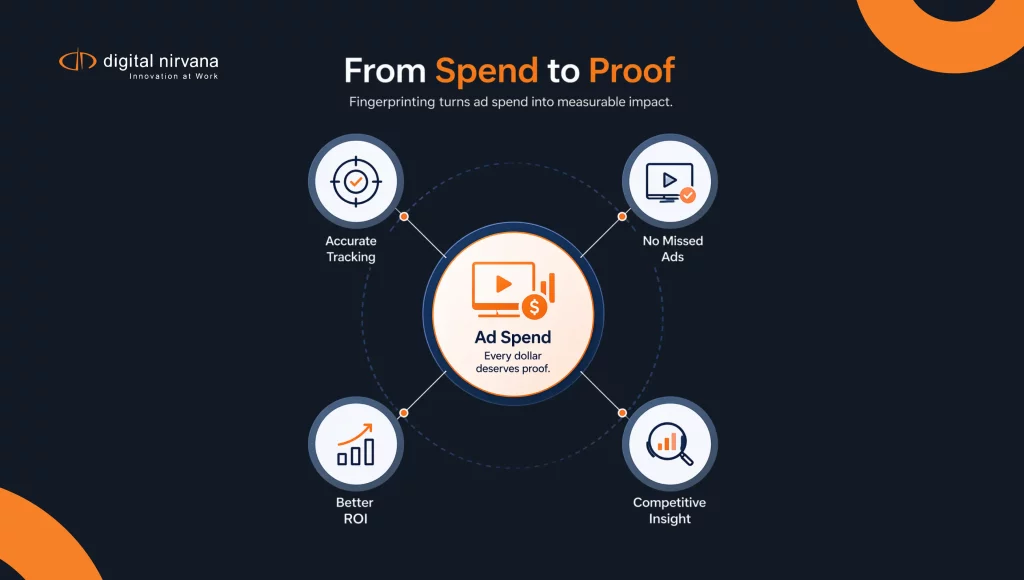
Ad ops teams buy fingerprinting to settle disputes. They keep it for the other four things it does.
- Competitive tracking. Fingerprint any brand’s creative and you get share of voice, spend patterns and flight timing across monitored channels.
- Sponsorship and rights reporting. Detected logo and audio signatures support exposure reporting for sponsors who want evidence, not estimates.
- Brand safety and adjacency. Knowing which spot ran against which segment protects sensitive advertisers before the complaint arrives.
- Revenue recovery. Verified airings turn into faster billing and fewer conceded makegoods, which is where the business case usually lands.
Each of these turns a compliance cost centre into something the sales floor uses. Our piece on media monetization with AI explores that shift across the wider content operation.
The metrics that actually matter
Vendors quote match accuracy. Evaluate on more than that.
| Metric | What to ask | Practical target |
| Detection rate | What share of known airings are found? | Measured against a labelled test week, not a demo reel |
| False positive rate | How often is a similar creative misidentified? | Low enough that exceptions stay reviewable |
| Time to detection | How quickly after air does a match appear? | Near real time for live, same day for reconciliation |
| Time to evidence | How long from question to exportable clip? | Minutes, from a browser, without an edit suite |
| Reference coverage | What percentage of the campaign library is registered? | The single biggest lever on the other four |
That fourth row decides how ad verification feels day to day. A frame-accurate clip with matching timecode, captions and loudness context ends a dispute in one email. Anything slower turns into a negotiation.
Implementation checklist
- Register every creative version, including cut-downs, regional edits and localised audio
- Capture at each delivery point that matters: SDI, OTT rendition, set-top return path
- Run audio and video matching together and score the pair, not each in isolation
- Bind every detection to frame-accurate timecode from a common clock reference
- Reconcile detections against traffic and as-run data automatically, and alert on exceptions
- Give sales and legal self-service clip export so engineering is not the bottleneck
- Set retention to match your longest contractual and regulatory obligation
- Re-audit reference coverage each campaign cycle
Common objections, answered
“Our as-run logs have never been challenged.” They have not been challenged yet. The cost of the first serious dispute usually exceeds a year of monitoring.
“We already record everything.” Recording is storage. Verification is recording plus recognition plus reconciliation. Without matching, you own an archive nobody can search under deadline.
“Fingerprinting will miss our edited versions.” It will, if those versions were never registered. That is a reference library problem with a straightforward fix, not a technology limitation.
How Digital Nirvana approaches ad verification
Digital Nirvana has been building this evidence layer for broadcasters since well before ad verification became a boardroom topic.
MonitorIQ records and indexes output from production SDI through OTT and set-top box returns, then aligns detections with timecode, captions, loudness graphs, SCTE messages and run log data in one view. Sales and legal teams spot-check ads, reconcile traffic logs against aired recordings and export frame-accurate clips from a browser, without booking an edit suite. That is what turns a monitoring platform into a proof-of-performance tool, a shift we unpack in our guide to broadcast compliance monitoring and proof of performance.
The recognition capabilities behind it sit in MediaServicesIQ, which exposes speech, OCR, logo, object and scene detection through APIs so ad monitoring can run inside your existing stack. For teams without the headcount to operate this themselves, our managed media monitoring service covers the SLA and retention side. Real deployments are documented in our customer success stories.
Where ad verification connects to the wider operation
Every detection you generate is metadata, and metadata compounds.
The same timecoded index that proves a spot aired also makes the surrounding programming searchable. MetadataIQ writes that layer into PAM and MAM environments, so the archive your compliance team fills becomes the archive your producers and licensing team mine. Detection data also feeds contextual ad placement and category-level competitive analysis, which is where real-time ad compliance workflows start paying back beyond the ad ops desk.
One capture layer. Compliance, revenue protection, and discovery all reading from it.
Frequently asked questions
What is the difference between audio fingerprinting and watermarking? Fingerprinting derives a signature from existing content and matches it against a reference database. Watermarking embeds an identifier into content before distribution. Fingerprinting needs no access to the production pipeline, which is why it dominates automatic content recognition.
Can fingerprinting detect edited or shortened versions of an ad? Partially and reliably, provided the edit shares enough signal with a registered reference. Cut-downs and regional variants are best registered as separate references rather than relying on partial matching.
Does fingerprinting work on OTT and FAST channels? Yes, but it requires capture at those delivery points. Dynamic ad insertion means the break a streaming viewer received may differ from the national linear feed, so a single master capture is not sufficient.
How is this different from simply recording every channel? Recording gives you an archive. Verification adds recognition, timecode binding and automatic reconciliation against traffic and as-run data, so exceptions surface without anyone watching playback.
Ready to see where your proof-of-performance workflow leaks? Book a 20-minute review and we will map your current traffic, as-run and capture records against what a fingerprinting layer would surface.
Conclusion
Ad verification is not a reporting problem. It is an evidence problem.
Traffic logs record intent. As-run logs record belief. Only the aired signal records fact, and audio and video fingerprinting is how you read that signal at scale without a human watching every break. Get the reference library right, capture at every delivery point, run audio and video together, and measure yourself on time to evidence rather than a match percentage on a slide.
Do that and the Tuesday email from the agency stops being a problem. It becomes a two-minute reply with a clip attached.
Key takeaways
- Fingerprinting derives a signature from the content itself, so it works on any creative, including competitors’, with no changes upstream.
- As-run logs report what playout believes happened. Fingerprinting reports what the signal actually carried.
- Fingerprinting, watermarking and SCTE-35 solve different problems. Layer them rather than choosing.
- Run audio and video matching together. A muted spot or a dubbed version will defeat either one alone.
- Detection quality tracks reference library coverage more than algorithm quality. Register every version.
- Measure time to evidence, not just match accuracy. Disputes are won by the team that can export the clip first.