A master control operator gets a call at 11:47 p.m. A regulator wants proof that a specific commercial aired during a specific window on a specific channel, three weeks ago. The tape logs are incomplete. The compliance officer spends the next two days combing through archived recordings, hoping the right clip still exists somewhere in the system.
This is not a rare story. It is the everyday reality for broadcast engineering teams that still rely on manual logging, spot checks, and disconnected systems to prove they followed the rules. AI is changing that reality, and it is changing it fast.
Why Media Compliance Has Gotten Harder, Not Easier
Broadcast and streaming teams are managing more channels, more languages, and more delivery formats than ever before. A single station group might operate a dozen linear feeds alongside an OTT catalog, each with its own captioning obligations, loudness standards, and advertising rules.
Regulatory frameworks like the FCC’s closed captioning requirements, the CALM Act’s sound volume rules, and Ofcom’s code on television access services have not gotten simpler either. They have gotten more specific, with stricter enforcement and higher penalties for repeat violations. Add multilingual audiences and accessibility mandates, and the compliance burden multiplies across every asset a media organization publishes.
Manual processes were never built for this volume. A team logging spots by hand, reviewing loudness levels on a sample basis, or checking captions after the fact is always working from incomplete information. The gap between what actually aired and what a team can prove aired is where compliance risk lives.
Where Traditional Compliance Workflows Break Down
Most legacy compliance systems were designed for a handful of channels and a fixed set of formats. They struggle with three things in particular.
First, they rely on human review for tasks that scale poorly. Spot-checking loudness or scanning for missing captions across dozens of hours of daily content is not something a small team can do consistently.
Second, they treat compliance as a downstream task rather than a built-in one. Logging happens after content airs, which means errors are discovered late, sometimes only after a complaint or an audit request.
Third, they fragment data across systems. Traffic logs live in one tool, caption files in another, and signal quality reports in a third. When a regulator or an ad partner asks for proof, someone has to manually reconcile all three, often under a tight deadline.
How AI-Powered Compliance Monitoring Actually Works
AI does not replace the need for human judgment in compliance. It replaces the need for humans to manually watch, listen to, and log every second of content. That distinction matters, because the strongest compliance programs still combine automated detection with human review for edge cases.
At a technical level, AI compliance monitoring typically involves continuous signal analysis (checking loudness, video quality, and transport stream integrity in real time), automated speech-to-text transcription for closed caption verification, and pattern recognition that flags anomalies like missing captions, dropped audio, or ad insertion errors as they happen rather than after the fact.
Platforms built for this, like MonitorIQ, pull compliance logging, quality-of-experience monitoring, ad verification, and proof-of-performance reporting into a single system. That means a compliance officer is not stitching together three separate tools to answer one regulator’s question.
A Day in the Life of AI-Driven Compliance
Picture a station group with eight linear channels and a growing OTT presence. Every piece of content that airs is monitored continuously. Loudness levels are checked against CALM Act thresholds in real time, not sampled once an hour.
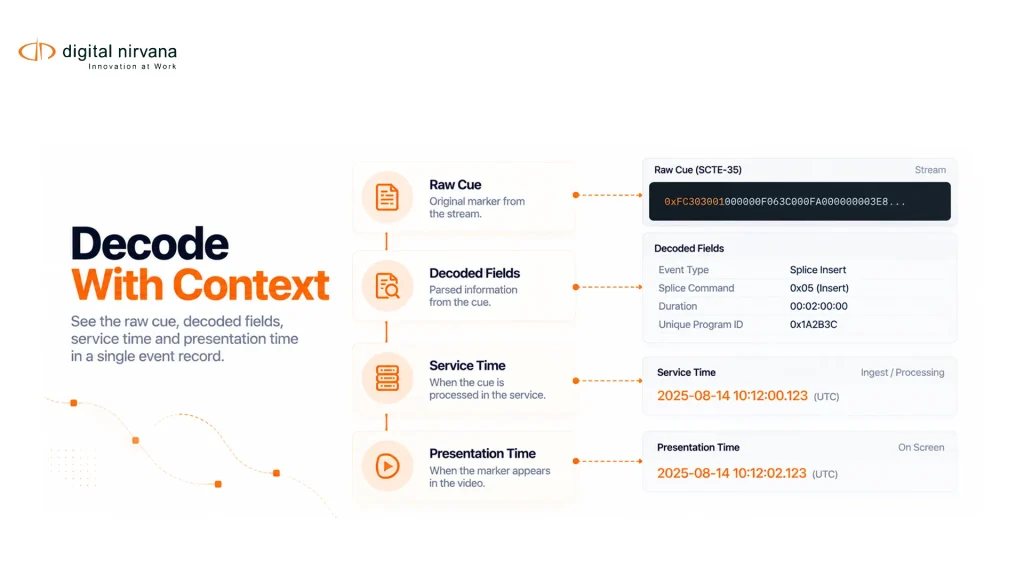
When a caption drops out mid-broadcast, the system flags it immediately instead of waiting for a viewer complaint. When an advertiser asks for proof their spot ran during the agreed window, the compliance team pulls a time-stamped record in minutes instead of days.
At the end of the month, instead of assembling a compliance report by hand, the team exports an audit-ready log that covers every channel, every caption event, and every ad break. That log becomes the organization’s defense if a regulator or partner ever asks hard questions.
The Measurable Impact of Automated Compliance
Teams that move from manual to AI-assisted compliance monitoring typically report faster proof-of-performance turnaround, because pulling historical records becomes a search instead of a manual archive dig.
They also see fewer missed violations, since continuous monitoring catches issues that a periodic spot check would miss entirely. And they see real headcount efficiency: engineers and compliance staff spend less time logging and more time on higher-value work, like reviewing genuinely ambiguous cases.
None of this eliminates human oversight. It redirects it toward the decisions that actually need a person’s judgment.
What to Consider Before You Implement
Moving to AI-powered compliance monitoring is not just a software swap. Teams should map their existing signal chain and identify where a monitoring system needs to sit, whether that is at the transport stream level, the playout server, or both.
Integration with existing MAM, DAM, or PAM systems matters too. A compliance platform that cannot talk to your archive or your traffic system creates a new silo instead of closing an old one. Tools like MetadataIQ are built to plug into these existing workflows rather than force a rip-and-replace.
Finally, plan for a transition period where AI-flagged issues are reviewed by a human before the system is trusted to run with minimal oversight. This builds confidence in the tool and catches any tuning that needs to happen.
Capabilities Worth Prioritizing in a Compliance Platform
When evaluating a compliance monitoring solution, a few capabilities separate the platforms that actually reduce risk from the ones that just add another dashboard.
Look for real-time loudness and QoE monitoring, automated closed caption verification against FCC and Ofcom standards, time-coded proof-of-performance reporting, and remote monitoring across multiple sites or channels from one interface. Also prioritize systems that generate audit-ready exports on demand, since that is usually the moment compliance actually matters most.
| Capability | Why It Matters |
| Real-time loudness monitoring | Catches CALM Act violations before they air repeatedly |
| Automated caption verification | Reduces accessibility compliance risk under FCC and Ofcom rules |
| Time-coded proof-of-performance | Cuts ad reconciliation time from days to minutes |
| Remote multi-site monitoring | Removes the need for on-site staff at every location |
| Audit-ready reporting | Turns a regulator request into a quick export, not a scramble |
Addressing the Common Pushback
Compliance leads often raise the same three concerns when AI monitoring comes up.
“We already have a compliance logger.” Most legacy loggers were not built for OTT delivery, multilingual captioning, or the volume of content today’s teams publish. The question is not whether you have a tool, but whether that tool covers your current footprint.
“AI accuracy is risky for something this regulated.” This is a fair concern, and it is exactly why the strongest platforms pair automated detection with human review rather than removing people from the loop entirely.
“Our budget is tight this year.” The strongest business case here is risk reduction, not just efficiency. A single missed caption violation or an unprovable ad dispute can cost more than a monitoring platform does in a year.
How to Know the Program Is Working
Compliance leaders should track a handful of metrics once a monitoring system is in place: time to retrieve proof-of-performance records, number of caption or loudness violations caught before broadcast versus after, and the percentage of compliance reports generated without manual reconciliation.
If those numbers are trending the right direction quarter over quarter, the investment is paying off in the way that matters most: fewer surprises during an audit.
Where Digital Nirvana Fits Into This Shift
Media compliance is not a problem that generic AI tools solve well, because it requires deep familiarity with broadcast standards, signal chains, and the specific formats regulators actually check. This is the gap Digital Nirvana was built to close.
MonitorIQ brings compliance logging, ad verification, and QoE monitoring into one platform built for broadcast engineering teams, not generic IT operations. TranceIQ pairs AI-driven captioning with human review to keep accessibility compliance accurate across languages and formats. And for teams that want AI output reviewed with the same rigor as a compliance audit, Managed AI applies human-in-the-loop oversight to catch drift or errors before they become a regulatory problem.
Because these products integrate with existing MAM and DAM environments through MetadataIQ, compliance teams are not asked to abandon their current infrastructure. They are asked to make it smarter.
Bringing Compliance and AI Governance Together
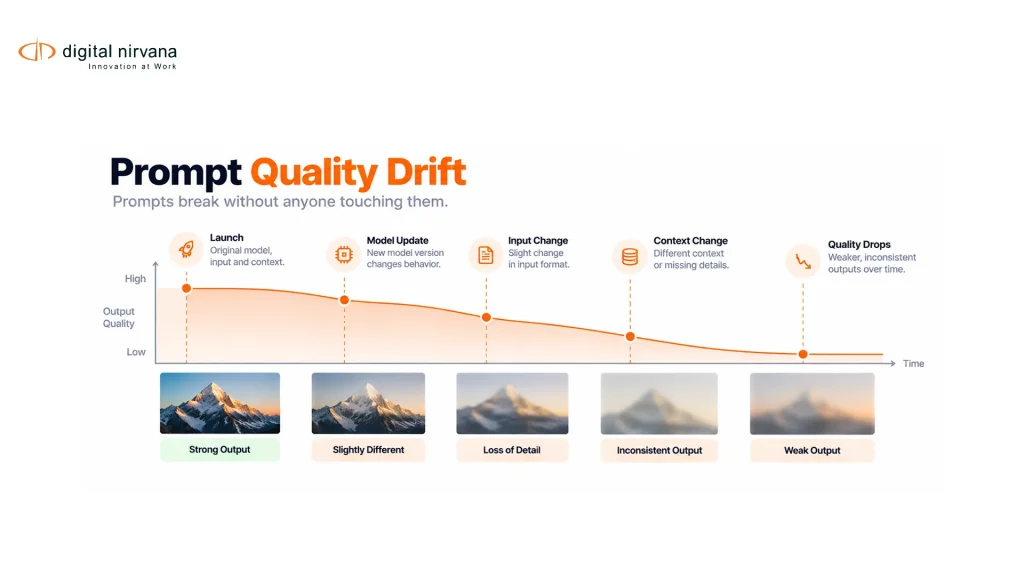
The organizations getting this right are not treating AI compliance monitoring and AI governance as separate initiatives. They are the same discipline applied to different layers of the operation: one keeps broadcasts compliant with regulatory standards, the other keeps the AI systems doing that monitoring honest, auditable, and accountable.
That combination, automated detection backed by human oversight and a full audit trail, is what turns compliance from a reactive scramble into a proactive, defensible process. It also happens to be the same operating model that works for AI reliability more broadly, which is worth remembering as more of the compliance stack becomes AI-driven.
FAQ
Does AI compliance monitoring replace the need for a compliance team? No. It shifts the team’s time away from manual logging and spot-checking toward reviewing flagged anomalies and handling edge cases that genuinely need human judgment.
What regulations should broadcast compliance monitoring cover? At minimum, FCC closed captioning rules, the CALM Act’s loudness requirements, and, for international operators, Ofcom’s code on television access services.
How quickly can a station group implement AI-based compliance monitoring? Timelines vary by channel count and existing infrastructure, but most teams start with a pilot on a subset of channels before expanding, which keeps early-stage risk low while the system is tuned.
Conclusion
Regulatory pressure on broadcasters and streaming platforms is not easing up, and the volume of content teams need to monitor keeps growing. Manual compliance processes were never designed to keep pace with that reality, and stretching them further only increases risk.
AI-powered compliance monitoring does not remove the need for human judgment. It removes the need for humans to do work that machines can do faster and more consistently, freeing compliance teams to focus on the decisions that genuinely require expertise. For media organizations weighing where to start, the highest-leverage move is usually the simplest one: get continuous, real-time visibility into what is actually airing across every channel.
Key Takeaways
- Manual compliance logging cannot keep pace with today’s multi-channel, multi-language broadcast and OTT environments.
- AI-powered monitoring catches loudness, caption, and quality issues in real time instead of after a complaint or audit request.
- The strongest compliance programs combine automated detection with human review, not full automation.
- Proof-of-performance requests that once took days can be resolved in minutes with time-coded, searchable records.
- Integration with existing MAM, DAM, and traffic systems matters more than replacing your entire tech stack.
- Track retrieval time, pre-broadcast violation catches, and manual reconciliation rate to measure whether your compliance program is actually improving.