A compliance officer used to spend hours each week scrubbing through recorded broadcasts, checking loudness levels, confirming closed captions were present, and verifying ad spots aired as contracted. Multiply that across every channel a station group operates, and manual media monitoring becomes a full-time job that still can’t catch everything.
That’s the gap AI in media monitoring is closing. Instead of relying on spot checks and manual review, broadcasters, OTT platforms, and ad operations teams are using AI to monitor content continuously, flag issues in real time, and generate the kind of audit-ready proof that used to take a team days to compile.
Here’s what AI-powered media monitoring actually does, where it delivers the most value, and what to look for if you’re evaluating a system for your own operation.
What Is Media Monitoring, and Why Is It Changing?
Media monitoring is the practice of tracking broadcast and streaming content for compliance, quality, and performance issues, things like signal quality, closed caption presence, loudness levels, ad verification, and content standards. Traditionally, this meant human reviewers watching or spot-checking recorded feeds, a process that’s slow, inconsistent, and impossible to scale across dozens of channels running 24/7.
AI changes the equation by monitoring continuously instead of periodically. Rather than sampling a few minutes of a broadcast hour, AI-powered systems can analyze every second of every channel, flagging anomalies the moment they happen instead of days later during a scheduled review.
How AI Actually Monitors Media Content
Signal and Quality of Experience (QoE) Monitoring
AI systems continuously analyze video and audio signals for quality issues: black frames, frozen video, audio dropouts, and signal loss. Instead of a technician noticing a problem after a viewer complaint, automated monitoring flags it in real time, often before most viewers even notice.
Loudness and Compliance Monitoring
Regulations like the CALM Act in the US require consistent loudness levels between programming and commercials. AI-powered loudness monitoring tracks levels continuously across every channel, flagging violations automatically instead of relying on periodic manual spot checks.
Closed Caption Verification
AI can confirm captions are present, properly timed, and matching the spoken audio, catching caption dropouts or sync issues that would otherwise require someone watching with captions on to notice.
Ad Verification and Proof-of-Performance
AI-powered systems can detect when a specific ad spot aired, cross-reference it against the traffic log, and generate proof-of-performance reports automatically. This replaces a historically manual reconciliation process that ad ops and traffic teams handled by hand, often after a dispute had already started.
Content and Brand Safety Monitoring
For ad operations and content teams, AI can scan for specific content types, brand mentions, or sensitive material, flagging anything that needs review before it becomes a compliance or brand safety issue.
Manual Monitoring vs AI-Powered Monitoring
| Factor | Manual Monitoring | AI-Powered Monitoring |
|---|---|---|
| Coverage | Sampled, periodic checks | Continuous, every second |
| Speed of detection | Hours to days | Real time |
| Scalability across channels | Limited by staff hours | Scales across unlimited channels |
| Proof-of-performance reporting | Manual compilation | Automated, audit-ready |
| Consistency | Varies by reviewer | Consistent detection criteria |
The gap isn’t just speed. It’s coverage. A human team monitoring dozens of channels around the clock simply can’t watch everything, which means issues get caught only when they’re bad enough to trigger a complaint. AI-powered monitoring closes that blind spot by watching continuously instead of sampling.
Where AI Media Monitoring Delivers the Most Value
Broadcast Engineering and Master Control
Station groups running multiple linear channels use AI monitoring to catch signal and quality issues before they become viewer-facing problems, and to maintain the compliance logs regulators expect during an audit.
Ad Sales, Traffic, and Revenue Operations
Ad disputes and makegood negotiations move faster when proof-of-performance data is generated automatically instead of assembled manually after the fact. AI-powered ad verification gives revenue teams a defensible, timestamped record of what actually aired.
Remote and Multi-Site Operations
Station groups operating channels across multiple markets can’t station a compliance reviewer at every site. AI monitoring provides centralized visibility across every channel from a single dashboard, regardless of where the signal originates.
OTT and Streaming Platforms
As streaming catalogs grow, so does the volume of content that needs quality and compliance review before and after publishing. AI monitoring helps OTT platforms catch caption issues, quality problems, and content flags at a scale manual QC teams can’t match.
Common Objections to AI-Powered Monitoring (And Why They Don’t Hold Up)
“We already have a compliance team.” AI monitoring doesn’t replace that team, it removes the impossible task of watching every second of every channel manually, freeing the team to focus on the issues that actually need human judgment.
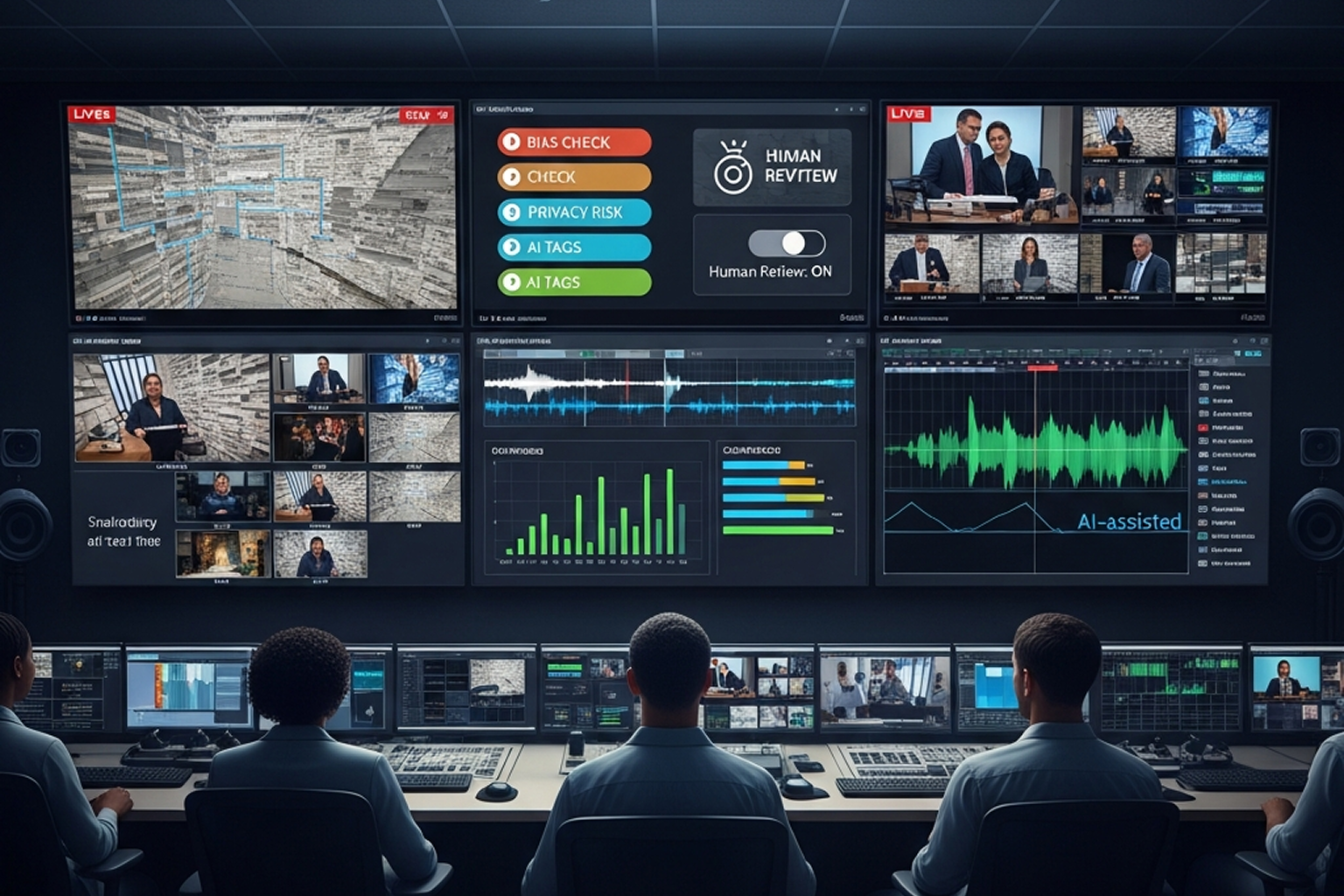
“AI accuracy is risky for compliance reporting.” The strongest AI monitoring systems pair automated detection with human review workflows for edge cases, combining the speed of automation with the judgment of experienced reviewers rather than relying on either alone.
“We don’t want another dashboard to manage.” Modern monitoring platforms are built to integrate into existing broadcast and master control workflows rather than requiring a separate standalone system, reducing rather than adding operational overhead.
A Practical Checklist for Evaluating AI Media Monitoring Systems
- [ ] Monitors continuously across every channel, not on a sampling basis
- [ ] Covers signal quality, loudness, closed captions, and ad verification in one platform
- [ ] Generates automated, audit-ready proof-of-performance reports
- [ ] Supports remote and multi-site monitoring from a centralized dashboard
- [ ] Integrates with existing broadcast infrastructure rather than requiring a full replacement
- [ ] Includes human review workflows for flagged anomalies, not fully automated decision-making
- [ ] Provides historical logging for regulatory audits, not just real-time alerts
How Digital Nirvana Approaches AI in Media Monitoring
Continuous monitoring only creates value if it’s accurate, comprehensive, and doesn’t require a team to babysit another dashboard. That’s the problem MonitorIQ is built to solve, combining signal monitoring, loudness compliance, closed caption verification, and ad verification into a single platform designed for broadcast engineering and master control teams managing multiple channels at once.
For teams that need to go deeper into what’s actually inside the content being monitored, whether that’s identifying specific logos, objects, or spoken content for compliance or ad monitoring purposes, MediaServicesIQ layers AI-driven content intelligence on top of signal-level monitoring. And because monitoring generates data that’s only useful if it’s searchable and reportable later, MetadataIQ helps teams turn monitoring logs and flagged content into indexed, retrievable records rather than isolated alerts.
For organizations running AI systems in production more broadly, whether for monitoring or other operational use cases, Managed AI provides the human-in-the-loop review layer that keeps automated detection accountable, auditable, and accurate over time.
Why This Matters Beyond Compliance
AI-powered media monitoring isn’t just about avoiding regulatory penalties, though that’s often the initial driver. It’s about giving broadcast, ad ops, and streaming teams visibility they’ve never had before: continuous, centralized, and immediate instead of reactive. Teams that adopt this kind of monitoring tend to catch fewer viewer complaints, resolve ad disputes faster, and walk into regulatory audits with documentation already assembled instead of scrambling to reconstruct it. Real examples of this shift in practice, across broadcast and OTT operations, are available on the Digital Nirvana success stories page.
Frequently Asked Questions
Can AI fully replace human compliance reviewers? No. AI handles continuous, high-volume detection, but human review remains essential for judgment calls, edge cases, and final sign-off on compliance-sensitive decisions.
How fast can AI detect a monitoring issue? Well-built AI monitoring systems detect anomalies like signal loss, loudness violations, or caption dropouts in real time, often before a viewer would notice.
Does AI monitoring work across both linear broadcast and streaming platforms? Yes, modern monitoring platforms are typically built to cover both linear and OTT delivery, since compliance and quality expectations increasingly apply to both.
What’s the difference between AI monitoring and AI metadata tagging? Monitoring focuses on real-time quality, compliance, and signal issues. Metadata tagging focuses on making content searchable and retrievable after the fact. The two are complementary, not interchangeable.
Key Takeaways
- AI in media monitoring replaces sampled, manual checks with continuous, real-time coverage across every channel.
- The biggest gains show up in signal quality, loudness compliance, closed caption verification, and ad proof-of-performance reporting.
- AI monitoring doesn’t replace compliance teams, it removes the impossible task of watching everything manually and frees reviewers to focus on judgment calls.
- The strongest systems combine automated detection with human review workflows rather than relying on either approach alone.
- Evaluate any AI monitoring platform on coverage, integration with existing infrastructure, and audit-ready reporting, not just detection speed.