The traffic log says the advertisement ran. The recording shows a shortened spot, and the OTT viewer received a different insertion. Those records answer different questions. Ad verification software should help you establish which creative appeared, where, when, and with what supporting evidence for the delivery path being examined.
For linear TV and OTT, start by defining the claim you need to prove. A channel recording, an as-run log, an insertion event, and a measured player impression are related evidence sources, but they are not interchangeable proof of the same outcome.
Key Takeaways
- Define whether the required evidence concerns scheduled transmission, recorded output, insertion, playback, or advertising measurement.
- Match recordings and logs using creative identity, channel, time interpretation, and relevant delivery conditions.
- Separate linear-channel verification from personalized OTT delivery and player-level measurement.
- Compare monitoring products by the evidence package they produce for your specific dispute or reconciliation task.
- Test missing, truncated, substituted, and out-of-window spots before accepting the workflow.
Table of Contents
- What Should Ad Verification Software Prove?
- Which Software Options Should Broadcast Teams Compare?
- How Does Verification Differ Between Linear TV and OTT?
- What Should a Proof-of-Performance Record Contain?
- How Should Traffic Logs and Recordings Be Reconciled?
- What Do VAST and Open Measurement Establish?
- Which Failure Cases Belong in a Pilot?
- How Should You Choose a Verification Workflow?
- FAQs
- Conclusion
What Should Ad Verification Software Prove?
Ad verification software should provide evidence for a defined delivery claim. Specify the claim before choosing the recording point, detection method, or report format.
A scheduled spot describes intent. An as-run entry records an automation event. A recorded output shows what was captured at a particular point in the chain. An OTT measurement event describes activity observed under a specific implementation. Each can contribute to reconciliation without independently settling every question.
Digital Nirvana’s guide to broadcast proof of play provides background on the evidence workflow. In procurement, turn the request into a testable statement such as “retrieve the observed creative and duration on this channel during this contracted window.”
Have sales operations, engineering, and the responsible contract owner agree what constitutes acceptable evidence. The software can organize records, but commercial acceptance conditions still need to be defined by the organization.
Which Software Options Should Broadcast Teams Compare?
Compare tools according to their documented monitoring and verification role. The following shortlist identifies evaluation routes rather than a universal ranking or a claim that every listed option covers every medium.
| Option | Documented Evaluation Starting Point | Boundary to Confirm |
| Digital Nirvana MonitorIQ | Recorded-output review and traffic-log reconciliation | The configured sources, detection, and evidence export |
| Actus Digital | Media monitoring with as-run log integration | The proposed linear and OTT verification workflow |
| Telestream iQ | Monitoring for dynamic ad-insertion quality | Which insertion and delivery points are observed |
| CloudREC.io | Audio-based spot matching against output recordings | Applicability to the medium and creative evidence required |
LiveU’s Actus Digital description, Telestream’s DAI monitoring page, and CloudREC.io’s verification documentation establish those respective roles.
Digital Nirvana offers MonitorIQ for broadcast monitoring and ad verification. Require each shortlisted supplier to demonstrate the same reconciliation task with the proposed inputs and configuration.
How Does Verification Differ Between Linear TV and OTT?
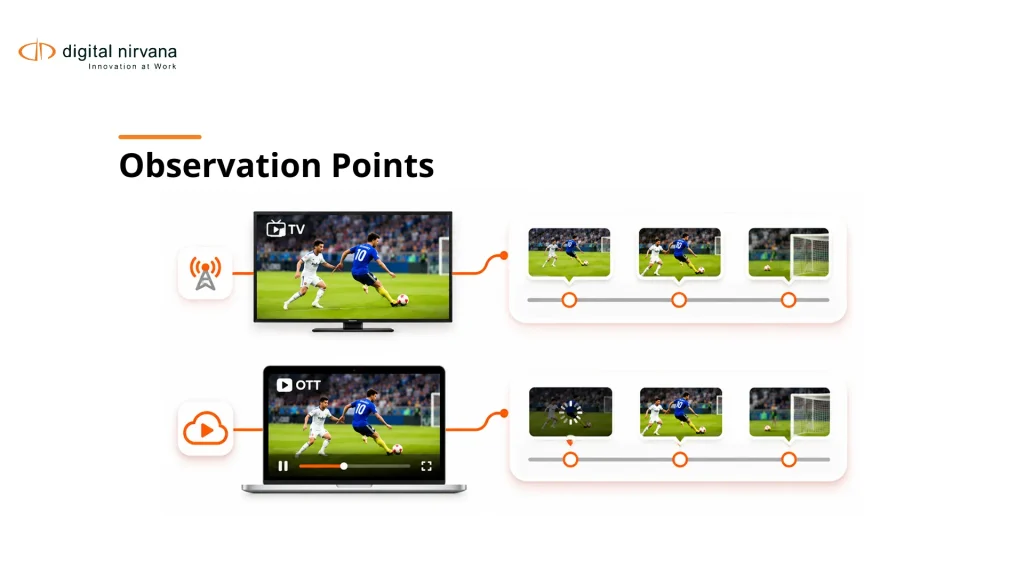
Linear verification commonly examines a particular channel output, while personalized OTT verification may require visibility into different insertion and playback paths. The observation point determines what a record can legitimately support.
A clean recording before downstream substitution does not prove which creative a personalized viewer session received. Similarly, a captured OTT rendition represents that observed path; it does not automatically represent every device, region, or session.
Map the delivery chain with engineering. Identify contribution, playout, distribution, insertion, CDN, and player observation points relevant to the campaign. Record which source supplies each report field and where coverage stops.
For an illustrative dispute, the broadcast feed may show the contracted spot while an OTT path contains a replacement. The correct response is to inspect the relevant path and insertion evidence. Combining all outputs into a single “aired” status can conceal the difference the advertiser actually needs explained.
What Should a Proof-of-Performance Record Contain?
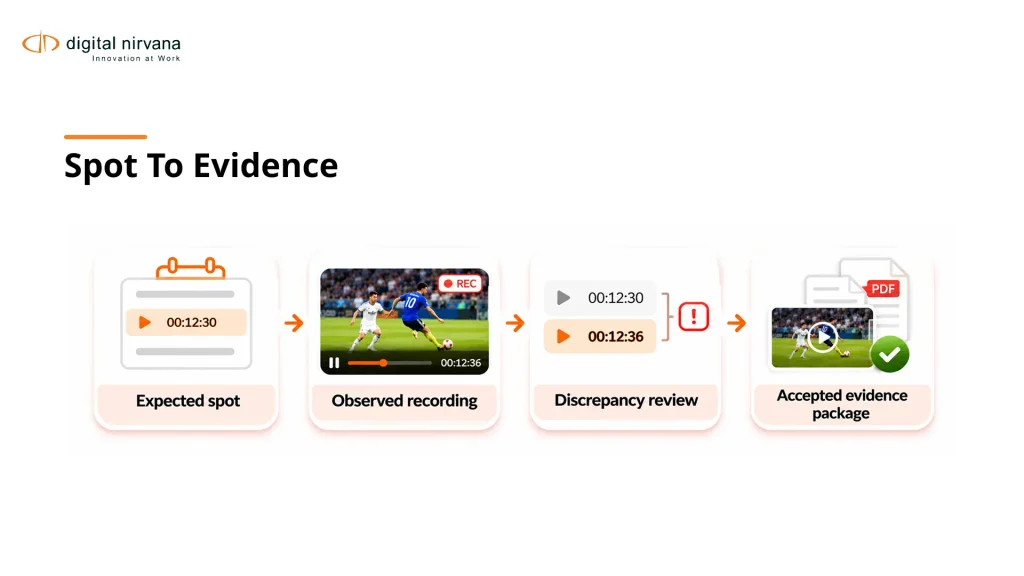
A useful record identifies the creative, observed source, relevant time range, matching basis, and verification decision. It should allow another authorized person to inspect the evidence and understand its limits.
Use this proposed evidence record:
- Campaign, order, and creative identifiers, including the specific version.
- Expected channel or delivery path and the scheduled window.
- Observed source, recording reference, and clock or time-zone interpretation.
- Detected start, end, and any relevant interruption or substitution.
- Matching method, uncertainty, and reviewer decision.
- Supporting logs and the accepted evidence-package version.
Keep expected and observed values in separate fields. That makes a shortened or displaced spot visible instead of allowing the schedule to overwrite the finding.
Decide how recipients will access the media and supporting records after export. An internal dashboard link that expires before a dispute is reviewed may be insufficient for your evidence process. Define retention and sharing requirements with the responsible team.
How Should Traffic Logs and Recordings Be Reconciled?
Reconciliation should compare scheduled or as-run events with independently observed output under explicit matching rules. Preserve discrepancies for review rather than forcing every event into a successful-match category.
Agree how creative variants, start-time tolerances, repeated airings, duration differences, and missing references will be handled. An audio match may establish a useful correspondence while leaving visual correctness or on-screen presentation untested.
Run the process using a known spot library and a recording with deliberate exceptions. Inspect matches around break boundaries and across clock changes. Verify that the report identifies which schedule entry a repeated creative is associated with.
Keep the original logs available alongside normalized values. If an operator corrects a campaign identifier, retain the correction and its reason. The purpose is a reproducible explanation of the discrepancy, not merely a count of matches that cannot later be traced to the underlying recording.
What Do VAST and Open Measurement Establish?
VAST and Open Measurement support digital video advertising workflows, but their presence alone does not prove complete campaign delivery. Evaluate what the configured player, service, and measurement integration actually observe.
IAB Tech Lab’s VAST specification defines an ad-response format and expected player behavior. Its Open Measurement SDK description concerns third-party viewability and verification measurement. These have a different role from a broadcast compliance recording.
Ask the OTT team which signals are available, who emits them, and what conditions can prevent their collection. A supplier should explain how a recorded stream, insertion log, and measurement record are joined without assuming that every system shares the same identifiers.
Keep reporting labels precise. “Observed in this recording,” “insertion event received,” and “measurement reported” communicate the evidence more accurately than one undifferentiated delivery claim. Have the campaign owner decide which combination satisfies the commercial requirement.
Which Failure Cases Belong in a Pilot?
Include failures that could produce an incorrect success report, beginning with the wrong creative or delivery path. A pilot consisting only of correctly scheduled full-length spots leaves the important reconciliation behavior untested.
Test a truncated spot, a repeated creative, an unexpected substitute, an ad outside its window, a missing recording interval, and an unmatched reference. Add the relevant OTT path conditions if the campaign includes personalized insertion.
Ask an ad-operations user to investigate each discrepancy and produce the evidence package. Measure review effort, unresolved cases, false matches, missed events, and time to an accepted explanation. Record where engineering or vendor support must intervene.
Use Digital Nirvana’s published monitoring and advertising-verification deployment example as a specific illustration of monitoring extending into business workflows. It is not evidence that your proposed configuration has passed the same requirements or will produce a particular outcome.
How Should You Choose a Verification Workflow?
Choose the workflow that can support your required delivery claim with usable evidence and manageable investigation effort. Agree the claim and acceptance owner before comparing dashboards or subscription prices.
Ask suppliers to price the same source coverage, recording and retention needs, detection scope, user access, integrations, support, and export requirements. Include internal reconciliation work and any separate player-measurement services needed for OTT.
Keep technical observation separate from commercial disposition. The report can show a discrepancy; the responsible team decides what it means under the applicable agreement and what action follows.
Once the observation map and test cases are ready, discuss an ad-verification workflow with Digital Nirvana. Request a demonstration that starts with a disputed spot and ends with a reviewer-accepted evidence package, including the limits of what was observed.
FAQs
It is software used to compare expected advertising activity with observed media or related records. The exact evidence can include recordings, matches, logs, and reports, depending on the configured workflow.
An as-run log records an automation event and does not independently prove viewer exposure. Match the evidence to the claim and examine the relevant delivery and measurement path.
A linear recording cannot establish every personalized OTT impression. OTT verification needs evidence from the relevant insertion and playback paths, with clearly stated coverage and measurement limits.
Audio matching can support creative identification but may leave visual presentation untested. Define whether your task also needs picture, duration, placement, graphics, or path-specific verification.
The evidence package should contain the identifiers, observed source, relevant ranges, supporting records, and review decision required by the agreed acceptance process. Keep expected delivery separate from the observed finding.
Compare the same known spots, delivery paths, failure cases, and evidence requirements. Measure accepted investigation outcomes and review effort alongside match results, coverage, and operating cost.
Conclusion
Define the delivery claim, map the observation points, and test reconciliation with deliberate discrepancies. Then compare which product produces an inspectable explanation your operations and commercial teams can accept. Reliable verification begins with an honest account of what the evidence can prove.