Fully autonomous AI sounds impressive. But in a real business, especially a regulated one, letting AI run with no oversight is how small errors turn into big problems. The moment an AI system deals with money, health, safety, or legal records, “the model was confident” is not a good enough answer when something goes wrong.
That is why the most reliable AI deployments are not fully automated. They are human-in-the-loop (HITL): the model handles volume, and a trained reviewer handles the decisions that carry real consequences. A well-built HITL review pipeline routes high-risk or low-confidence outputs to expert reviewers through structured workflows, then feeds every decision back into the system so it keeps improving.
The concept is simple. The value shows up in where you apply it. Here are six uses where human-in-the-loop is not a nice-to-have but the thing that makes the deployment viable at all.
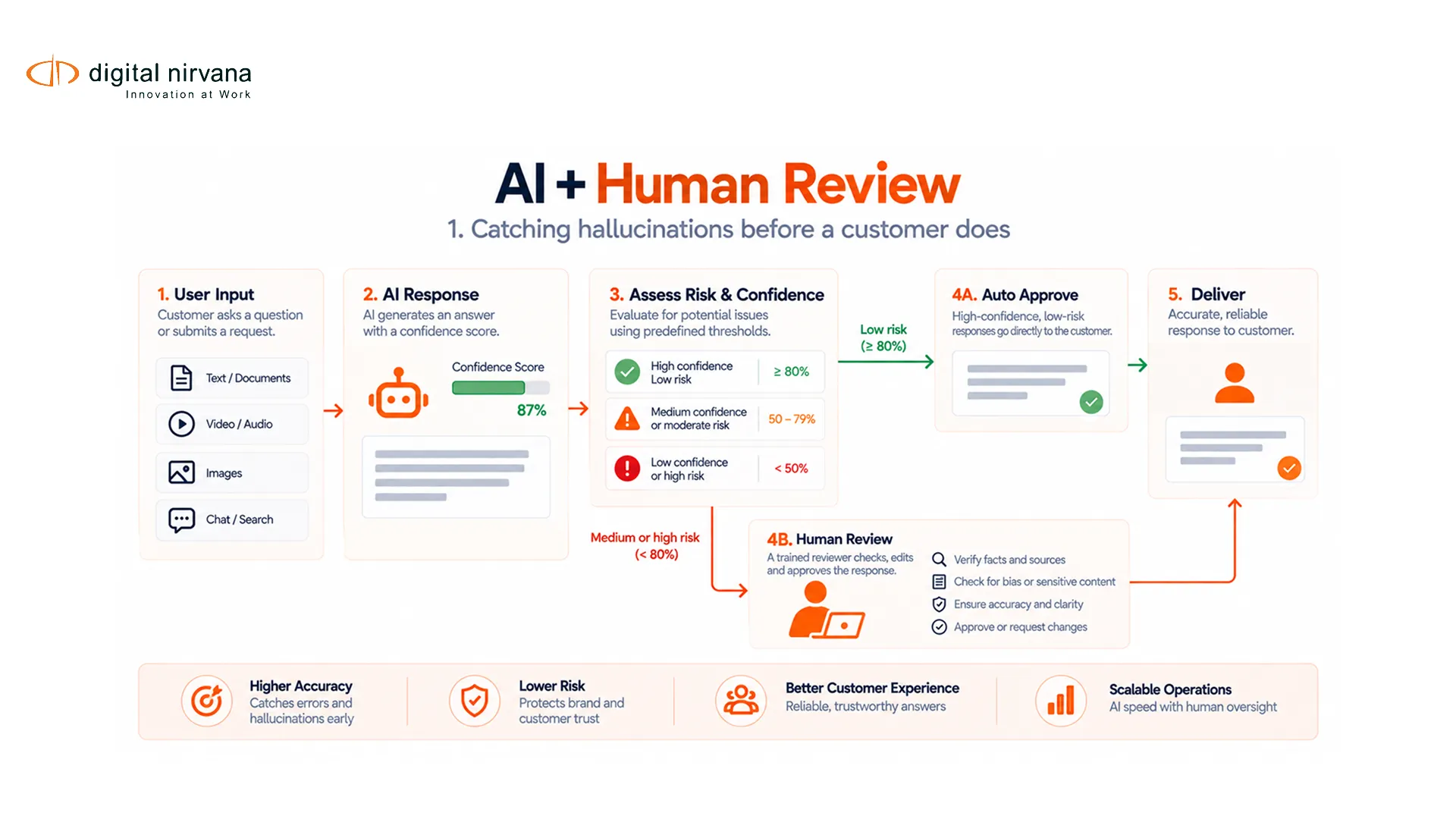
1. Catching hallucinations before a customer does
A generative model answering customer questions, drafting summaries, or producing reports will, sooner or later, state something false with total confidence. In a low-stakes setting that is an annoyance. In banking, insurance, or healthcare, it is a compliance event.
A HITL pipeline flags low-confidence or high-risk responses and routes them to a reviewer before they reach the customer. The volume stays automated; the risky edge cases get a human check. The result is the speed of AI without betting your brand on the model being right every single time.
2. Keeping AI decisions defensible in regulated industries
In finance, healthcare, insurance, and legal work, it is not enough for an AI decision to be correct. You have to be able to show it was correct, to an auditor or a regulator, months later. An unexplained model output is a liability.
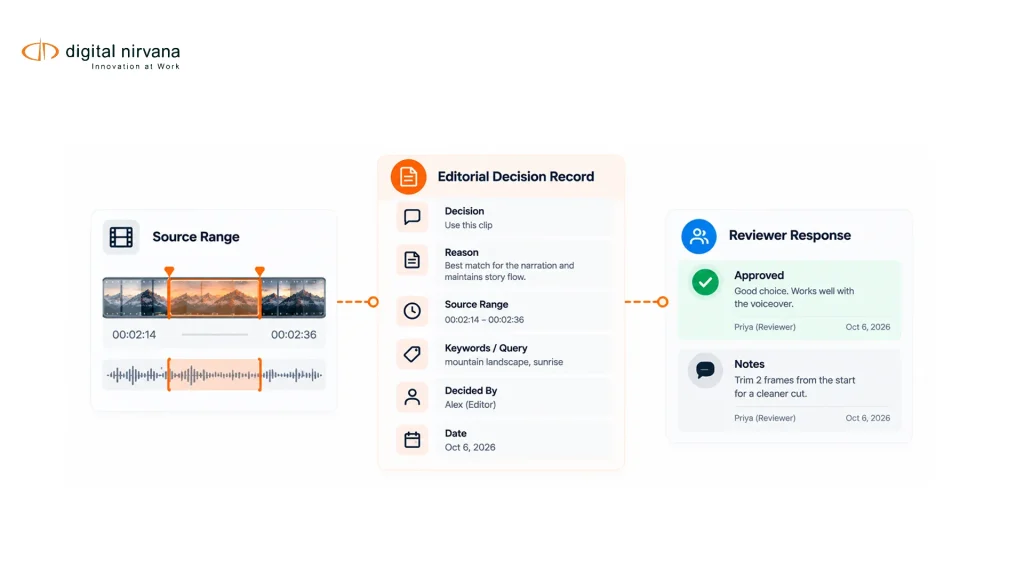
Human-in-the-loop review creates that trail by design. Every routed decision, who reviewed it, what they decided, and why, becomes part of an auditable record. When the regulator asks how a decision was made, you have an answer that holds up, not a shrug about model weights.
3. Content moderation and brand safety at scale
Automated moderation catches the obvious cases and misses the subtle ones: sarcasm, context, cultural nuance, the genuinely borderline post. Set the filter too loose and harmful content slips through; too tight and you censor legitimate users. Neither failure is acceptable when your brand is on the line.
A HITL pipeline sends the ambiguous middle to human reviewers while the model clears the clear-cut volume. Moderators handle the judgment calls machines cannot, and their decisions sharpen the model over time so the gray zone keeps shrinking.
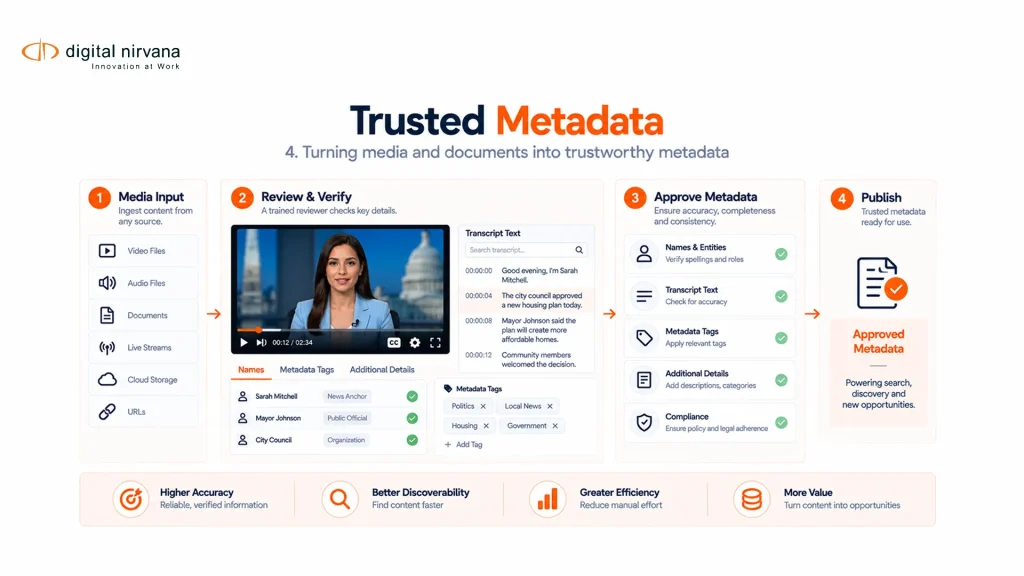
4. Turning media and documents into trustworthy metadata
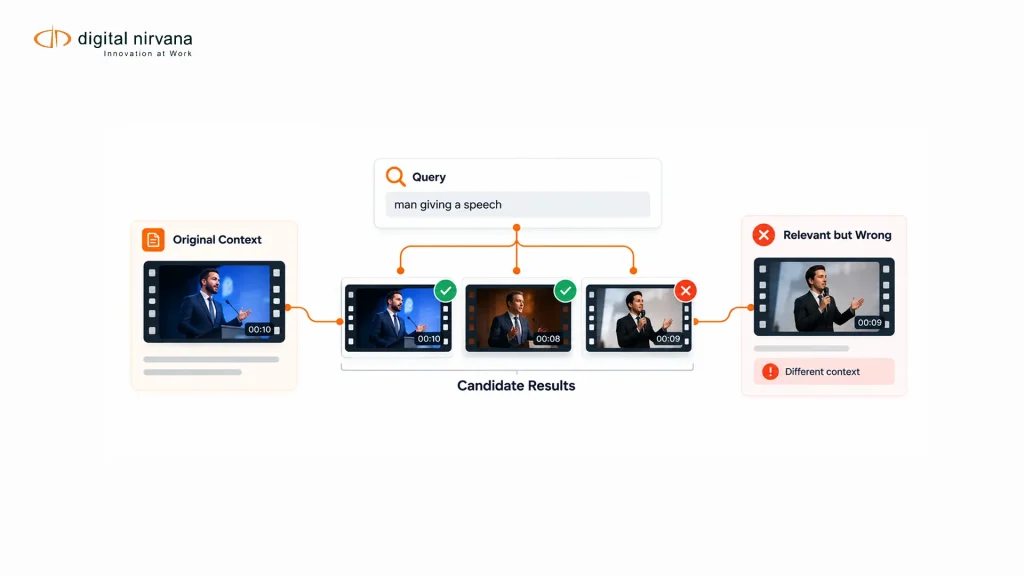
Organizations sitting on huge archives of video, audio, and documents increasingly use AI to transcribe, tag, and index them. But a transcript that mishears a name or a tag that misclassifies a clip quietly corrupts everything built on top of it: search, compliance, monetization.
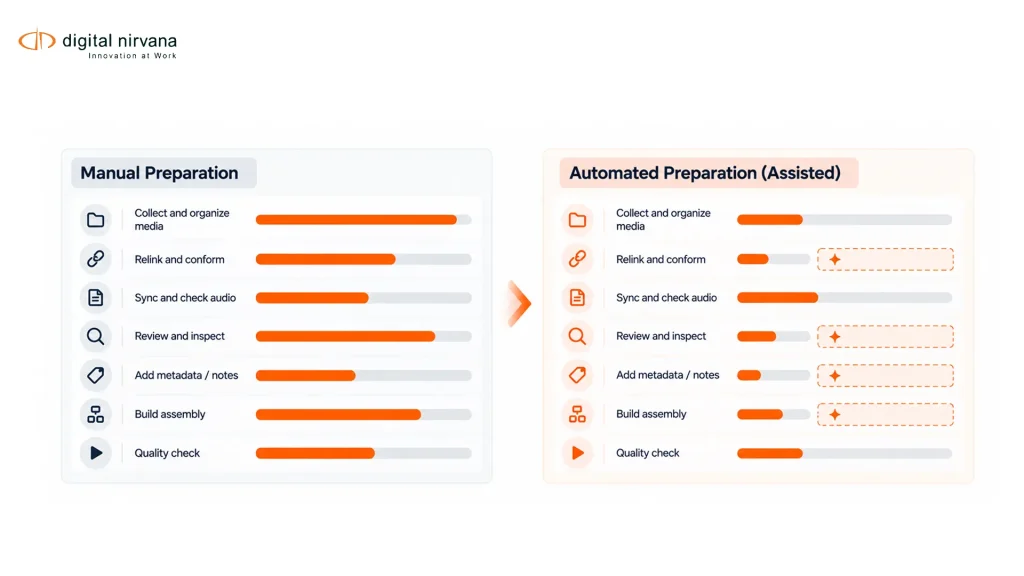
Human review at the points that matter, proper nouns, regulated terms, high-value assets, keeps the metadata trustworthy. This is exactly the discipline behind media-focused AI tooling like MetadataIQ and MediaServicesIQ, where accuracy at the metadata layer is the whole point.
5. Building the high-quality training data models actually need
Every model is only as good as the data it learned from, and generic, crowd-labeled data produces generic, error-prone models. Domain-specific work, medical coding, financial classification, industry taxonomies, needs annotators who understand the domain.
Human-in-the-loop labeling pipelines apply business-specific taxonomies and expert annotation to build datasets that reflect how your business actually works. The same reviewers who catch production errors also generate the labeled examples that train the next, better model. The loop feeds itself.
6. Detecting model drift before it becomes an outage
Models do not fail loudly. They drift. Accuracy that was excellent at launch degrades quietly as the world, and your data, changes underneath them. By the time the drift is obvious in your metrics, it has been affecting decisions for weeks.
Because reviewers in a HITL pipeline are continuously looking at real outputs, they are an early-warning system. A rising rate of corrections in one category is a signal that the model is slipping there, long before it shows up as a headline number. You fix a drift problem instead of explaining an incident.
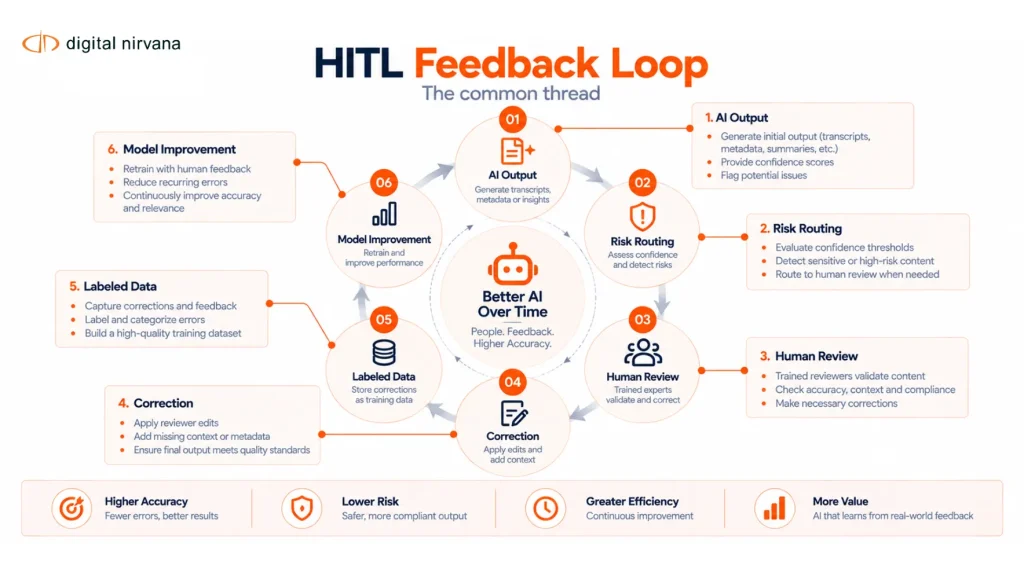
The common thread
Across all six, the pattern is the same: the machine does the volume, the human does the judgment, and every human decision makes the machine better. That is not a fallback for when AI is not good enough yet. It is how you run AI responsibly in production, especially when accuracy, compliance, and trust are non-negotiable.
Building and staffing that review layer in-house, the workflows, the trained reviewers, the audit trails, the feedback loops, is a serious undertaking. It is also precisely what Digital Nirvana’s Managed AI services are built to provide, so your team gets the reliability of human-in-the-loop oversight without standing up the operation from scratch.
Wondering where human review would most protect your AI systems? Explore Digital Nirvana’s Managed AI services to see how a managed HITL pipeline could fit your workflows.
Frequently Asked Questions
Human-in-the-loop AI is an approach in which an AI system handles high-volume processing while trained people review outputs that require judgment, carry higher risk, or fall below a confidence threshold.
Human review helps prevent incorrect or risky outputs from reaching customers or affecting important decisions. It adds judgment, accountability, and context where automated systems may fall short.
Finance, healthcare, insurance, legal services, media, and other regulated or high-stakes industries benefit strongly because accuracy, auditability, safety, and compliance are central to their workflows.
A HITL pipeline routes low-confidence or high-risk responses to a reviewer before delivery. The reviewer can verify, correct, or reject an output instead of allowing a confident but false response to pass unchecked.
Yes. A structured HITL workflow can record which decisions were reviewed, who reviewed them, what was decided, and why, creating an audit trail that supports later examination.
HITL improves content moderation by sending ambiguous cases involving context, sarcasm, cultural nuance, or borderline content to human moderators while automation handles clear-cut cases at scale.
Human reviewers can verify proper nouns, regulated terms, and high-value assets so transcription or tagging errors do not weaken search, compliance, monetization, or other systems that depend on accurate metadata.
Yes. An increase in human corrections within a category can reveal declining model performance before the issue becomes obvious in broader performance metrics.