A station group is evaluating a new compliance monitoring platform, and the conversation always reaches the same fork: on-prem, cloud, or hybrid. Engineering wants the predictability of local infrastructure. IT wants the scalability of the cloud. Compliance just wants proof, fast, no matter where it lives.
This isn’t a question with one universally right answer. It’s an architecture decision that depends on how distributed your operations already are, how many facilities you’re monitoring, and how your teams actually need to access evidence when something goes wrong. Getting it right matters more than most broadcasters realize, because the wrong architecture doesn’t just add friction, it slows down exactly the moments where speed matters most.
Why This Decision Is Harder Than It Used to Be
Broadcast monitoring used to mean watching a single, clean linear output from one facility. That’s no longer the reality for most operations.
Master control today often spans multiple distribution paths simultaneously, from traditional SDI signals to OTT streams to managed IP networks. Channels frequently originate in one location but get monitored and managed from an entirely different one. Playout, branding, and distribution can be split across sites. And linear and streaming outputs typically run in parallel, each with its own compliance obligations and failure modes.
This is what’s driving distributed master control as the new normal, and it’s exactly why the on-prem versus cloud versus hybrid question has become a real architectural decision rather than a simple preference.
What On-Premises Monitoring Actually Offers
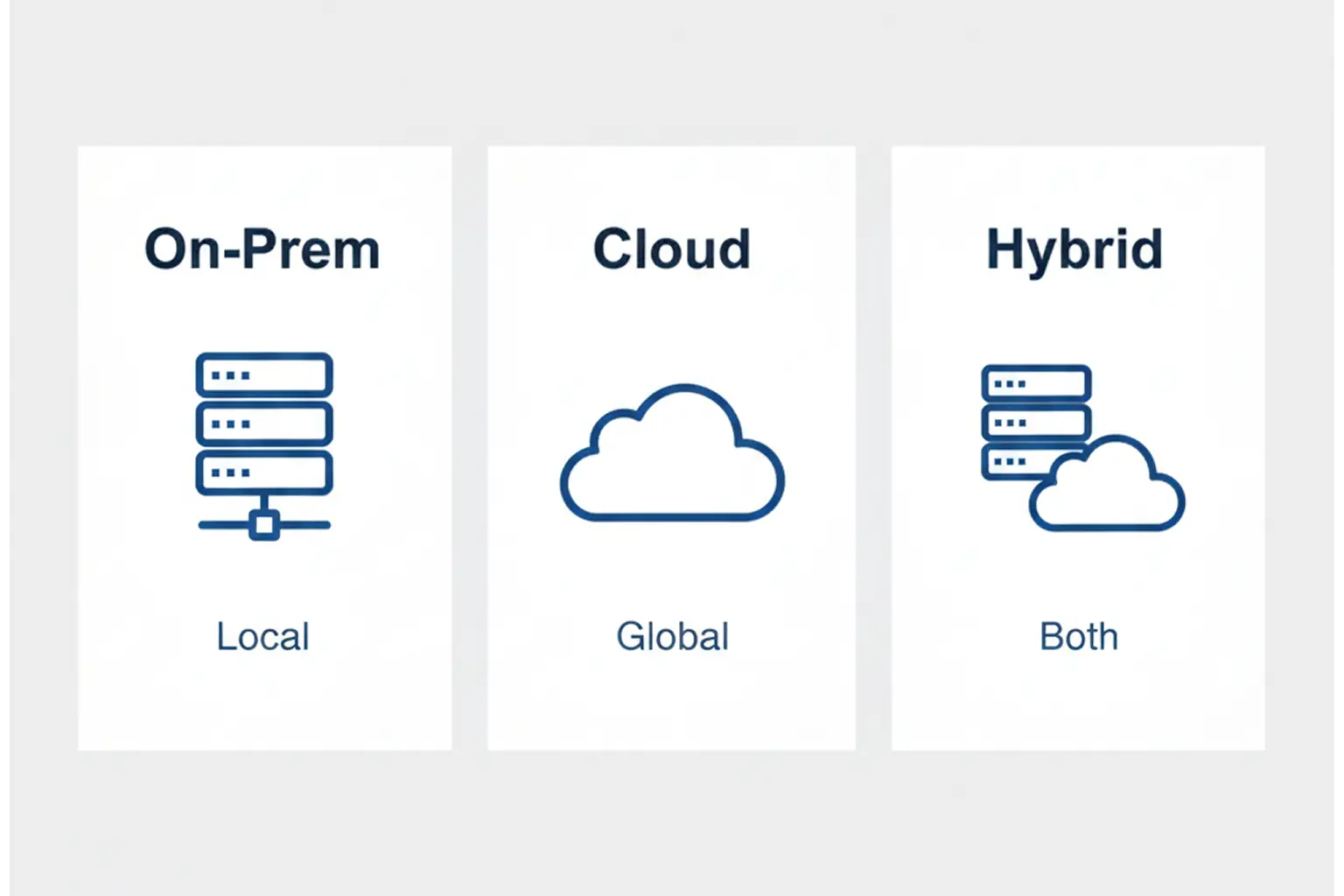
On-premises monitoring keeps recording, alerting, and evidence storage physically close to the broadcast signal itself, typically inside the same facility where content originates.
The core advantage is predictable local performance. There’s no dependency on external network paths between the signal and the recording system, which means latency stays consistent and reliable, even during periods of high network demand elsewhere. For facilities monitoring high-stakes live content, that predictability carries real operational value.
The tradeoff is flexibility. On-prem systems are harder to scale quickly, since adding monitoring capacity typically means physical infrastructure changes rather than a configuration update. They also make centralized access harder when a broadcaster operates multiple facilities, since each site’s evidence often lives in a separate, siloed system.
What Cloud Monitoring Actually Offers
Cloud-based monitoring shifts recording, storage, and alerting into cloud infrastructure, emphasizing global access and elastic scale over local proximity to the signal.
The advantage here is speed of scaling and centralized access. Adding monitoring capacity for a new channel or facility becomes a configuration change rather than a hardware procurement cycle, and teams across multiple locations can access the same evidence through a shared interface rather than juggling separate local systems.
The tradeoff is a heavier dependency on network paths, storage strategy, and governance design. Cloud monitoring performance depends more on the reliability of the connection between the signal source and the cloud environment, which means network architecture decisions carry more weight than they would in a fully local deployment.
Why Most Broadcasters End Up Choosing Hybrid
For broadcasters running distributed master control, hybrid architecture tends to win out, and the reasoning is fairly consistent across the industry.
Hybrid lets a broadcaster capture signal close to its source, preserving the local performance and reliability advantages of on-prem recording, while centralizing access, alerting, and evidence across every monitored location through a shared cloud layer. That combination directly addresses the core challenge of distributed operations: engineers, compliance officers, and ad sales teams across multiple facilities all need access to the same proof, without each site becoming its own isolated silo.
Hybrid also manages complexity better as environments grow more mixed. Few broadcasters run a purely on-prem or purely cloud environment today. Most operate somewhere in between, and hybrid monitoring architecture is built specifically to give visibility across that mixed environment rather than forcing an all-or-nothing choice.
Comparing the Three Approaches Side by Side
| Factor | On-Prem | Cloud | Hybrid |
| Signal proximity | Closest, most predictable | Depends on network path | Close capture, centralized access |
| Scaling speed | Slower, requires hardware changes | Fast, largely configuration-based | Flexible across both layers |
| Multi-facility visibility | Siloed by default | Centralized by design | Centralized, without sacrificing local capture |
| Network dependency | Minimal | Higher | Moderate, by design |
| Best fit | Single-facility, high-stakes live monitoring | Rapidly scaling, cloud-native operations | Distributed master control across multiple sites |
How This Plays Out in a Real Distributed Operation
A station group monitors channels originating from three regional facilities, with compliance and ad sales teams operating out of a central corporate office. Under a hybrid model, each facility captures and records its local signal close to the source, preserving the accuracy and low latency that matters for real-time alerting.
That recorded evidence, along with alerts for loudness, caption, and ad timing violations, flows into a centralized cloud layer accessible to the corporate compliance team and ad sales without anyone needing separate logins or systems per facility. When an advertiser disputes a spot months later, the corporate team pulls proof in minutes, regardless of which regional facility originally aired it.
Handling IP Facilities and Modern Signal Formats
As broadcast infrastructure moves toward IP-based facilities, often using formats like SMPTE ST 2110, the architecture decision gets an additional layer of complexity. IP facilities generate signal in a format that’s inherently more network-friendly than traditional SDI, which can make cloud and hybrid architectures a more natural fit than they would have been in a purely SDI environment.
That said, the fundamentals don’t change. Signal capture close to the source still matters for reliability, and centralized evidence access still matters for distributed teams. The shift toward IP simply makes hybrid architecture easier to implement well, rather than changing which architecture makes sense in the first place.
Measurable Impact of Getting the Architecture Right
Broadcasters that move from siloed, facility-by-facility monitoring to a hybrid architecture typically see change across a few consistent areas.
Dispute resolution time drops, since compliance and ad sales teams can pull evidence from any monitored facility through one shared interface rather than contacting each site individually. Scaling to new facilities or channels becomes faster, since the centralized layer doesn’t require rebuilding infrastructure at each new location from scratch. And visibility improves across the board, since leadership and compliance teams get a consistent view of what’s airing everywhere, not just at the facility they happen to be closest to.
What to Evaluate Before Choosing a Monitoring Architecture
A few practical questions should drive this decision more than a general preference for cloud or on-prem.
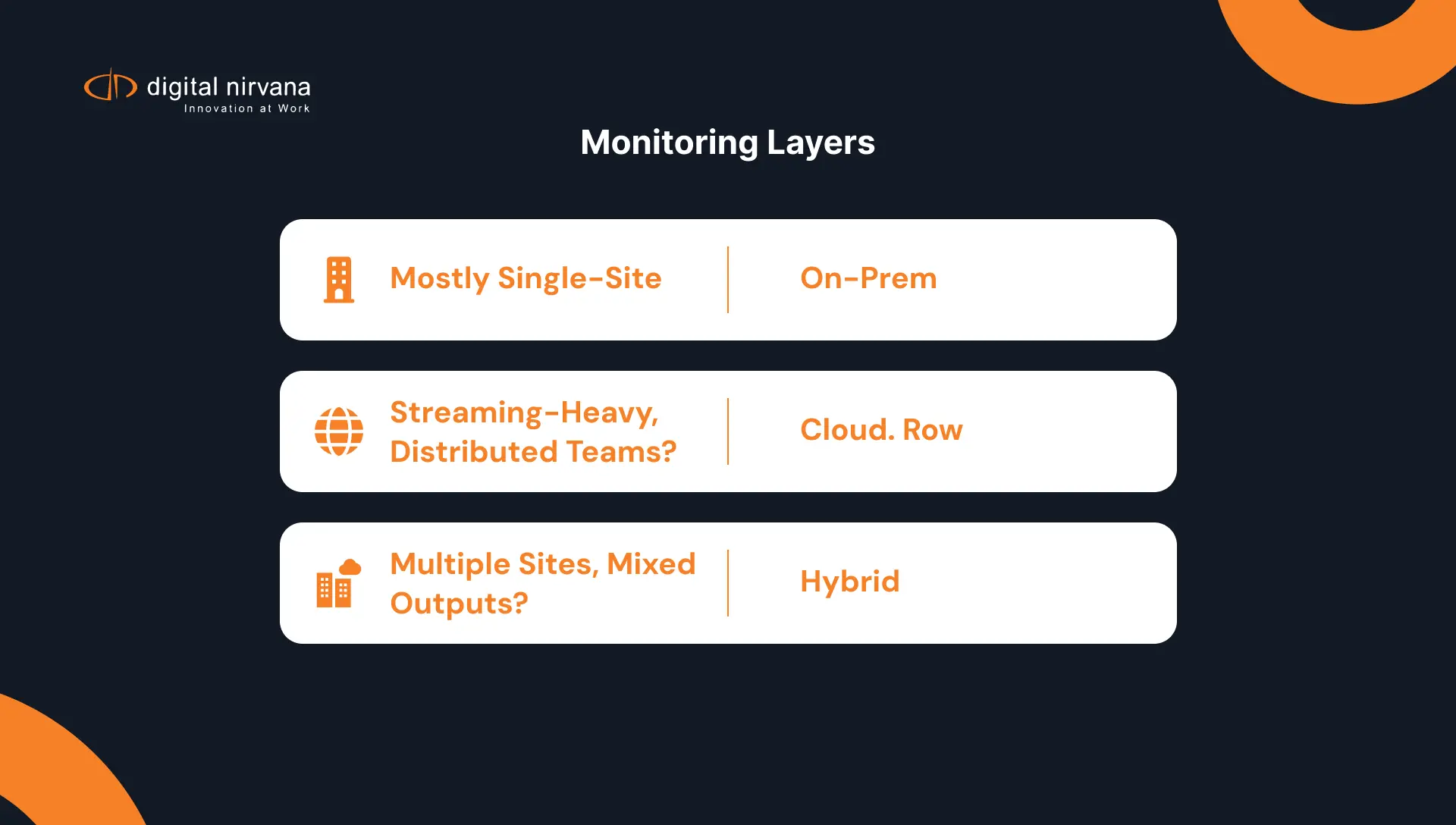
How many facilities does your operation actually span, and do they need to share evidence and alerting today or in the near future? How reliable and fast is the network connectivity between your facilities and any cloud environment you’re considering? Does your compliance and ad sales team need centralized access, or does each facility operate independently enough that siloed systems aren’t actually a problem? And how quickly do you expect to add channels or facilities, since that pace affects how much scaling flexibility actually matters.
Key Capabilities Worth Prioritizing
- Signal capture close to source, regardless of overall architecture, to preserve alerting reliability
- Centralized evidence access across facilities for distributed compliance and ad sales teams
- Flexible storage and archiving that scales as channel count and retention requirements grow
- Support for both traditional SDI and modern IP-based signal formats like ST 2110
- Alerts tied directly to exportable, timestamped recordings, regardless of where the signal originated
Addressing the Common Objections
“On-prem has worked fine for us, why change?” For a single-facility operation, it often still does. The calculus changes specifically when operations span multiple sites and teams need shared, centralized access to evidence.
“Cloud sounds risky for something as time-sensitive as compliance monitoring.” This is exactly why hybrid architecture exists. It preserves the low-latency, close-to-signal capture that time-sensitive monitoring depends on, while still centralizing access through the cloud layer.
“Migrating to hybrid sounds like a major infrastructure project.” It can be, but it doesn’t have to happen all at once. Many broadcasters phase this in facility by facility, keeping existing on-prem recording in place while layering centralized cloud access on top.
How Digital Nirvana Supports Distributed Monitoring Architecture
MonitorIQ is built specifically to run across on-premises, cloud, and hybrid environments, giving broadcasters the flexibility to capture close to signal at each facility while centralizing compliance evidence, alerting, and ad verification through a shared platform.
For broadcasters also managing searchable archives across distributed facilities, MetadataIQ extends that same centralized visibility to content search and retrieval, not just compliance evidence. Teams handling captioning and transcription alongside monitoring across multiple sites often connect this work to TranceIQ.
Why This Matters as Broadcast Operations Keep Distributing
Broadcast operations aren’t becoming less distributed. More channels, more platforms, and more facility consolidation all push in the same direction: broadcasters need monitoring architecture that gives centralized visibility without sacrificing the local reliability that live, time-sensitive content demands.
Hybrid architecture isn’t a compromise between on-prem and cloud. It’s the approach purpose-built for exactly this reality, and broadcasters who choose their monitoring architecture based on how distributed their actual operations are, rather than a general cloud-first or on-prem-first instinct, end up with systems that hold up under real operational pressure. Digital Nirvana’s success stories show how broadcast groups managing multiple facilities have built exactly this kind of distributed monitoring visibility.
Frequently Asked Questions
Is hybrid always the right choice for broadcast monitoring? Not always. A single-facility operation with no need for centralized access across sites may do perfectly well with a purely on-prem or purely cloud approach. Hybrid becomes the stronger fit specifically as operations span multiple facilities.
Does moving to IP-based facilities with ST 2110 require a cloud-first monitoring approach? Not necessarily, but IP-based signal formats do tend to make cloud and hybrid architectures easier to implement, since the signal is already in a more network-friendly format than traditional SDI.
Can hybrid monitoring architecture be rolled out gradually rather than all at once? Yes. Many broadcasters phase in hybrid architecture facility by facility, keeping existing on-prem recording in place while adding centralized cloud access incrementally.
Conclusion
There’s no universal right answer to on-prem versus cloud versus hybrid broadcast monitoring, but there is a right answer for your specific operation, and it depends almost entirely on how distributed your facilities, teams, and evidence needs actually are. For broadcasters running master control across multiple sites, hybrid architecture consistently delivers the combination that matters most: reliable signal capture where content originates, and centralized access where teams actually need to find proof fast.
Key Takeaways
- Master control monitoring now spans multiple facilities, formats, and distribution paths, not a single clean linear feed
- On-prem offers predictable local performance but struggles with multi-facility centralized access
- Cloud offers fast scaling and centralized access but depends more heavily on network reliability
- Hybrid combines close-to-signal capture with centralized evidence access, which is why most distributed broadcasters choose it
- IP-based facilities using formats like ST 2110 make cloud and hybrid architectures easier to implement well
- Architecture choice should follow how distributed your actual operations are, not a general cloud-first or on-prem-first preference