Introduction
Radio is still one of the most resilient mediums in the world: always-on, local, and trusted, especially during emergencies and live events. But the environment in which the radio operates has changed dramatically.
Today, a single station may be responsible for:
- Traditional AM/FM transmission
- HD Radio variants
- Simulcast internet streams
- Smart speaker feeds
- Podcasts and on-demand audio built from live content
At the same time, regulators expect robust compliance logging: complete recordings, documentation of political advertising, verification of Emergency Alert System use, and proof that content standards are being met. In many markets, broadcasters are required to retain logs and recordings for significant periods and produce them quickly when requested.
Radio broadcast monitoring has therefore evolved from simple “aircheck recording” into a strategic system for compliance, quality assurance, ad verification, and content repurposing.
This guide digs into:
- What compliance logging really entails for radio
- How monitoring supports both regulators and revenue
- The role of AI in making monitoring practical at scale
- How Digital Nirvana’s Media Enrichment Solutions help radio teams close the gap between “we might have a recording” and “we can prove exactly what aired, when, and why.”
Why Radio Broadcast Monitoring Matters More Than Ever
Radio monitoring has moved from “nice to have” to a structural necessity across four dimensions.
Regulatory and legal risk
Regulators in many regions (for example, the FCC in the U.S.) require broadcasters to maintain recordings and logs to demonstrate compliance with content rules, EAS participation, children’s content limits, and political advertising obligations. ,
Without reliable recordings and time-aligned logs, it is tough to defend the station against complaints regarding:
- Alleged indecency or profanity
- Incorrect or missing emergency alerts
- Mis-timed or mis-labeled political ads
- Disputes over sponsorship identification and underwriting
Robust monitoring reduces the risk of fines, license delays, and reputational damage.
Audio quality and listener experience
Listeners do not distinguish between “over the air” and “over the top.” They expect:
- Stable audio levels
- No unexplained silence or dropouts
- No repeated ad blocks or stuck playlists
- Consistent branding, and imaging
Monitoring helps engineering teams:
- Detect audio dropouts, silence, and distortion
- Compare off-air reception to studio output.
- Track the performance of multiple transmitters and streams
Modern RF and stream monitoring tools can also track signal strength, bit error rates, and other technical metrics that indicate quality issues.
Commercial accountability
Advertising and sponsorship are the economic backbone of most stations. Advertisers increasingly expect:
- Proof-of-performance reports
- Confirmation of exact air times
- Documentation for make-goods or bonus spots
Monitoring and compliance logging provide the data needed for:
- Ad verification
- Competitive analysis
- Campaign reconciliation
This is especially important for political advertisers and agencies that must meet strict reporting rules.
Multi-platform consistency
Stations now simulcast on:
- Terrestrial signals
- Web players and mobile apps
- Aggregator platforms
- Smart speakers
- Podcasts derived from live shows
Monitoring across all these outputs ensures that:
- Required content (e.g., EAS alerts) appears everywhere
- Rights-sensitive content is blocked or replaced where necessary.
- Bringing and sponsorships are carried consistently.
As broadcasters expand into OTT and streaming, they are increasingly extending their compliance systems to cover these platforms too.
Compliance logging explained: regulations, logs, and retention
“Compliance logging” is a broad term. In practice, it includes three intertwined elements:
- Recording what goes out over the air (and often over IP)
- Retaining those recordings for a defined period
- Maintaining machine- or human-readable logs that link time, content, and context
Typical regulatory expectations
Requirements differ by jurisdiction, but many regulators and industry best practices call for broadcasters to:
- Record 24/7 program output or defined broadcast hours
- Retain recordings for a minimum period (often 30–90 days for routine material, and longer for political or investigative content)
- Document political ads, rates, and air times.
- Track sponsorship identification and underwriting announcements
- Participate in and log Emergency Alert System or equivalent public warning tests.
- Maintain engineering and station logs as part of a public file or license renewal process.
In the United States, for example, 47 CFR §73.1840 addresses retention of required logs, while other parts of the rules and guidance outline how political, children’s, and technical records must be maintained. ,
Even where specific regulations are lighter, industry norms and contractual requirements with advertisers and affiliates still lean heavily on accurate logging.
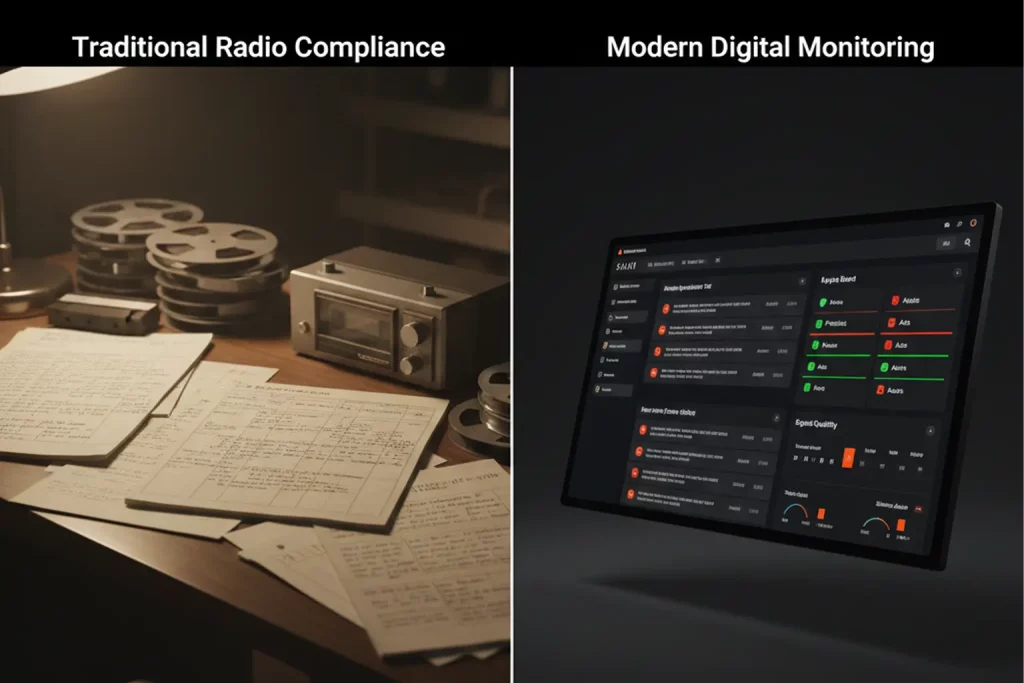
Why manual methods no longer work
Historically, some stations relied on:
- Spot-check recordings on tapes or memory cards
- Handwritten program logs and traffic sheets
- Partial or on-demand recording for “sensitive” programming
With today’s volume of content and scrutiny, those methods introduce serious risk:
- Gaps in recordings
- Illegible or inconsistent logs
- Staff dependency (knowledge locked in one engineer’s head)
- Slow response times when regulators or advertisers request evidence
Modern compliance logging systems automate capture, indexing, and storage, ensuring complete, defensible audit trails.
Operational realities: what radio teams struggle with day to day
Even when stations understand their obligations, daily reality gets in the way. Common pain points include:
- Fragmented tools for on-air, streaming, and podcast monitoring
- Unclear ownership of compliance (engineering vs. programming vs. legal)
- Limited staff time to manually review logs and recordings
- Slow retrieval when a complaint arrives (“find this 30-second segment from three weeks ago”)
- Lack of transcripts, which forces staff to listen in real time just to understand what was said
- No centralized view for regional groups managing multiple stations
These issues lead to:
- Higher risk of missed violations
- Difficulty proving compliance even when the station did the right thing
- Lost opportunities to reuse or repurpose high-value content
AI-enabled monitoring and enrichment are designed to relieve this pressure.
Core capabilities of a modern radio monitoring system
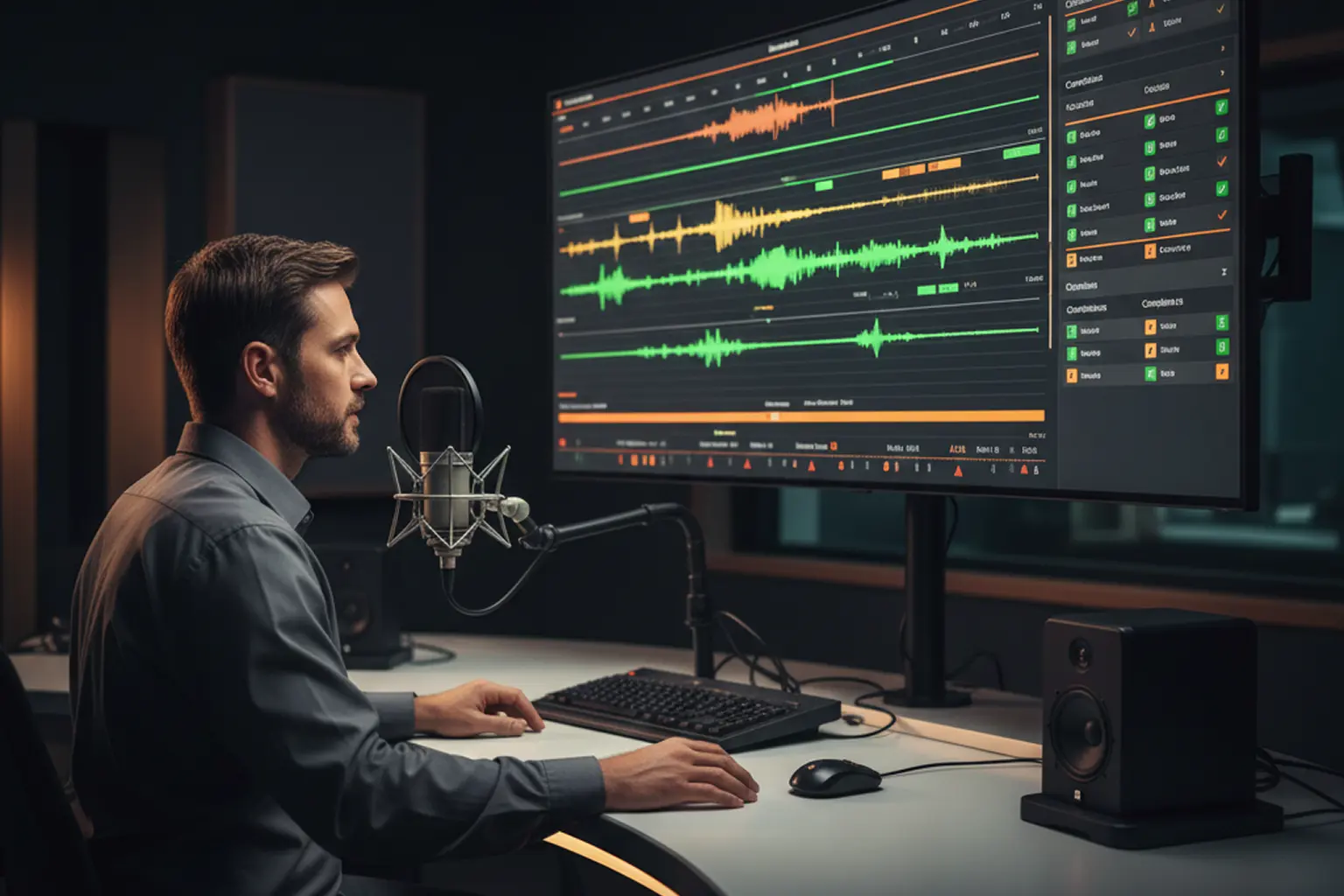
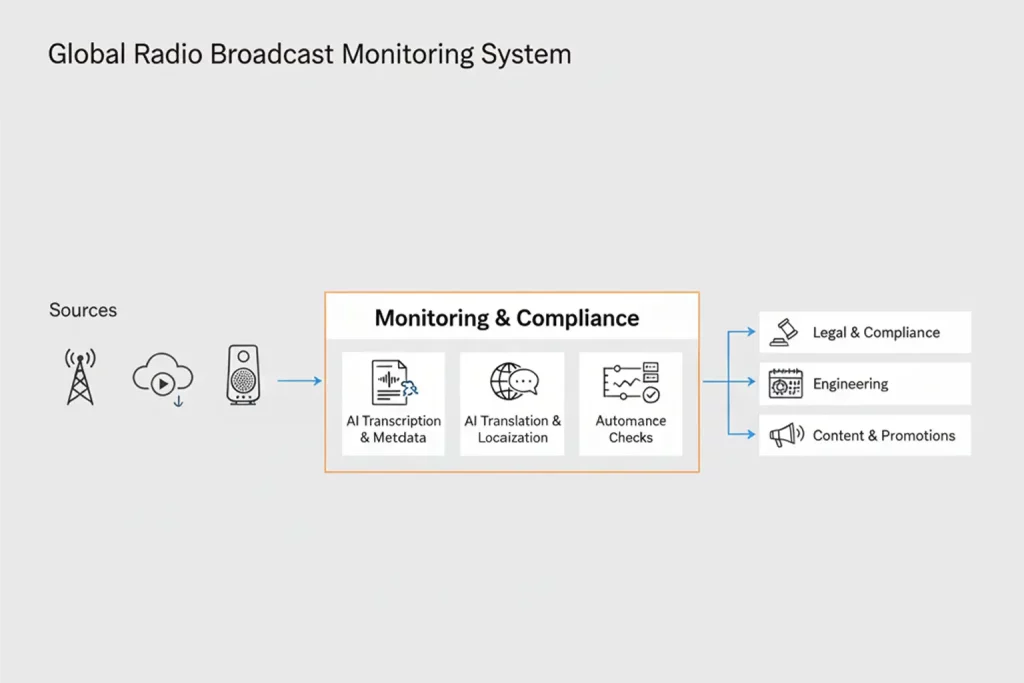
A serious radio broadcast monitoring and compliance solution needs to go beyond simply “record and store.”
Key capabilities typically include:
- Robust capture
- Continuous recording of all relevant outputs (AM/FM, HD Radio, streams)
- Failover mechanisms and health monitoring to avoid gaps
- Precise time alignment
- Accurate timecode stamps across channels
- Consistent synchronization with traffic, automation, and EAS systems
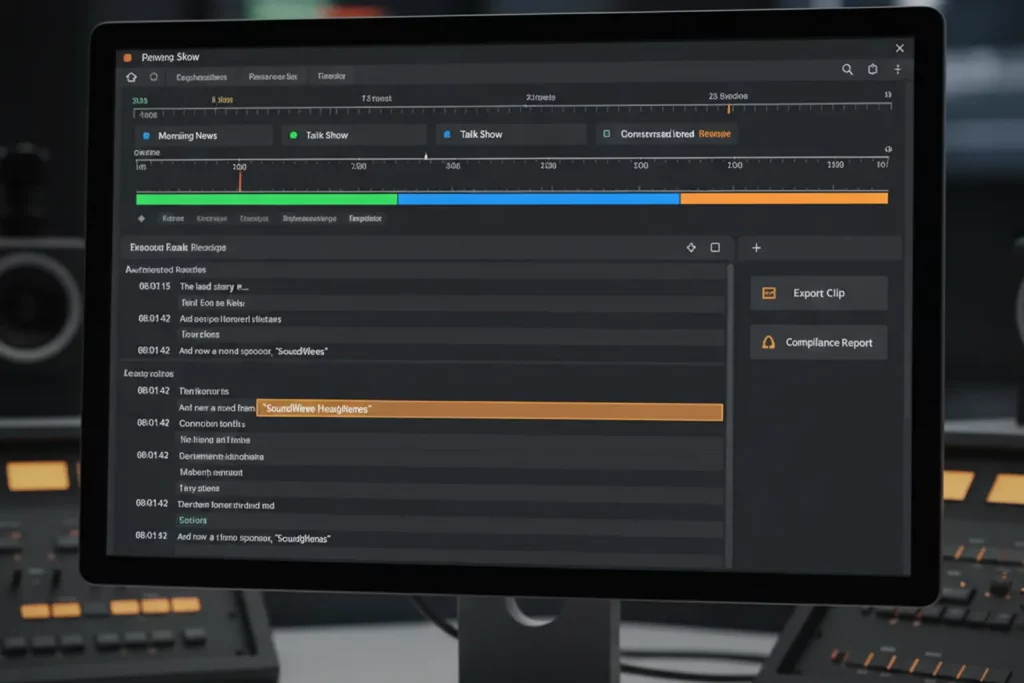
- Search and navigation
- Fast scrubbing and bookmark navigation
- Search by date, time, and channel at a minimum
- Content awareness
- Ability to see program blocks, ad breaks, IDs, and events in context
- Optional AI-generated transcripts and tags
- Export and sharing
- Easy clip extraction in regulator-, and advertiser-friendly formats
- Secure sharing links with internal or external stakeholders.
- Resilient storage
- Policy-based retention periods
- Secure, tamper-resistant archives (local, cloud, or hybrid)
The more “content-aware” the system is, the easier it becomes to use the same platform for compliance, quality control, and editorial support.
From Raw Audio to Insight: Compliance Logging Lifecycle
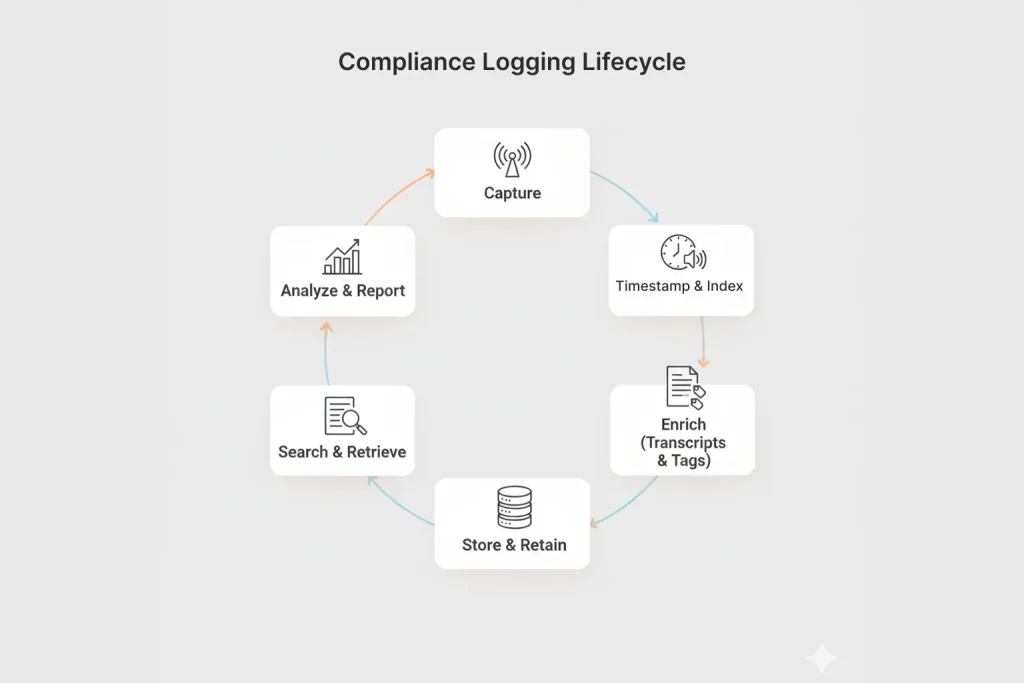
Think of compliance logging as a lifecycle that starts the moment a signal leaves the studio.
Capture
- Off-air antennas, IP taps, or stream inputs feed audio into a logger.
- Multiple logs may be captured: main program, HD subchannels, web-only channels, and maybe even competitor stations for benchmarking.
Index
- The system timestamps all audio.
- It may also ingest automation logs or traffic data to align segments with schedules.
- AI or rules may generate markers for top-of-hour IDs, ad breaks, or recurring shows.
Enrich
- Optional speech-to-text generates transcripts from audio, turning audio into searchable text.
- Keyword spotting identifies mentions of brands, politicians, topics, or regulatory categories.
- Additional metadata (language, genre, show ID) is attached.
Store
- Recordings and associated metadata are moved to short- and long-term storage tiers in accordance with retention policies.
- Politically sensitive or high-risk content may be flagged for extended retention.
Retrieve
- Staff can search by time, keyword, show, or event.
- Compliance or legal teams extract high-resolution clips for regulators or legal counsel.
- Sales can generate proof-of-performance clips for advertisers.
Analyze, and act
- Engineering reviews silence and error reports to improve reliability.
- Content teams review “best-of” segments for repurposing into promos, podcasts, or social content.
- Management uses dashboards to track issues, trends, and resolution times.
When this lifecycle runs smoothly, radio broadcast monitoring becomes an asset rather than a chore.
How AI and automation transform radio broadcast monitoring
Automation is not just about capturing more; it is about understanding more with less manual effort.
AI transcription and indexing
Automatic speech recognition can generate transcripts that:
- Make it possible to search “what was said” instead of guessing at times.
- Allow legal and compliance teams to scan for risk without listening to hours of audio.
- Support accessibility initiatives and content repurposing.
This is particularly useful for talk radio, news, sports, and public affairs programming.
Keyword and rules-based detection
AI models and rules engines can:
- Identify political ads by keyword, candidate names, and issue terms.
- Detect sponsorship or underwriting phrases that must be disclosed.
- Flag profanity or prohibited content according to station or regulatory standards.
- Tag emergency alerts for verification and reporting.
Instead of manually monitoring everything, teams can focus human attention on the segments that automation flags as important.
Audio quality and anomaly detection
AI can monitor:
- Unexpected silence or dead air.
- Sudden level jumps or distortion.
- Stream disconnections or buffering problems.
Alerts go to engineering in near real time, reducing the duration of on-air problems and helping document SLA compliance.
Multi-platform unification
AI-driven logging systems are increasingly designed to handle:
- Linear broadcast
- OTT streams
- Web audio
- Podcasts and on-demand assets
This unified logging and enrichment approach is becoming the standard as broadcasters expand beyond traditional radio.
Where Digital Nirvana’s Media Enrichment Solutions fit in
Digital Nirvana’s ecosystem is built for precisely this kind of media environment: multi-channel, compliance-heavy, and content-rich.
While MonitorIQ is Digital Nirvana’s flagship monitoring and compliance logging platform for television, radio, and streaming, the Media Enrichment Solutions layer adds significant value on top of that monitoring foundation.
Media Enrichment Solutions for radio
Digital Nirvana’s Media Enrichment Solutions provide:
- High-accuracy transcription of broadcast audio, using ASR plus human expertise where needed
- Captioning and subtitling capabilities that can support simulcast video, web streams, and visual radio
- Metadata tagging that aligns transcripts with audio, making specific segments easy to locate
- Translation services are needed when radio content needs to reach multilingual audiences or be repurposed for other platforms.
For radio teams, this means:
- Every monitored hour can become a fully searchable text
- Compliance teams can search logs by keyword or phrase instead of scrubbing audio.
- Program directors can quickly locate standout moments for promos or podcasts.
- Archives become a living research resource, not just a storage obligation.
Complementing compliance logging with enrichment
In a typical deployment:
- MonitorIQ or a similar logger continuously records the station’s output and provides core compliance functions.
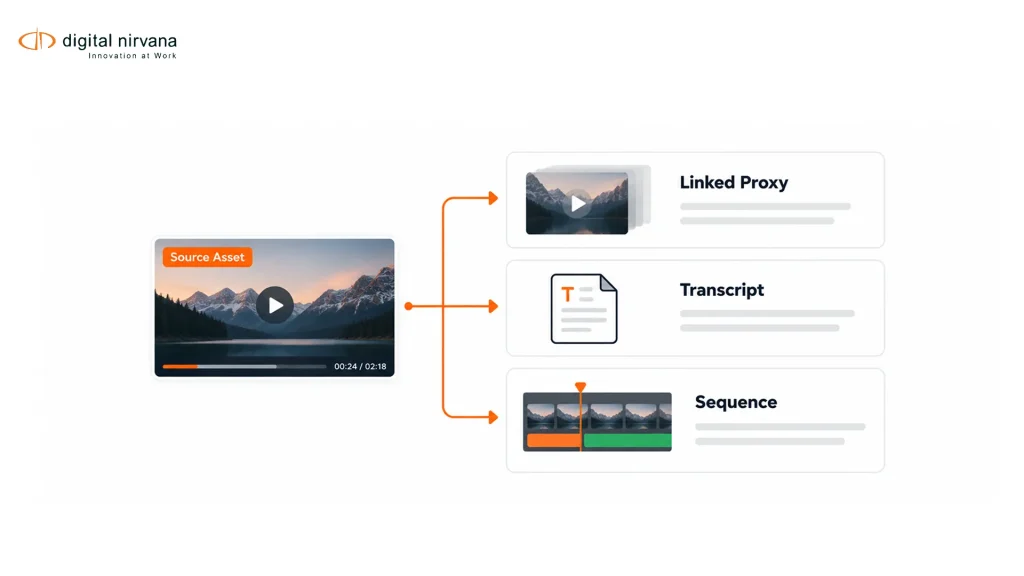
- Media Enrichment Solutions adds transcripts, captions, and metadata to that raw audio.
- The enriched content can be pushed into PAM/MAM systems, search portals, or internal dashboards.
The result is a hybrid stack where:
- Compliance requirements are met with robust, tamper-resistant logs.
- Editorial and commercial teams gain powerful discovery tools.
- Radio content is ready for repurposing into digital, social, and on-demand formats without rework.
Implementation roadmap for reliable compliance and quality control
Moving from basic aircheck recording to an AI-supported monitoring and enrichment stack is best done in phases.
Phase 1: Baseline compliance capture
- Ensure continuous recording of all critical outputs (primary signal, HD channels, streams).
- Verify retention periods align with your regulator’s guidelines and internal risk appetite.
- Standardize where recordings are stored and who can access them.
Phase 2: Centralize and normalize logging
- Bring disparate logging (engineering, traffic, automation, EAS) into a unified view.
- Define consistent time references (NTP, GPS, or equivalent) so that all systems align.
- Document standard workflows for responding to complaints and regulator requests.
Phase 3: Add transcription and search
- Enable automated transcription on key formats such as news, talk, and public affairs.
- Expose search tools to legal, programming, and management teams.
- Use real-world cases (complaints, advertiser requests) to refine how logs are labeled.
Phase 4: Introduce AI detection and enrichment
- Configure keyword spotting for politics, brands, sensitive topics, and emergencies.
- Add rules that route flagged content to specific stakeholders (e.g., legal, engineering).
- Begin using enriched data for promo selection and content strategy.
Phase 5: Extend across platforms and brands
- Bring streaming-only channels, podcasts, and digital-only shows into the same logging ecosystem.
- Integrate with your media asset management or content management systems.
- Roll out standardized policies across group-owned clusters or regional operations.
Throughout this journey, a partner like Digital Nirvana can help align technology with real-world compliance demands, editorial use cases, and resource constraints.
FAQs
Radio broadcast monitoring is the continuous recording and analysis of radio output, over-the-air, and often over IP, to support regulatory compliance, audio quality control, advertising verification, and content management.
Compliance logging is the practice of capturing broadcast output, retaining it for a defined period, and maintaining accurate logs that demonstrate what aired and when. This typically covers program content, ads, political messages, sponsorship IDs, and emergency alerts.
Requirements vary by country and by content category. In many cases, regulators expect stations to retain recordings for 30–90 days, and sometimes longer, for specific categories such as political or investigative content. In the U.S., certain logs may need to be retained for up to two years. Always consult local legal counsel or your regulator’s guidance.
AI automates transcription, keyword spotting, anomaly detection, and metadata tagging. That makes it much faster to search broadcasts, identify potential issues, and repurpose content, without listening to every second manually.
Digital Nirvana provides an ecosystem that includes AI-driven compliance logging and monitoring, as well as Media Enrichment Solutions for transcription, captioning, subtitling, translation, and metadata tagging. Together, these services help stations capture, understand, and reuse their radio content while meeting compliance and quality standards.
Yes. Modern platforms are designed to handle over-the-air broadcast signals and IP-based streams, allowing you to monitor AM/FM, HD Radio, web players, smart speaker streams, and more in a unified way.
Conclusion
Radio broadcast monitoring is no longer a background process. It is a central pillar of regulatory compliance, brand protection, and commercial accountability.
In a world of growing scrutiny, multi-platform distribution, and high audience expectations, stations must be able to:
- Prove exactly what aired, and when
- Identify and resolve quality issues quickly.
- Demonstrate that political and regulated content followed the rules.
- Provide advertisers and stakeholders with trustworthy proof-of-performance
- Unlock the editorial and commercial value of their archives.
AI-powered monitoring and media enrichment turn compliance logging into a strategic capability. With Digital Nirvana’s Media Enrichment Solutions, radio broadcasters can pair robust recording and logging with powerful transcription, metadata, and localization services, creating an environment where every second of audio is both accountable and reusable.
If your organization wants to reduce risk, improve quality, and get more value from every broadcast hour, this is the moment to modernize your radio monitoring and enrichment stack.