It’s 4:47 PM on a breaking news day. A U.S. Senator just made a controversial statement during a press conference. Your news director needs footage of her saying the exact same thing six months ago. It’s a simple request. Two clips side-by-side. The story writes itself.
Except nobody knows where the footage is.
Your assignment desk manager starts searching the archive. “Senator,” “controversy,” “statement.” Hundreds of results come back. Thousands. She scrolls through manual descriptions written years ago by interns who are no longer at the station. Some describe the content. Some describe technical specs. Some are just timestamps with no context.
She starts watching clips. Fast-forwarding. Rewinding. Thirty seconds here. Two minutes there. Looking for the right moment. The exact quote. The comparable angle.
An hour passes. The news cycle keeps moving. The web team is asking for the clip. The social team is asking for the clip. The broadcast team is asking for the clip.
Finally, at 5:51 PM, she finds it. She’s got one clip. She still needs the second one. Repeat the entire process.
By the time both clips are ready, it’s 6:32 PM. The story airs at 6 PM. You missed the broadcast window. The clip went live on Twitter at 6:35 PM instead of 5:30 PM. Your competitors already had their versions up. Your engagement is half what it should have been.
All because nobody could find footage fast enough.
This is the story of newsroom efficiency in 2026. And it’s more expensive than anyone wants to admit.
The Crisis That Nobody Talks About in Newsroom Meetings
Here’s what news directors know but don’t say out loud: the archive is killing productivity.
Fifteen years ago, newsrooms had tape libraries. A librarian. Physical organization. If you needed something, you went to the library. It took time, but at least you knew what you were looking for.
Then everything went digital. And suddenly you had thousands of hours of footage with minimal organization. No consistent naming. No standardized descriptions. Inconsistent tagging. Search functions that work by luck.
So now when you need footage, you have infinite options and no way to find what you actually need.
A producer needs quotes from a specific politician. Instead of typing a name and finding clips organized by theme, she’s got 847 results including clips where the politician is mentioned, clips from rallies where the politician wasn’t present, clips from other politicians saying the name, archived footage that’s unrelated.
An assignment desk manager needs breaking news from the last 48 hours. Instead of a curated feed organized by topic and recency, he’s scrolling through everything the archive has ever captured.
A digital team needs clips for social media. Instead of finding footage organized by length, they’re manually editing raw footage to fit 15-second windows.
This waste of time compounds. A producer spending an extra 45 minutes finding footage per day. Multiply that across a 15-person newsroom. That’s over 100 hours per week just lost to archive searching.
At a fully-loaded newsroom salary, that’s $120,000+ in annual productivity loss. Per station.
And that’s not even counting the missed stories, the late-to-air content, and the engagement you’re losing because your clips come out after your competitors’ clips.
Why Manual Tagging Is Slowly Destroying Your Archive
Here’s the brutal truth about how most newsrooms currently manage archives: someone manually types descriptions.
When footage comes in, an intern (or increasingly, nobody at all) watches enough to write a description. “Footage of city council meeting, 5/14/2024, discusses zoning.” That’s the metadata.
This works until three things happen: the person who wrote the descriptions leaves (and nobody else knows what the abbreviations mean), the station gets busier (and descriptions start getting skipped), or somebody searches for something the describer didn’t anticipate.
Then the system falls apart.
A reporter searches “zoning controversy” and gets no results, even though you have 90 minutes of zoning footage. Why? Because the describer wrote “zoning meeting” not “zoning controversy.”
A producer searches “neighborhood” and gets nothing, because the archive description doesn’t mention neighborhoods. It just says “city council.”
An assignment desk manager searches for recent footage and gets 10-year-old content because the search function doesn’t sort by date. It just sorts by relevance to keywords that might not even appear in the description.
Your archive isn’t broken. It’s just incompletely described. And incompletely described archives are functionally broken.
This is the hidden tax of manual tagging: it fails silently. You don’t realize it’s not working until you need something and can’t find it. By then, it’s often too late.
The Workflow That Changes Everything
Imagine a completely different experience.
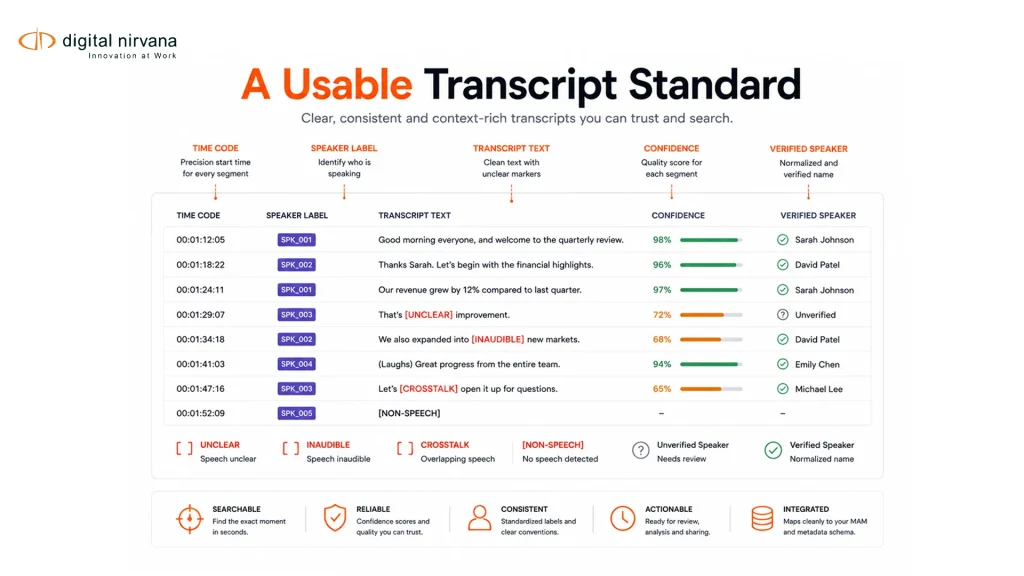
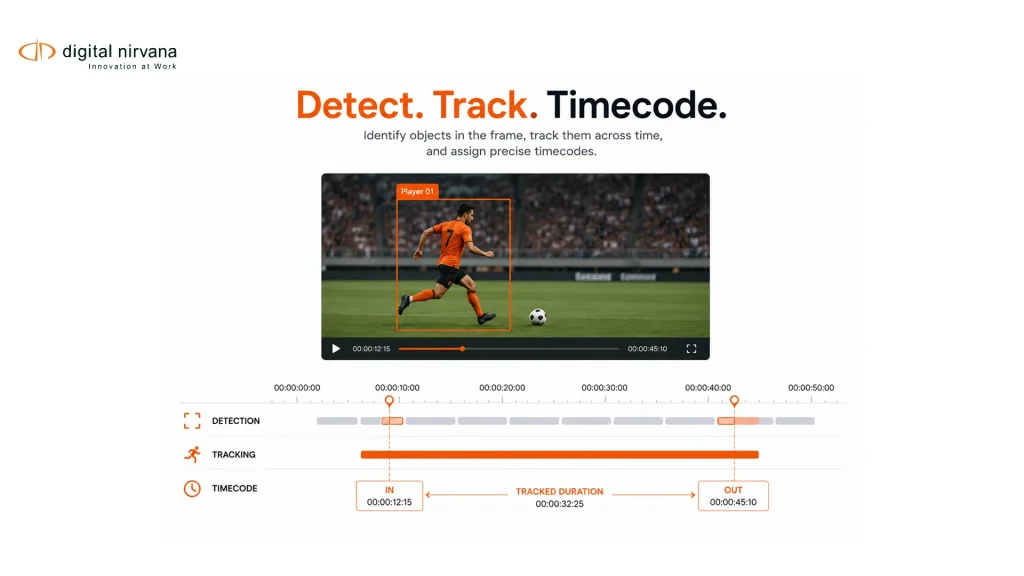
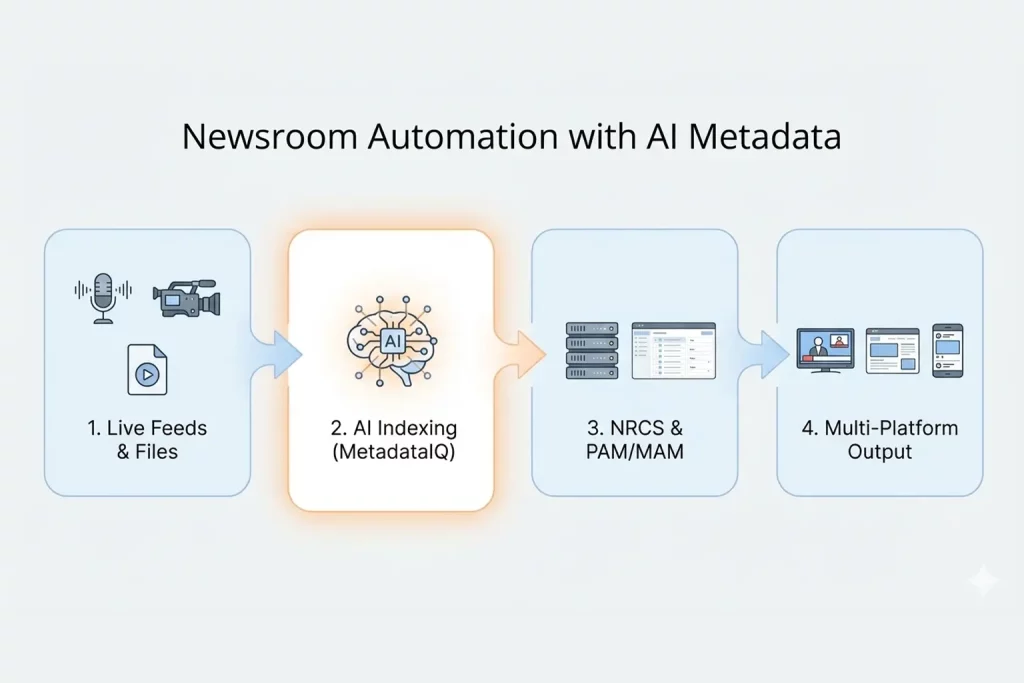
A clip comes into the newsroom. Within minutes, AI analyzes it. The system identifies every person in the footage by face. It transcribes every word spoken, timestamped to the exact second. It identifies every location shown. It detects scene changes and tags key moments.
All of this happens automatically. Zero manual effort.
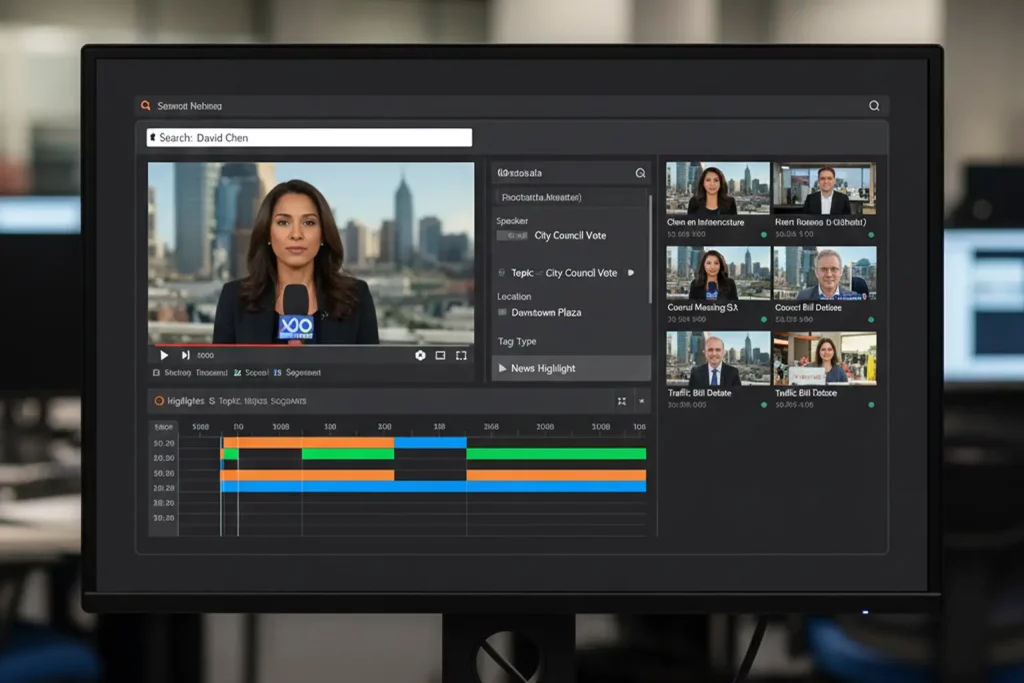
Now a producer searches “Senator Johnson says taxes.” The system doesn’t search descriptions written by interns years ago. It searches the actual content. It finds every instance where Senator Johnson appears on camera and says anything about taxes. It returns results ranked by relevance, with exact timestamps.
An assignment desk manager searches “protests downtown.” The system finds all footage showing downtown locations where there were protests. It shows them recent footage first. It shows them multiple angles. It shows them the exact moments where the protest was most visible.
A digital team needs a 15-second clip of the mayor’s emotional response. They search “mayor emotional reaction.” The system finds moments where the mayor’s facial expressions changed dramatically. It flags the exact seconds where the moment is most powerful. The team exports a pre-trimmed 15-second clip ready for social media.
This isn’t theoretical. This is what modern newsroom automation actually looks like.
And here’s what happens as a result: search times drop from hours to minutes. Stories get more competitive because clips are ready faster. Digital teams get more content because finding footage is no longer the bottleneck. Archive footage gets repurposed because it’s finally discoverable.
Learn how AI-powered media indexing and searchable metadata transform newsroom workflows and archive productivity.
The Moment When One Newsroom Went From Chaos to Efficiency
A top-25 market news operation was drowning. They had a massive archive (15 years of daily newscasts). Every search took forever. Producers were recreating footage instead of finding it. The archive was basically a storage graveyard.
Then they implemented AI indexing for their entire archive.
The system processed all 15 years of footage in three weeks. Every segment got indexed. Every person got identified by face. Every word got transcribed. Every location got tagged.
Then something unexpected happened: producers started using the archive.
A story about the housing crisis needed historical context. A producer searched “housing shortage 2018.” Results came back instantly, showing every piece of footage the station had ever done on housing, dating back to the first mention in 2008.
Breaking news about a political scandal? The system showed every statement the politician had ever made on air, timestamped, with quotes searchable by exact language.
A reporter needed to show how a neighborhood had changed. Search “elm street 2015” and “elm street 2024.” Compare the two. Instant before-and-after visual.
More importantly, that same content could be repurposed instantly for digital, social, and streaming platforms. Footage that had been buried in an unsearchable archive suddenly became available for five different platforms, creating five different content opportunities from one search.
In the first six months, their social media engagement increased 40% because their clips were more competitive and came out faster. Their website traffic increased because archive content started appearing in stories again. Their reporters started winning more competitive battles because they could find supporting footage instantly.
None of that happened because the newsroom got better talent. It happened because archive footage became findable.
Why This Matters Beyond Just Efficiency
Here’s what doesn’t get discussed enough in newsroom meetings: archive quality is a competitive advantage that most stations are completely wasting.
A station that doesn’t use its archive loses context. Every story starts fresh because finding historical perspective takes too long. A station that has a searchable archive starts seeing patterns. Has this issue come up before? What did we learn? What’s changed?
This makes storytelling better. It makes fact-checking easier. It makes investigations more rigorous.
A reporter can now build a story by searching “homelessness downtown 2019” and seeing exactly what the situation was five years ago. She can compare then and now. She can show patterns. She can prove that something has gotten better or worse.
Without the searchable archive, she’s starting from scratch every time. With it, she’s standing on the shoulders of five years of institutional knowledge.
This also creates a defensibility advantage. Did we get this right? Search the archive for similar stories. How did we cover this last time? What were the outcomes? What did we learn?
News organizations that use their archives effectively become more rigorous, more informed, and ultimately more trusted.
Discover how metadata-rich newsroom workflows improve both efficiency and editorial quality.
The Numbers That Actually Matter
Let’s talk about what this costs in real money.
A 25-person newsroom with an average salary of $60,000 per person. If each person spends 45 minutes per day searching archive footage, that’s 3.1 hours per day across the newsroom. Per week, that’s 155 hours. Per year, that’s 8,060 hours.
At an average fully-loaded cost of $100,000 per employee (salary, benefits, workspace, equipment), that’s roughly $386,000 in annual productivity loss. Just from archive searching.
Now add the opportunity cost. Stories that come out late because clips weren’t ready in time. Social media content that doesn’t get created because finding footage is too hard. Competitive losses to stations that get clips out faster.
A typical station is losing somewhere between $400,000 and $600,000 annually from archive inefficiency.
Implementing AI indexing costs $30,000 to $80,000 annually depending on archive size and search volume.
The math is simple. Most stations recover their investment in the first six months.
Why Your Current Archive Search Is Costing You Stories
If your archive searches still rely on manual descriptions and keyword matching, you’re probably not even aware of what you’re missing.
A story opportunity comes up. You search for relevant footage. You get 200 results, most of which aren’t quite right. You give up and either recreate the footage or move on to a different story angle.
But that right footage exists in your archive. It just isn’t findable because it wasn’t described the way you searched for it.
Multiply this across a newsroom over a year. You’re missing stories because your archive is invisible.
With AI indexing, that footage becomes findable. Not perfectly. But dramatically better. From “we can’t find it” to “here it is, timestamped and ready.”
That’s not just efficiency. That’s competitive advantage.
The Workflow That Wins Breaking News
Here’s where AI indexing becomes critical: breaking news situations.
A senator resigns. Within minutes, your newsroom needs:
Footage of the senator from recent hearings (for context). Footage of the senator making controversial statements (for narrative). Footage of reactions from other politicians (for response). Footage of the senator’s district (for local angle). Footage from previous scandals involving similar issues (for pattern).
In a traditional newsroom, gathering all this takes hours. Precious hours you don’t have in a breaking news situation.
With AI indexing, you search “senator resigned name,” and the system starts pulling all relevant footage in order of relevance and recency. You’re not finding one or two pieces. You’re finding everything. Timestamped. Organized. Ready to edit.
The station that can pull together a comprehensive visual narrative in 15 minutes instead of 90 minutes wins that day’s competitive battle.
Learn how real-time metadata tagging and searchable archives enable faster newsroom response to breaking stories.
Why Assignment Desks Need This More Than Anyone Admits
The assignment desk is the heartbeat of a newsroom. It’s where decisions get made about what stories matter today. It’s where producers get sent out. It’s where timing gets managed.
An effective assignment desk needs context. What’s the story behind the story? Have we covered this before? What angle haven’t we explored? What visual elements do we already have?
A broken archive means an assignment desk operates with incomplete information. They make decisions based on “what sounds good today” instead of “here’s what we’ve learned about this issue.”
With an AI-indexed archive, every story decision is informed by historical context. The assignment desk can see not just what’s happening now, but what’s happened before in this same situation. That changes the story angle. It improves the coverage.
More importantly, it reduces duplicate work. If the station already did an investigation on this topic two years ago, the assignment desk can revive that work, update it, and republish it. Three days of investigation work becomes three days of updates. That’s efficiency that compounds.
Your Archive Is Losing You Money Every Single Day
If your newsroom is still searching archives manually, you’re probably losing $100,000+ annually in productivity. You might not be calculating it that way, but the time is being lost.
More importantly, you’re losing competitive advantage. Stories that competitors get out faster. Clips that competitors have ready first. Context that competitors pull together before you do.
Your archive isn’t a storage locker. It’s a competitive weapon. If you’re not using it as one, someone else will.
Why Digital Nirvana Is the Standard for Newsroom Automation and Archive Intelligence
Newsroom archive management sounds like a solved problem until you try to do it at scale. Most newsrooms have archives but no way to search them effectively. They have footage but it’s trapped behind incompletely described metadata and clunky search functions. What you need is a system purpose-built for newsroom workflows that automatically indexes every piece of content, makes it searchable by actual content (not just descriptions), and integrates directly into the editorial workflow.
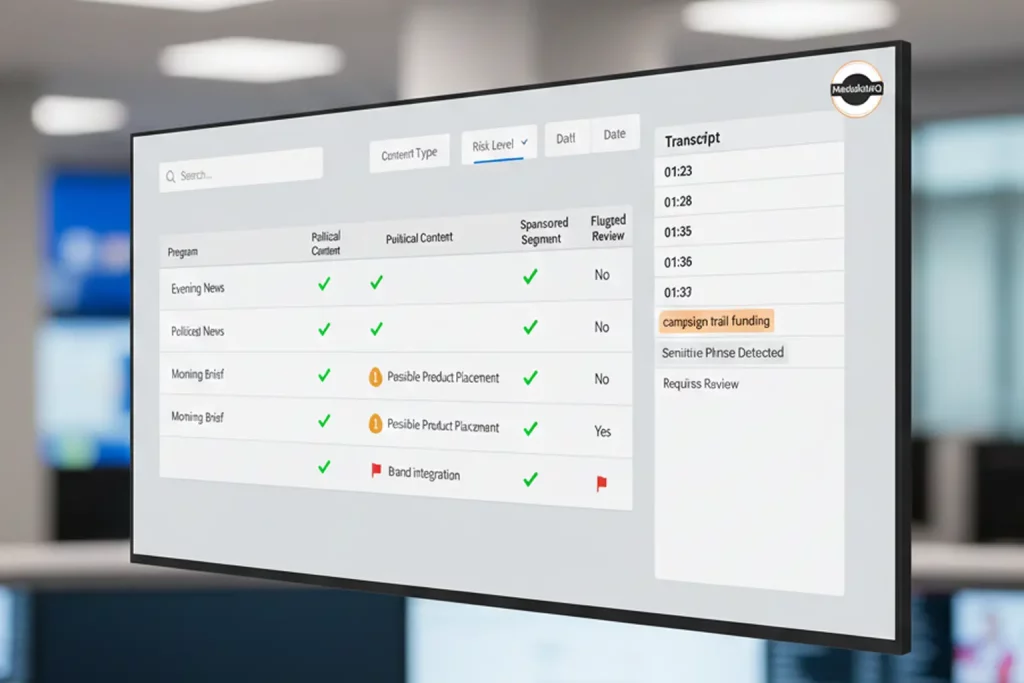
MetadataIQ transforms newsroom archives from unsearchable storage into competitive advantage. The system automatically indexes all incoming footage (newscast segments, reporter packages, raw interviews, b-roll, breaking news footage) with AI-powered face recognition, voice transcription, scene detection, and location tagging. When a producer searches “mayor emotional reaction Tuesday,” the system doesn’t search descriptions. It searches actual content. It returns the exact moments where the mayor’s expression changed, timestamped and ready for editorial review.
For newsrooms managing large archives and multiple platforms, MetadataIQ integrates with editing software, DAM systems, and social media platforms so that indexed metadata automatically flows through your entire workflow. A producer finds a clip, exports it, and the system has already pre-tagged it with the correct metadata for social publishing, broadcast graphics, and online archival. For newsrooms that need even faster turnaround on breaking news or that want managed analysis services for complex stories, Media Enrichment provides expert-level metadata analysis and content organization.
The result is predictable and measurable: archive search times drop from 45+ minutes to 2-5 minutes. Stories become more competitive because clips are ready faster. Social content increases because archive footage becomes repurposable. Breaking news coverage improves because historical context is instantly accessible. Assignment desk decisions improve because they’re informed by searchable institutional knowledge. And perhaps most importantly, your archive stops being a black hole of unsearchable footage and becomes what it should be: an intelligence asset that makes your newsroom more effective, more competitive, and more credible.
FAQ
Q: How long does it take to index an existing archive?
Depends on the size of your archive. A typical station with 5-10 years of daily newscasts can be fully indexed in 2-4 weeks. Indexing happens in the background without interrupting your current workflows.
Q: Does AI indexing replace our current archive system?
Not necessarily. Most newsrooms add AI indexing as a layer on top of existing systems, making them searchable. You don’t have to migrate everything. The AI system works alongside your current archive infrastructure.
Q: How accurate is AI identification of people in footage?
Modern face recognition in newsroom footage achieves 92-97% accuracy, depending on footage quality and lighting. The system flags uncertain identifications so you can verify them before relying on them. Over time, as you correct identifications, the system learns your specific newsroom environment and becomes more accurate.
Q: Can we customize what gets indexed for our specific station?
Yes. Different markets have different priorities. Some stations care most about people. Some care about locations. Some care about specific topics. The system can be configured to prioritize different metadata based on your workflow needs.
Q: Does transcription accuracy matter for archive search?
It matters more than people realize. Modern AI transcription achieves 95%+ accuracy for clear audio. A quote that’s 95% accurate is usually findable. The system also flags uncertain words so you know when to manually verify transcription.
Q: How does this work for breaking news footage that’s messy?
Breaking news footage is often lower quality, has lots of background noise, and involves unclear audio. AI indexing handles this by being more conservative with confidence levels. If it’s uncertain about something, it flags it rather than guessing. This means you might need to verify some identifications manually, but you still save time by not having to watch hours of footage to find what you need.
Q: Can we search across multiple platforms (broadcast, streaming, social)?
Yes. If your content is indexed centrally, you can search across everything simultaneously. Find a clip on broadcast? Export it for social with updated metadata. Find b-roll for streaming? The metadata automatically formats for that platform.
Q: What about privacy concerns with face recognition?
This is mostly about internal use within the newsroom. You’re not publishing a database of everyone’s face. You’re indexing internal newsroom footage for internal searchability. Privacy regulations (like GDPR) mostly care about external data sharing, not internal newsroom operations. However, you should still have clear policies about how footage gets used.
Q: Does AI indexing work for live broadcasts?
Yes, though with slightly different workflow. Live footage can be indexed as it airs. This means that by the time a live event ends, metadata is already being generated. You can search and retrieve clips from live broadcasts almost immediately after they finish airing.
Q: How much does this cost compared to hiring more archivists?
AI indexing costs $30,000-$80,000 annually depending on your archive size and indexing depth. Hiring an additional archivist costs $50,000-$70,000 annually in salary, plus benefits and workspace. AI indexing is more cost-effective and scales without adding staff.
Q: Can we use this for content moderation or fact-checking?
Absolutely. If you need to verify whether a politician said something, search the archive for their exact quote. If you need to check whether someone was in a location, search for footage from that location during that time period. The searchable archive becomes a fact-checking tool.
The Moment When Your Newsroom Stops Losing Competitive Battles
You’ve seen the numbers. You know the problem exists. You’ve probably had moments where you wish you could find footage faster, or moments where competitors got a story out first because they had better visuals.
But knowing the problem and solving it are different things. Most newsrooms are still stuck in manual archive searching because the alternative feels expensive or complicated.
The newsrooms winning right now aren’t hoping their archives work. They’re building searchable archives that make their reporters faster, their stories better, and their coverage more competitive.
The investment is small. The payoff is immediate. And the competitive advantage compounds over time.
Schedule a 20-minute consultation to audit your current archive workflows and see exactly how much time you’re losing to unsearchable footage. No assumptions. No estimates. Just clarity on your specific situation and what AI indexing could change.
Your newsroom’s speed, your story quality, and your competitive position all depend on it.
Archive intelligence isn’t optional anymore. It’s essential infrastructure.